
Build your strategy from your own words
Wildflower Trading School · Lesson 2.4.8.1 · This exercise is free

This is the first of the lessons on doing indicators in Wildflower, and they share one goal: your own indicator strategy: a signal and a filter you chose from Studio's indicators, every number yours, checked trade by trade, and drawn on your own chart platform. By the end, you'll have a saved strategy in Wildflower, a seven-line rule on paper or in a note, a backtest you've gone through, and, with a Trade subscription, the same setups on your own charting platform. Today you write lines one, three and five, and save your strategy.
1 of 12
What you'll learn
- Write lines 1, 3 and 5 of your indicator rule before you open Wildflower.
- Open Strategies, press Get started, and describe your rule in your own words.
- Say which side a filter is for. A filter row reads the same for buys and sells.
- Press Check my rules and read each rule against your lines. It's saved as Version 1.
- Answer every question Wildflower asks, like how far past the line a close must be.
Exercise
- Write lines 1, 3 and 5 of your indicator rule. The seven lines are above.
- Open Strategies and press Get started (or New strategy, then Describe it in words).
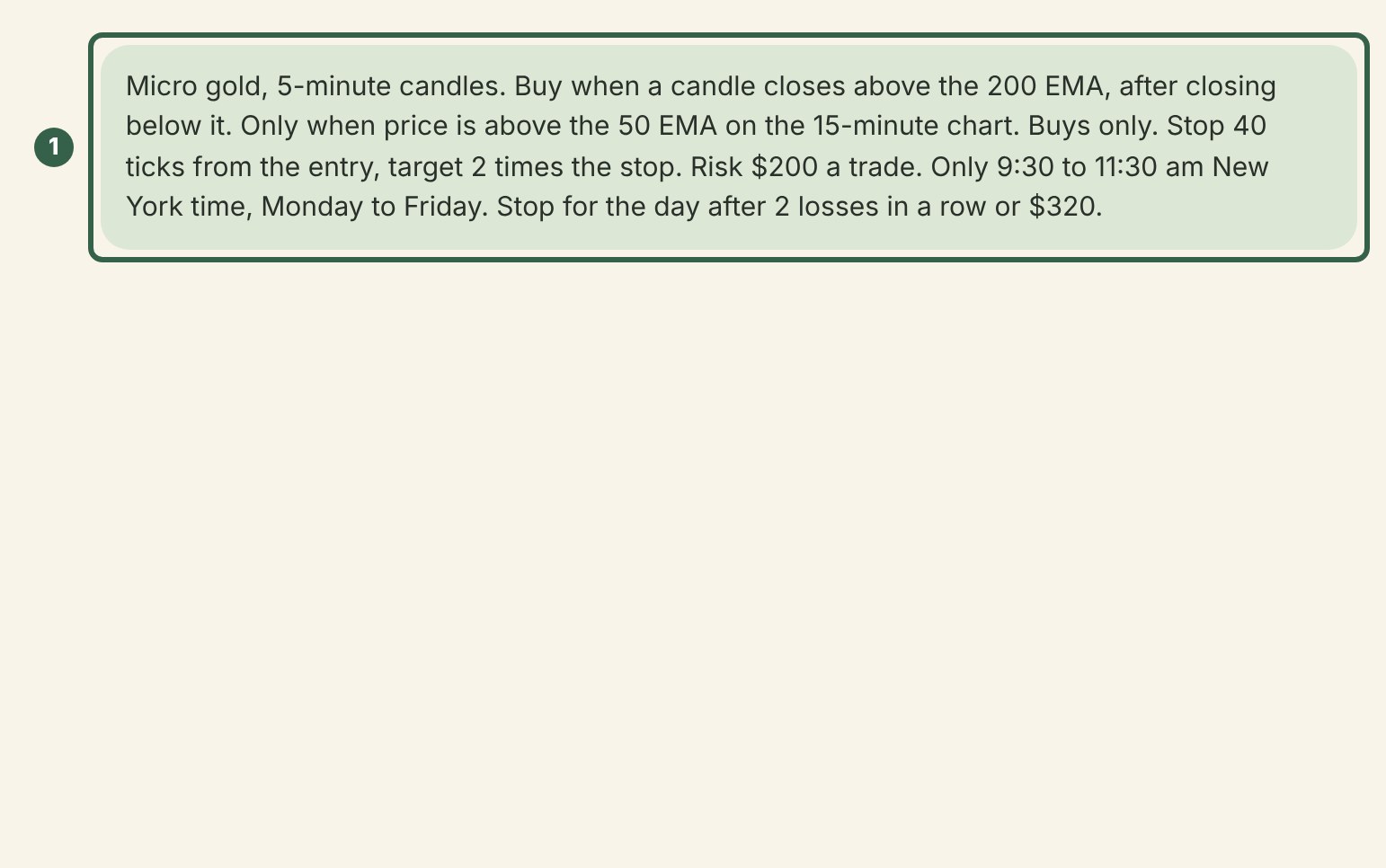
- Type your rules in your own words: the signal, the filter and which side it's for, your stop, target and risk, and your candles and hours.
- Answer every question Wildflower asks, then press Check my rules.
- Read each rule against lines 1, 3 and 5. Click a rule to change it.
- Help article Describe your strategy in your own words
- Help article The indicator condition gate
Quick check
1. Sam's filter is Price above the 50 EMA, with both sides on. What can a sell do when price is above the 50?
2. Sam's check reads Buy, sell or both: long entries only. What does his strategy take?
3. Where do you read every rule back before you test it?
0 of 3 answered.
Finished this lesson?
Tick it off and keep your place
Read the full notes
An indicator read by eye gives a different trade on different days. Written down, it gives the same trade every time, so a test of it means something. In Wildflower, open Strategies, press Get started, and describe your strategy in your own words: the signal, the filter, which side each is for, your stop, target and risk, and your candles and hours. Answer the questions Wildflower asks, then press Check my rules. Wildflower saves it as Version 1 and reads every rule back, including the indicator, its candles and its length.
What you're building. These lessons share one goal: your own indicator strategy: a signal and a filter you chose from Studio's indicators, every number yours, checked trade by trade, and drawn on your own chart platform. Today you write lines 1, 3 and 5 and save your strategy. Next lesson checks it trade by trade.
| My indicator rule |
|---|
| 1. The signal: … (which indicator, and what it must do) |
| 2. The signal's numbers: … candles, …-minute candles, the price it reads … |
| 3. The filter: … (which indicator, must hold or must not, buys, sells or both) |
| 4. The filter's level: … in its own unit |
| 5. Stop … ticks, target … times the stop, $… a trade, … to … New York |
| 6. The wait: my strategy needs … candles before it can trade |
| 7. Checked: … trades gone through, and on my platform: … |
Why. Sam is made up, and so are his numbers. A rule in your head takes different trades on different days. Written down, it takes the same trade every time, and you can test it. More in Testing an indicator idea yourself.
| Line | Sam writes | Why |
|---|---|---|
| 1. The signal | A close above the 200 EMA, after a close below it | The line on his chart |
| 3. The filter | Price above the 50 EMA on 15-minute candles, buys only | He wants the bigger chart rising |
| 5. Stop, target, risk, hours | Stop 40 ticks, target 2 times, $200 a trade, 9:30 to 11:30 am New York, Mon to Fri | 4 contracts × 40 ticks × $1 = $160 at the stop |
Free three times a month. With no paid plan, describing a new strategy in words is free three times a month. Changing one with Change a rule never counts. The same steps for a candle pattern: Use a candle pattern as your signal.
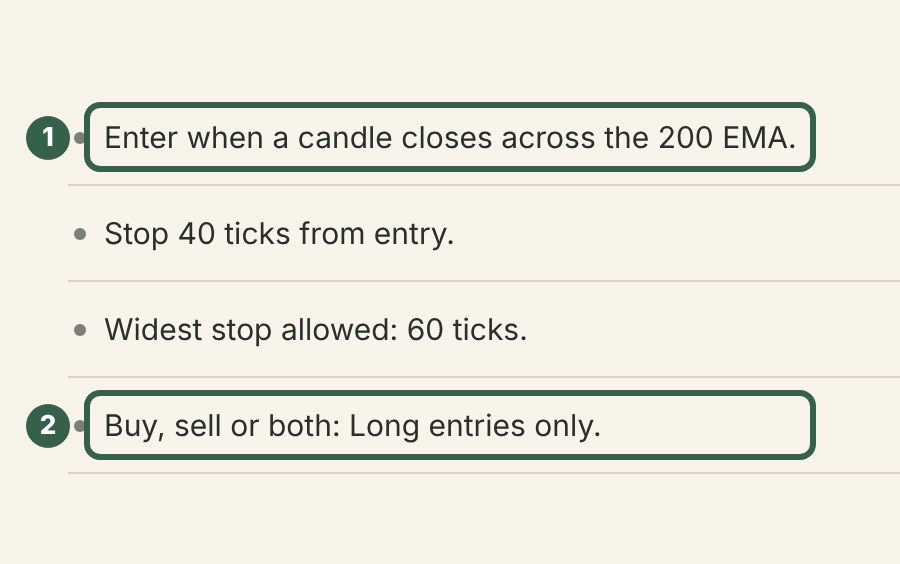
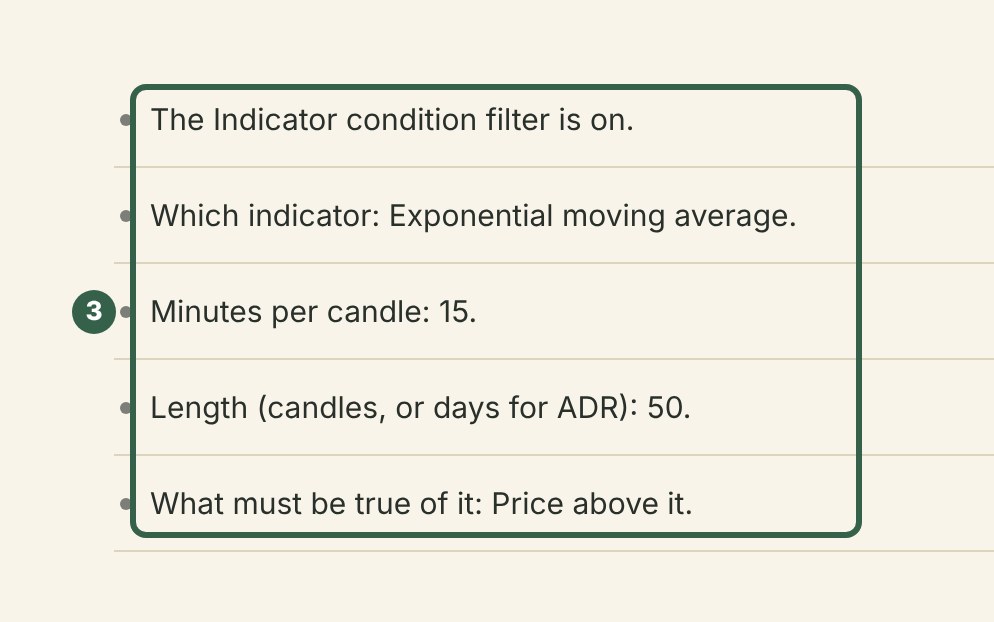
Say which side a filter is for. A filter row reads the same for a buy and a sell. With both sides on, Price above the 50 would also let a sell through whenever price was above the 50. Sam wants buys only, so he says so.
How traders write an indicator rule. We can't tell you which to choose. These are the common choices. The signal first and the filter after. The filter written for one side. Or no filter until the signal is checked on its own.
Worked example
Made-up numbersSam's lines 1, 3 and 5
Sam is made up. Micro gold, $1 a tick for each contract. He risks $200 a trade with a 40-tick stop.
- Line 1: a 5-minute candle closes above the 200 EMA, after closing below it.
- Line 3: only when price is above the 50 EMA on 15-minute candles. Buys only, so the filter means what he says.
- Size: Wildflower leaves room for slippage, so $200 at 40 ticks comes to 4 contracts. 4 × 40 × $1 = $160 at the stop.
- Target: 2 times the stop is 80 ticks. 4 × 80 × $1 = $320.
Sam's gold EMA cross, Version 1: the 200 EMA cross, the 15-minute 50 EMA filter, buys only, a 40-tick stop, a target 2 times the stop, $200 a trade, 9:30 to 11:30 am New York.
Trading is risky. You can lose money. This lesson shows how Wildflower works. It isn't advice.