
Use a candle pattern as your signal
Wildflower Trading School · Lesson 2.2.5.1 · This exercise is free

This is the first of six lessons with one goal: your own candle pattern strategy, written down and checked trade by trade. By the end of the six, you'll have a saved strategy in Wildflower that trades one candle pattern on your numbers, a seven-line rule on paper or in a note, and a backtest you've gone through one trade at a time. Today you write lines one, five and six, and save your strategy.
1 of 12
What you'll learn
- Write lines 1, 5 and 6 of your candle pattern rule before you open Wildflower.
- Open Strategies, press Get started, and type your rules in your own words.
- Answer every question Wildflower asks, like how far back the fall before a hammer is read.
- Press Check my rules and read each rule against your lines. It's saved as Version 1.
- Change a rule on the strategy's page is how the next lessons make it exact.
Exercise
- Write lines 1, 5 and 6 of your candle pattern rule. The seven lines are above.
- Open Strategies and press Get started (or New strategy, then Describe it in words).
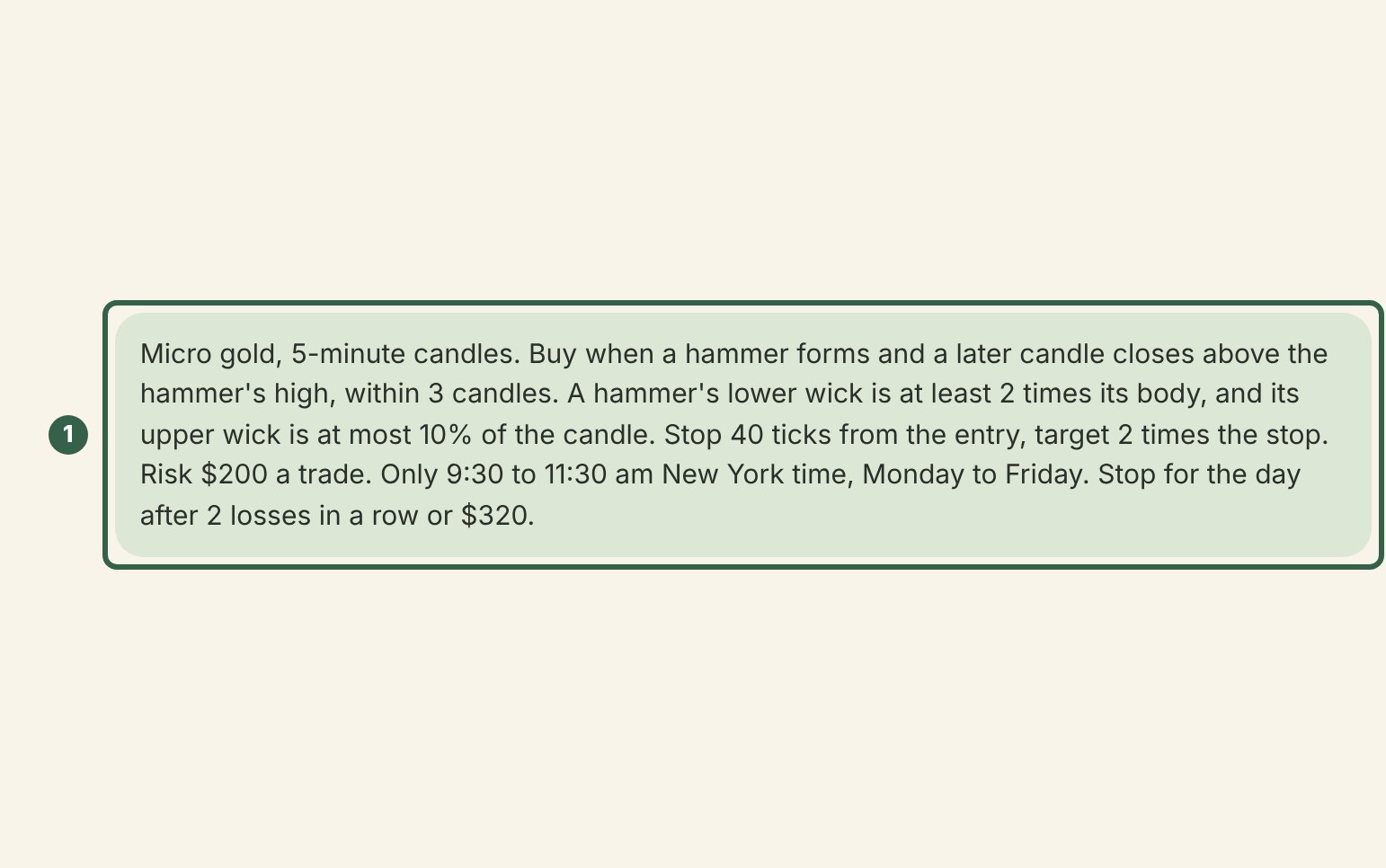
- Type your rules in your own words: the pattern, what makes it trade, your stop, target and risk, and your candles and hours.
- Answer every question Wildflower asks, then press Check my rules.
- Read each rule against lines 1, 5 and 6. Click a rule to change it.
- Help article Describe your strategy in your own words
- Help article Candle patterns in Studio
- Help article Versions, notes and comparing them
Quick check
1. Sam's stop is 40 ticks with 4 micro gold contracts at $1 a tick each. What does a full loss cost, before slippage and fees?
2. Where do you start a new strategy in Wildflower?
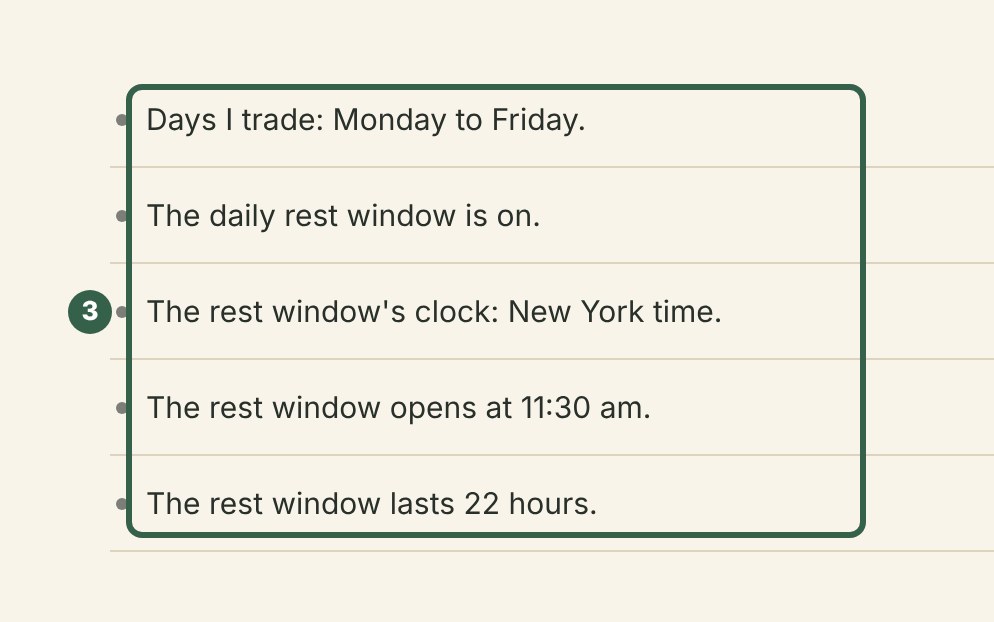
3. Check my rules says the rest window opens at 11:30 am and lasts 22 hours. When does Sam trade?
0 of 3 answered.
Finished this lesson?
Tick it off and keep your place
Read the full notes
A candle pattern traded by feel is a different pattern each day. Written down, it's the same shape every time, so a test of it means something. In Wildflower, you start by describing your strategy in your own words. Open Strategies, press Get started, and type your rules: the pattern, what makes it trade, your stop, target and risk, and your candles and hours. Answer the questions Wildflower asks, then press Check my rules. Wildflower saves it as Version 1 and reads every rule back, so you can check each one against what you wrote.
What you're building. This is the first of six lessons with one goal: your own candle pattern strategy, written down and checked trade by trade. Today you write lines 1, 5 and 6 and save your strategy. Next lesson adds line 4.
| My candle pattern rule |
|---|
| 1. The pattern: … (bullish or bearish twin) |
| 2. Its numbers: … (long wick, small body) |
| 3. When it trades: its close, or a later close within … candles |
| 4. A filter: … there, not there, or none |
| 5. Stop … ticks, target … times the stop, $… a trade |
| 6. …-minute candles, … to … New York, days … |
| 7. Checked: … trades, gone through one by one |
Why. Sam is made up, and so are his numbers. A hammer traded by feel is a different candle each day. Written down, it's the same shape and the same risk every time, and you can test it. What a hammer is: Hammer and shooting star. Where it shows up matters too: Context: where a pattern shows up.
| Line | Sam writes | How he got it |
|---|---|---|
| 1. The pattern | Hammer (bullish), buys only | A long lower wick after a fall |
| 5. Stop, target, risk | Stop 40 ticks, target 2 times, $200 a trade | 4 contracts × 40 ticks × $1 = $160 at the stop. Target 80 ticks, $320 |
| 6. Candles and hours | 5-minute, 9:30 to 11:30 am New York, Mon to Fri | The hours he's at his desk |
Free three times a month. With no paid plan, describing a new strategy in words is free three times a month. Changing one with Change a rule never counts. More in Write your strategy in words in Wildflower.
How traders use a candle pattern. We can't tell you which to choose. These are the common choices. As the signal itself, or as a filter behind another signal. A stop a set number of ticks away, or just past the pattern's low (Where traders put the stop for each pattern). A target at a set multiple of the stop, or at the next level.
Worked example
Made-up numbersSam's lines 1, 5 and 6
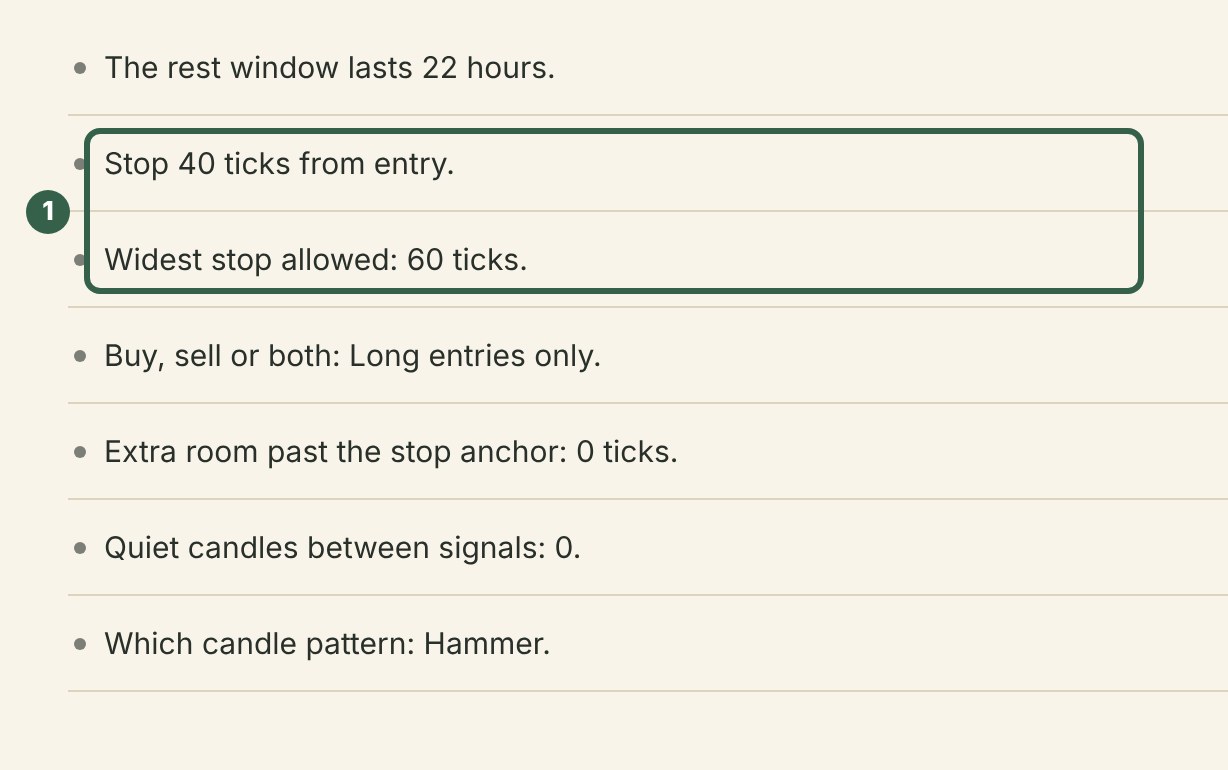
Sam is made up. Micro gold, $1 a tick for each contract. He risks $200 a trade with a 40-tick stop.
- Line 1: Hammer, the bullish one, so buys only.
- Size: Wildflower leaves room for slippage, so $200 at 40 ticks comes to 4 contracts. 4 × 40 × $1 = $160 at the stop.
- Target: 2 times the stop is 80 ticks. 4 × 80 × $1 = $320.
- Line 6: 5-minute candles, 9:30 to 11:30 am New York, Monday to Friday.
Sam's gold hammer, Version 1: a hammer, a 40-tick stop, a target 2 times the stop, $200 a trade, 5-minute candles, 9:30 to 11:30 am New York, Monday to Friday.
Trading is risky. You can lose money. This lesson shows how Wildflower works. It isn't advice.