
Wait for the break, or take the close
Wildflower Trading School · Lesson 2.2.5.3 · This exercise is free

This is the third of six lessons towards your own candle pattern strategy, written down and checked trade by trade. Today is line three of your rule: when your pattern becomes a trade.
1 of 9
What you'll learn
- Write line 3. The pattern's own close, or a later close past it within so many candles.
- Press Change a rule, then Signal, and find What fires the signal.
- Set Candles the break may occur in and Close-through distance for a break.
- Press Help me choose, then Try a few, to see three values side by side. Nothing is saved.
- Read the trade count in each column before anything else.
Exercise
- Write line 3 of your candle pattern rule.
- Open your strategy in Strategies, press Change a rule, then the Signal step.
- Set What fires the signal, Candles the break may occur in and Close-through distance, then press Save if you changed them.
- Press Help me choose under Candles the break may occur in, type three values under Try a few, and press Run.
- Help article Candle patterns in Studio
- Help article Help me choose a setting
Quick check
1. Which choice enters sooner, on every pattern?
2. Sam's break window is 3 on 5-minute candles. How long does he wait for the break?
3. What does Try a few save to your strategy?
0 of 3 answered.
Finished this lesson?
Tick it off and keep your place
Read the full notes
A candle pattern can trade at its own close, or wait for a later candle to close past it. Waiting enters later, and some patterns never break, so it trades less. In Wildflower, three boxes on your signal decide this. Press Change a rule, then the Signal step. Set What fires the signal, Candles the break may occur in, and Close-through distance. Help me choose under a box opens Try a few, which runs three values on the practice chart side by side without saving anything.
What you're building. The third of six lessons towards your own candle pattern strategy. Last lesson was line 4, a filter. Today is line 3. Next lesson is line 2.
| My candle pattern rule |
|---|
| 1. The pattern: … (bullish or bearish twin) |
| 2. Its numbers: … (long wick, small body) |
| 3. When it trades: its close, or a later close within … candles |
| 4. A filter: … there, not there, or none |
| 5. Stop … ticks, target … times the stop, $… a trade |
| 6. …-minute candles, … to … New York, days … |
| 7. Checked: … trades, gone through one by one |
Why. Sam is made up, and so are his numbers. Taking the pattern's own close enters sooner, on every pattern. Waiting for a later close past it enters later and only when price moves your way, so it trades less, and the stop sits in a different place. A break five candles later is a different trade from one on the next candle.
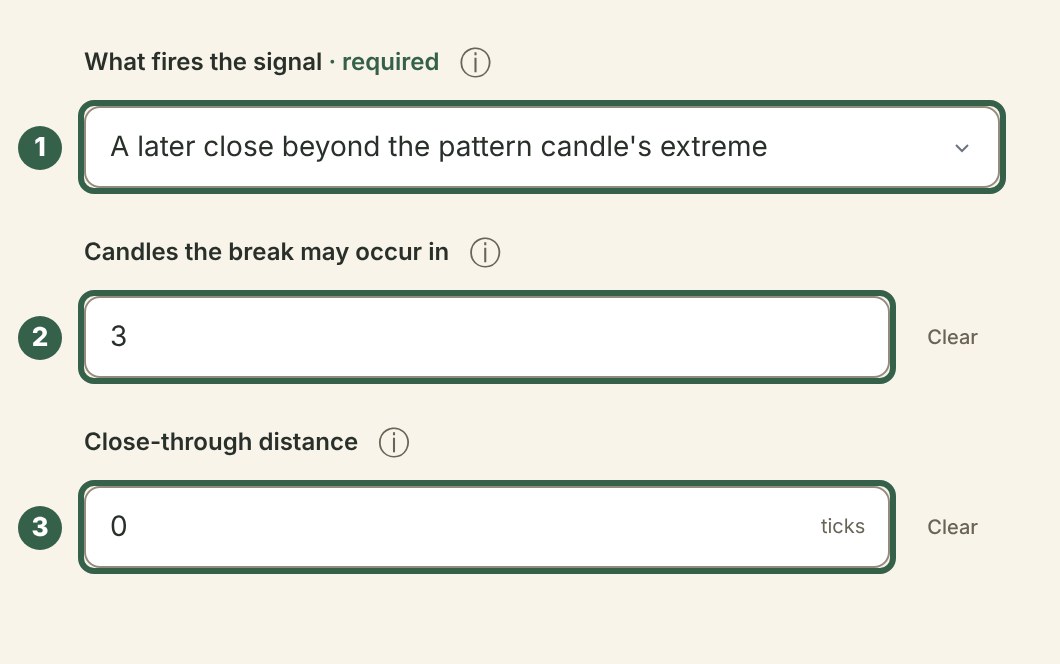
- What fires the signal: *A later close beyond the pattern candle's extreme* waits for the break. *The pattern candle's own close* takes the close.
- Candles the break may occur in: how many candles after the pattern a break may still trade.
- Close-through distance: how far past the pattern the close must be, in ticks. 0 means any close past it.
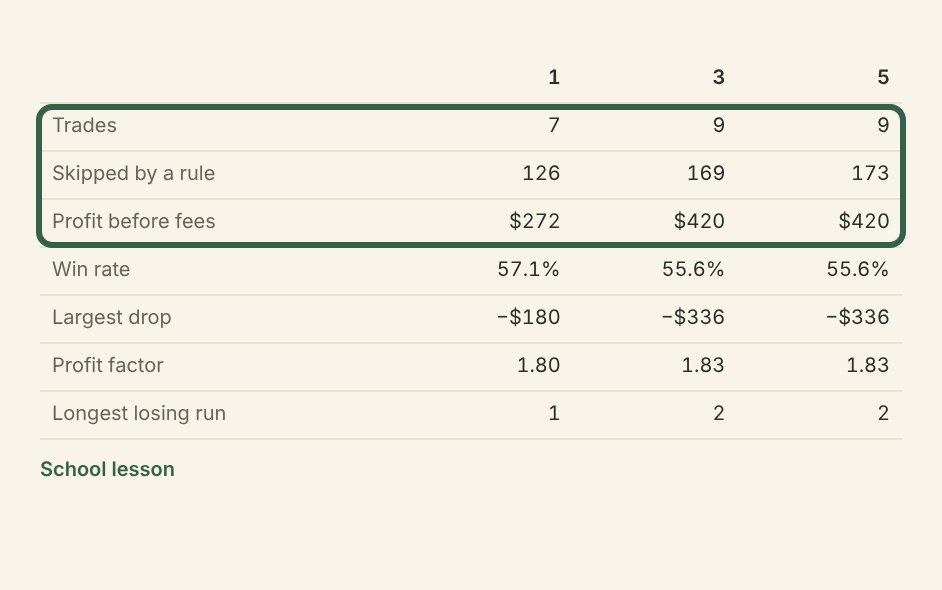
| Candles the break may occur in | 1 | 3 | 5 |
|---|---|---|---|
| Trades | 7 | 9 | 9 |
| Win rate | 57.1% | 55.6% | 55.6% |
| Profit before fees | $272 | $420 | $420 |
How traders choose. We can't tell you which to choose. These are the common choices. The close (sooner, more trades) or the break (later, fewer). A break window of the next candle only, 2 or 3 candles, or longer. Any close past the pattern, or a few ticks past. Only a pattern with a direction, like a hammer (Hammer and shooting star), can take its own close. How to count by hand: Testing a pattern before trusting it.
Worked example
Made-up numbersSam's break window
Sam is made up. 5-minute candles. His hammer forms on the candle that closes at 10:00.
- Candles the break may occur in: 3, so the break may come on the candles closing at 10:05, 10:10 or 10:15.
- Close-through distance: 0, so any close above the hammer's high counts.
- If the 10:10 candle closes above the high, he buys at that close.
- If none of the three does, there's no trade from this hammer.
Line 3: a later close above the hammer's high within 3 candles, 0 ticks past.
Trading is risky. You can lose money. This lesson shows how Wildflower works. It isn't advice.