
Use any oscillator
Wildflower Trading School · Lesson 2.4.8.5 · This exercise is free

This lesson works towards your own indicator strategy: a signal and a filter you chose from Studio's indicators, every number yours, checked trade by trade, and drawn on your own chart platform. Today is lines three and four: an oscillator as your filter, and its level.
1 of 11
What you'll learn
- Write lines 3 and 4. Your filter's indicator, and its level in its own unit.
- The level is the rule. RSI above 50 and above 60 are two filters.
- Try three levels with Try a few before you pick one.
- The same number of trades can be different trades. Compare the trades.
- Must hold and must not hold are two different filters.
Exercise
- Write lines 3 and 4 of your indicator rule.
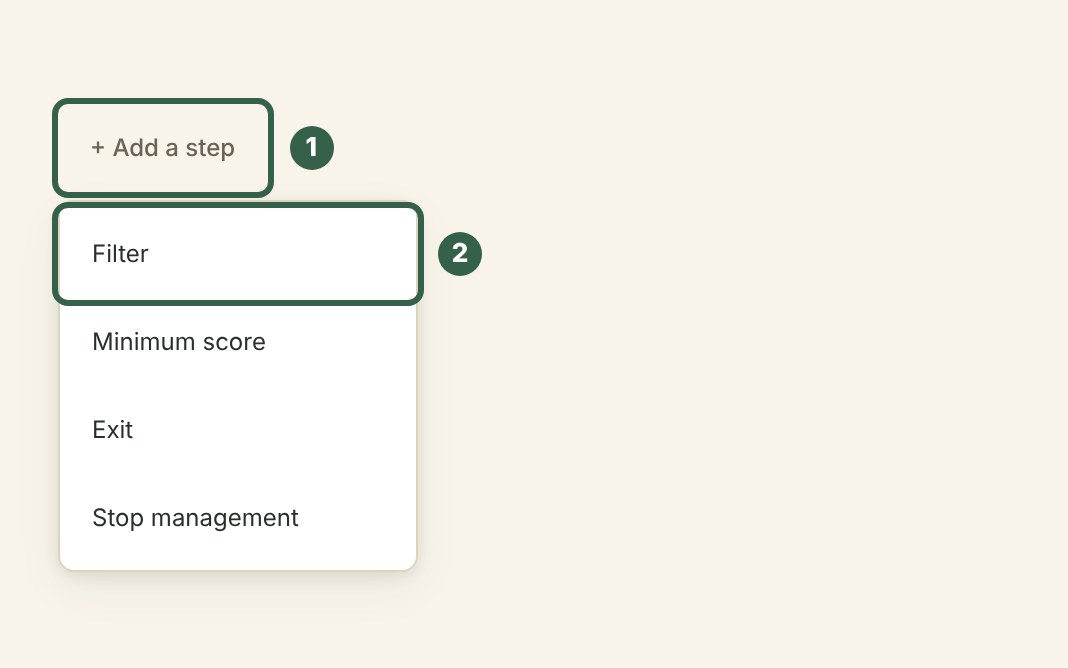
- Open your strategy in Strategies, press Change a rule, then + Add a step, Filter, and Indicator condition.
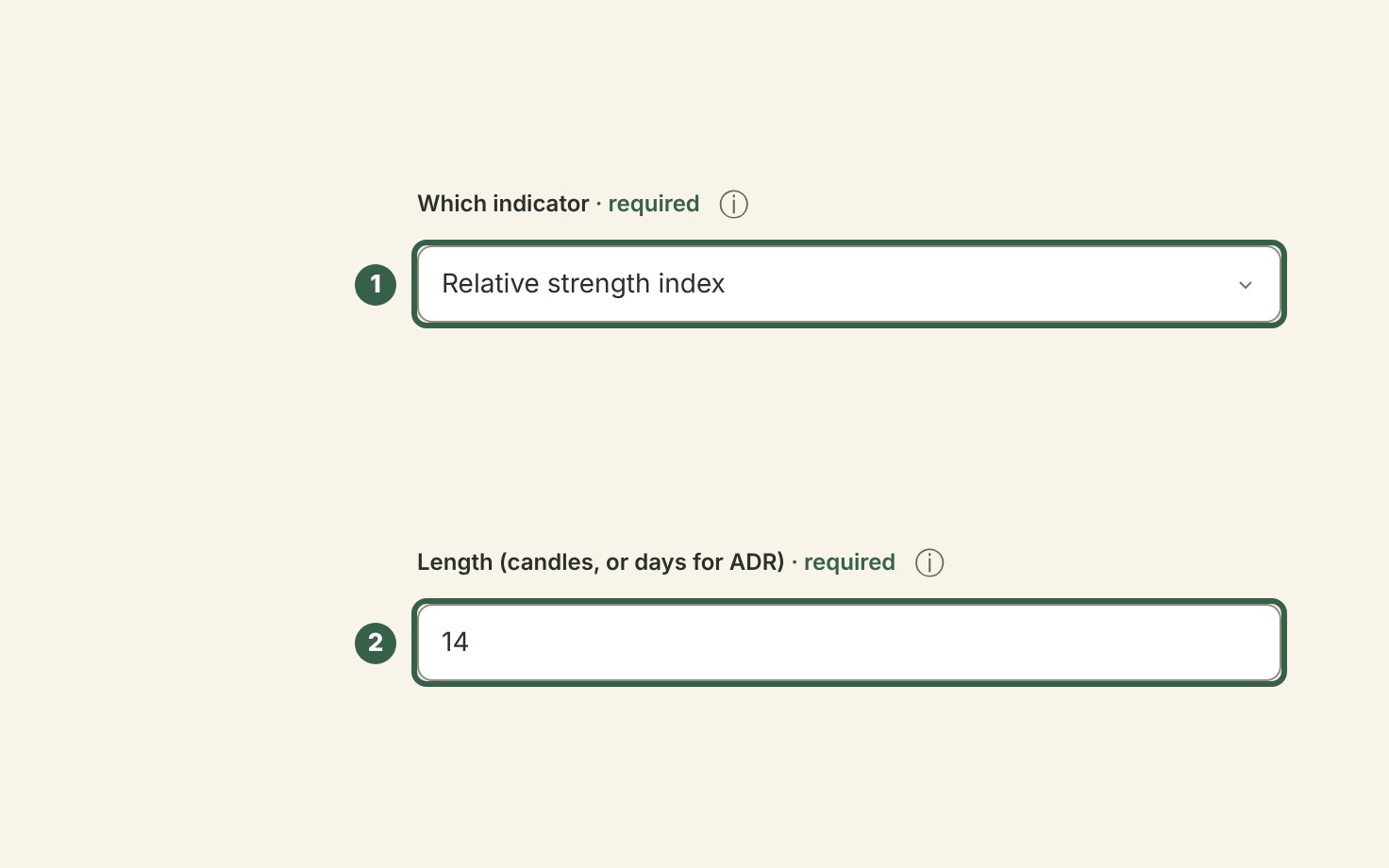
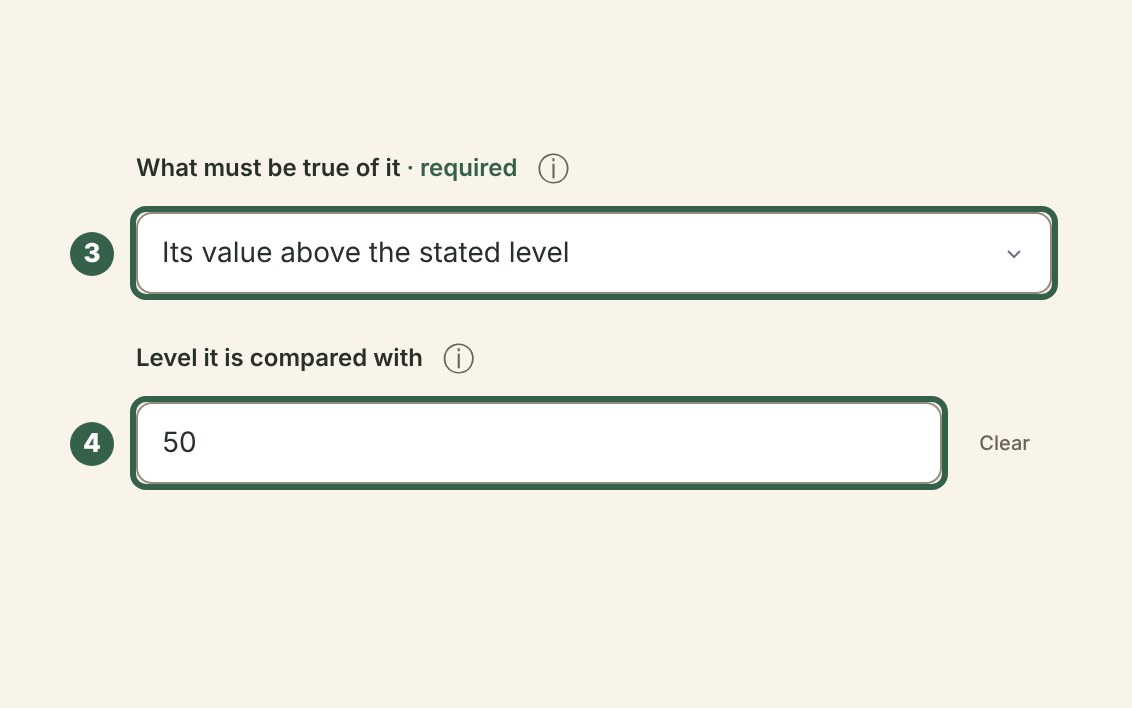
- Fill in the row: the indicator, its length, what must be true of it and the level.
- Click into the level, press Help me choose, type three values under Try a few, and press Run.
- Press Save, run your check from lesson 2 again, and copy it to your platform again.
- Help article Oscillators in Studio
- Help article The indicator condition gate
- Help article Help me choose a setting
Quick check
1. Sam's RSI above 40 took 18 trades, and no filter at all took 18. Were they the same trades?
2. What unit is the RSI's level in?
3. A filter set to Must not hold and RSI above 80 does what?
0 of 3 answered.
Finished this lesson?
Tick it off and keep your place
Read the full notes
An oscillator reads in its own unit, like the RSI's 0 to 100, so the level you pick is the rule. In Wildflower, press Change a rule, then Add a step, then Filter, and pick Indicator condition. Choose the indicator, its length, what must be true of it, like its value above a level, and the level. Help me choose under the level opens Try a few, which runs three levels on the free practice chart without saving anything. Must hold and must not hold make two different filters. Two runs with the same number of trades can still be different trades.
What you're building. A lesson towards your own indicator strategy: a signal and a filter you chose from Studio's indicators, every number yours, checked trade by trade, and drawn on your own chart platform. Last lesson was lines 1 and 2. Today is lines 3 and 4. Next lesson uses a trend indicator.
| My indicator rule |
|---|
| 1. The signal: … (which indicator, and what it must do) |
| 2. The signal's numbers: … candles, …-minute candles, the price it reads … |
| 3. The filter: … (which indicator, must hold or must not, buys, sells or both) |
| 4. The filter's level: … in its own unit |
| 5. Stop … ticks, target … times the stop, $… a trade, … to … New York |
| 6. The wait: my strategy needs … candles before it can trade |
| 7. Checked: … trades gone through, and on my platform: … |
Why. Sam is made up, and so are his numbers. An oscillator reads in its own unit, so the level is the rule. Must hold and must not hold are two different filters. How traders read the RSI: RSI: overbought, oversold and divergence. Others: Momentum oscillators.
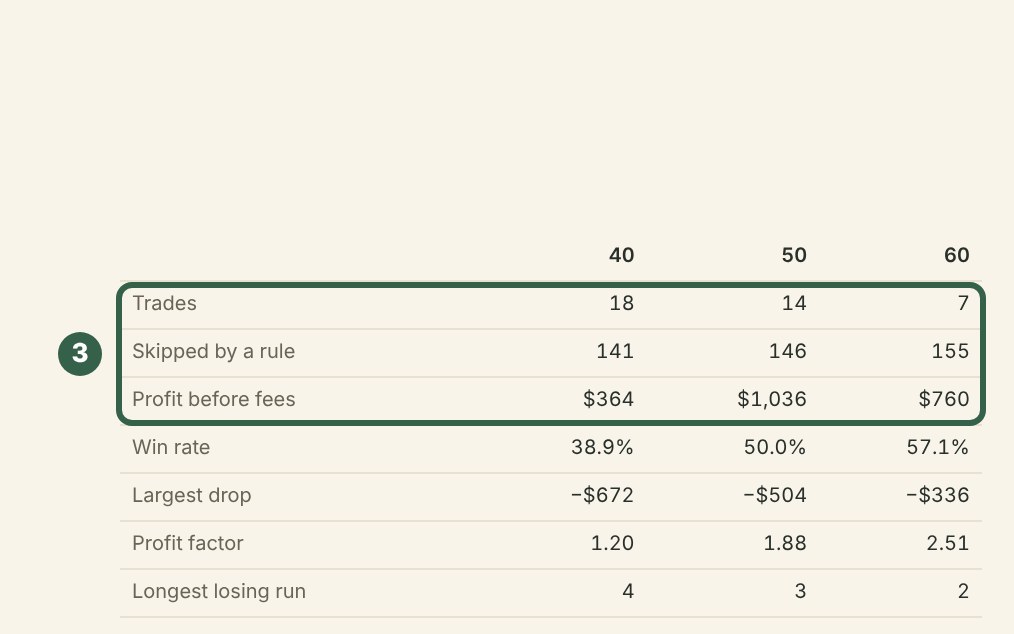
| RSI 14 above | 40 | 50 | 60 |
|---|---|---|---|
| Trades | 18 | 14 | 7 |
| Profit before fees | $364 | $1,036 | $760 |
| Win rate | 38.9% | 50.0% | 57.1% |
The same count isn't the same trades. RSI above 40 took 18 trades, and so did no filter at all. But 7 won instead of 9, and $364 instead of $1,332. The filter skipped some trades, and others came in their place. Compare the trades, not only the count.
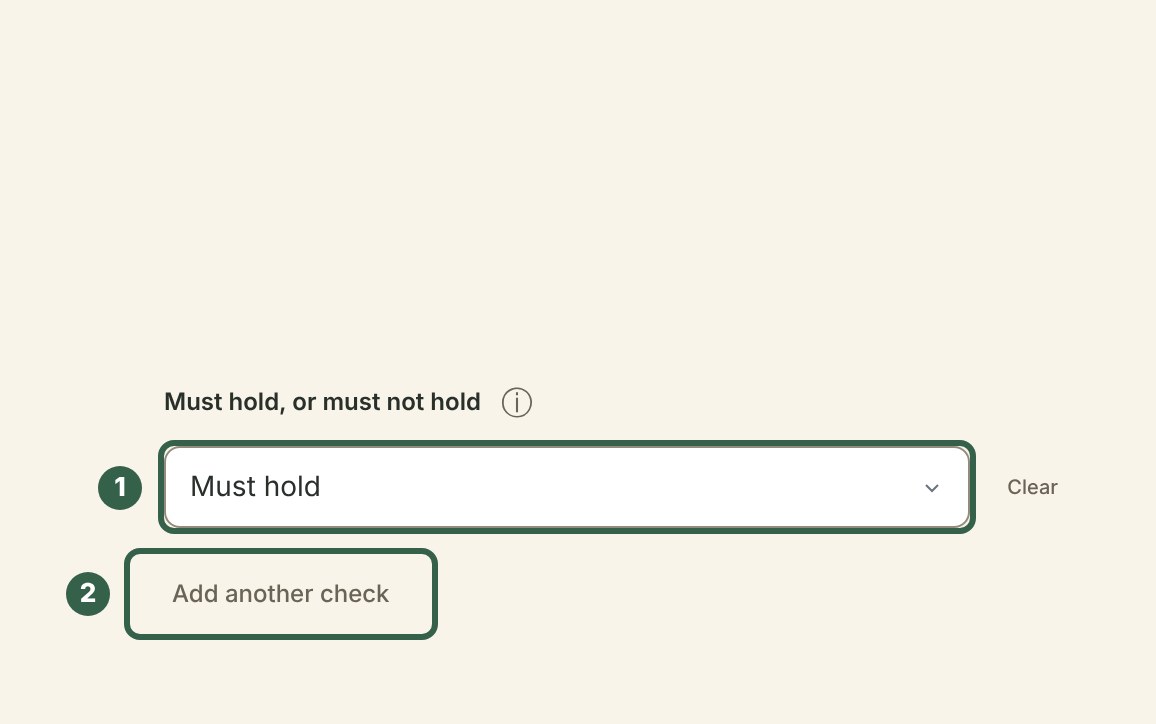
How traders pick an oscillator's level. We can't tell you which to choose. These are the common choices. The middle of the range, like 50. A stricter level for fewer trades. Or must not hold at an extreme.
Worked example
Made-up numbersReading Sam's filter
Sam is made up. Buys only. His filter is RSI 14, Its value above the stated level, 50, Must hold.
- A candle closes up through the 200 EMA. The signal says buy.
- The RSI on the last closed candle is 47. 47 isn't above 50, so the filter says no.
- On another day the RSI is 58. 58 is above 50, so the trade is taken.
The level decides. With 40, the first trade would have been taken too.
Trading is risky. You can lose money. This lesson shows how Wildflower works. It isn't advice.