
An adaptive price zone filter on an EMA cross
Wildflower Trading School · Lesson 2.4.8.19 · This exercise is free

This lesson works towards your own indicator strategy: a signal and a filter you chose from Studio's indicators, every number yours, checked trade by trade, and drawn on your own chart platform. Today is lines three and four, and reading the conditions a row offers.
1 of 9
What you'll learn
- Each indicator has its own list under What must be true of it.
- Inside the bands took all 18 trades, so it filtered nothing.
- A touch with width 1 took 11 trades, 7 won. Width 3 took none.
- A touch can be either band. The row doesn't say which.
Exercise
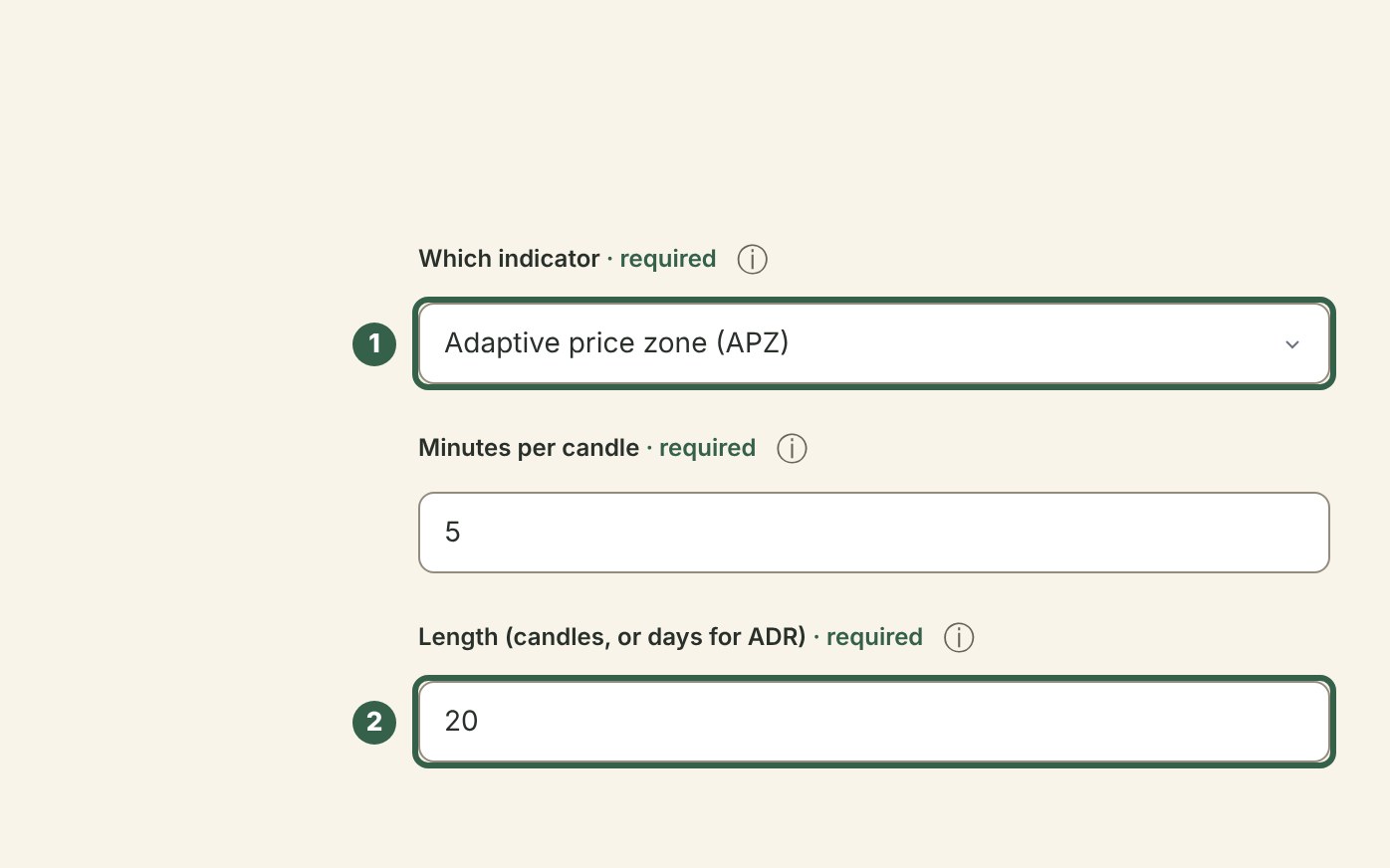
- Open your strategy in Strategies and press Change a rule. Open the Filter step and change Which indicator to Adaptive price zone (APZ), Length 20, Band width (smoothed candle ranges) 2.
- Open What must be true of it and read every choice before you pick one.
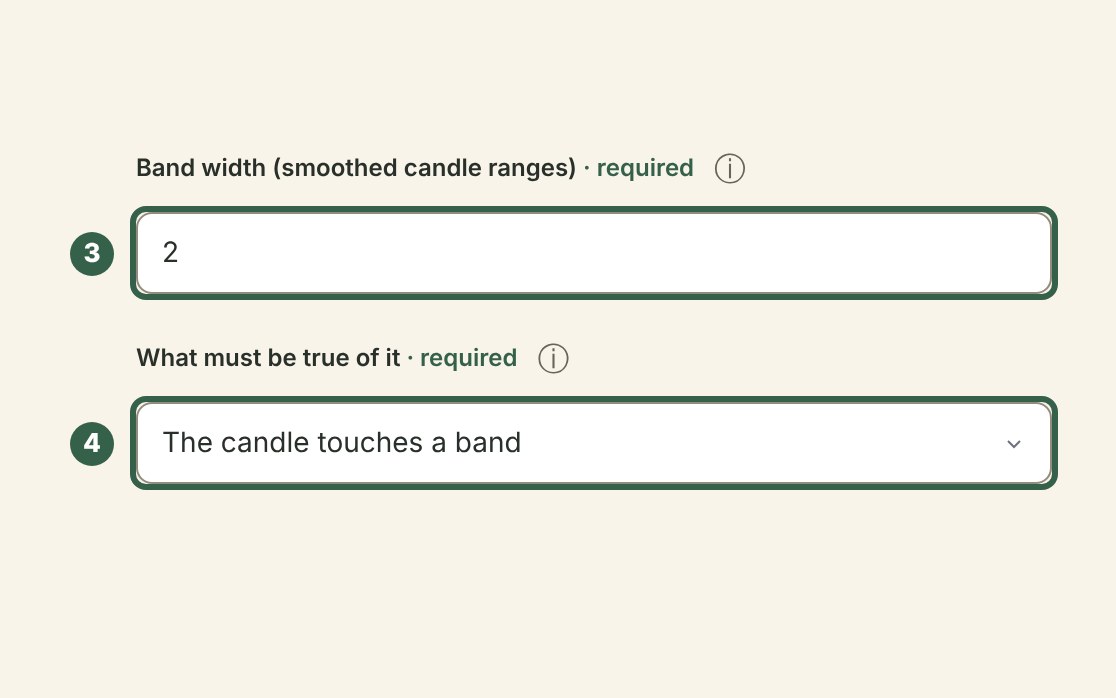
- Click into What must be true of it, press Help me choose, and under Try a few pick inside the bands, touches a band and outside. Find the one that takes the same trades as no filter.
- Change it to The candle touches a band, click into Band width, press Help me choose, and run 1, 2 and 3.
- Write lines 3 and 4 with the condition and width you'd test further, and why.
- Help article Adaptive price zone, fractal chaos bands and projection bands in Studio
- Help article The indicator condition gate
- Help article Help me choose a setting
Quick check
1. Inside the bands took all 18 trades. What does it mean?
2. Why did width 3 take no trades?
3. Does The candle touches a band mean the bottom band?
0 of 3 answered.
Finished this lesson?
Tick it off and keep your place
Read the full notes
Lee Leibfarth's adaptive price zone (APZ) is a pair of bands around a fast double average of the close, as far apart as a number of smoothed candle ranges. Each indicator offers its own list under What must be true of it. For the APZ that's the close above, below, crossing, inside or outside the bands, the candle touching one, or the bands wider or narrower than a number of ticks. In Wildflower, press Change a rule, open the Filter step, change Which indicator to Adaptive price zone (APZ), pick a condition and try a few band widths. Read the list before you pick: inside the bands never said no to Sam's signal.
What you're building. A lesson towards your own indicator strategy: a signal and a filter you chose from Studio's indicators, every number yours, checked trade by trade, and drawn on your own chart platform. Last lesson compared two versions. Today is lines 3 and 4 with the adaptive price zone, and the conditions a row offers. Next lesson uses the Reflex filter.
| My indicator rule |
|---|
| 1. The signal: … (which indicator, and what it must do) |
| 2. The signal's numbers: … candles, …-minute candles, the price it reads … |
| 3. The filter: … (which indicator, must hold or must not, buys, sells or both) |
| 4. The filter's level: … in its own unit |
| 5. Stop … ticks, target … times the stop, $… a trade, … to … New York |
| 6. The wait: my strategy needs … candles before it can trade |
| 7. Checked: … trades gone through, and on my platform: … |
Why. Sam is made up, and so are his numbers. The list under What must be true of it changes with the indicator. With the same bands, inside took all 18 of Sam's trades, outside took none, and a touch took 3.
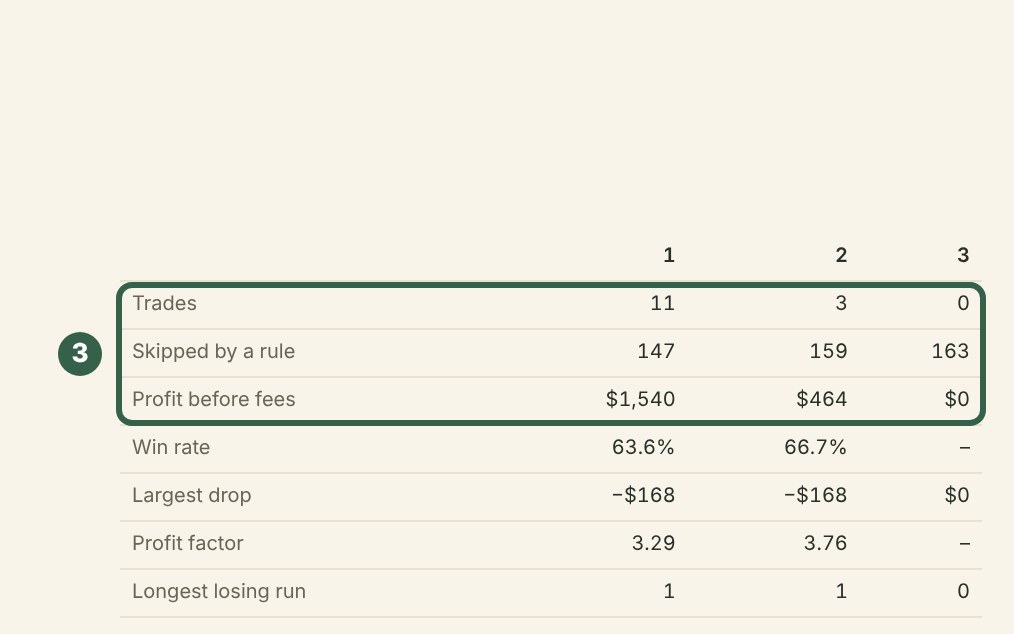
| APZ 20, the candle touches a band | No filter | Width 1 | Width 2 | Width 3 |
|---|---|---|---|---|
| Trades | 18 | 11 | 3 | 0 |
| Won | 9 | 7 | 2 | 0 |
| Profit before fees | $1,332 | $1,540 | $464 | none |
| APZ 20, width 2 | Inside the bands | Touches a band | Outside the bands |
|---|---|---|---|
| Trades | 18 | 3 | 0 |
The APZ's conditions. The close above the top band or below the bottom one, crossing one, inside or outside, the candle touching one, and the bands wider or narrower than a number of ticks. A touch can be either band, and the row doesn't say which.
How traders use the APZ. We can't tell you which to choose. These are the common uses. Leibfarth's own: in sideways markets, buy a touch of the bottom band and sell a touch of the top one. Often with a trend check, such as the ADX below 30. Or a close outside a band as the start of a move.
Worked example
Made-up numbersReading Sam's APZ touch
Sam is made up. Buys only. Signal, the 5-minute EMA 200 cross. Filter, APZ 20 with width 1, the candle touches a band.
- The APZ middle is 2,030.0, and the bands sit at 2,028.8 and 2,031.2.
- A candle closes at 2,031.0, up through the 200 EMA. Its high reached 2,031.4, above the top band. It touched a band, so the filter says yes.
- Another cross closes at 2,030.4 with a high of 2,030.9. It stayed between the bands, so the filter says no.
With narrow bands, a touch picks out the stronger crossing candles.
Trading is risky. You can lose money. This lesson shows how Wildflower works. It isn't advice.