
Build an opening range or London breakout
Wildflower Trading School · Lesson 3.2.29.1 · This exercise is free

This is the first of the lessons on doing this course's setups in Wildflower, and they share one goal: a setup card for every setup you trade: described in your own words in Wildflower, every number yours, one box tried three ways on the practice chart, and compared with a plain entry. By the end of today, you'll have Sam's opening range card filled in, and your own opening range saved in Wildflower.
1 of 14
What you'll learn
- Describe your opening range in words from Strategies, then Get started.
- Read the window back on Check my rules, in minutes after midnight.
- Try three window ends with Help me choose, then Try a few.
- Compare each with a plain 10:00 entry on the same days.
- Take about $8 a trade off Try a few's profit for fees.
Exercise
- Copy the seven lines of the setup card above onto paper or into a note.
- Open Strategies and press Get started (or New strategy).
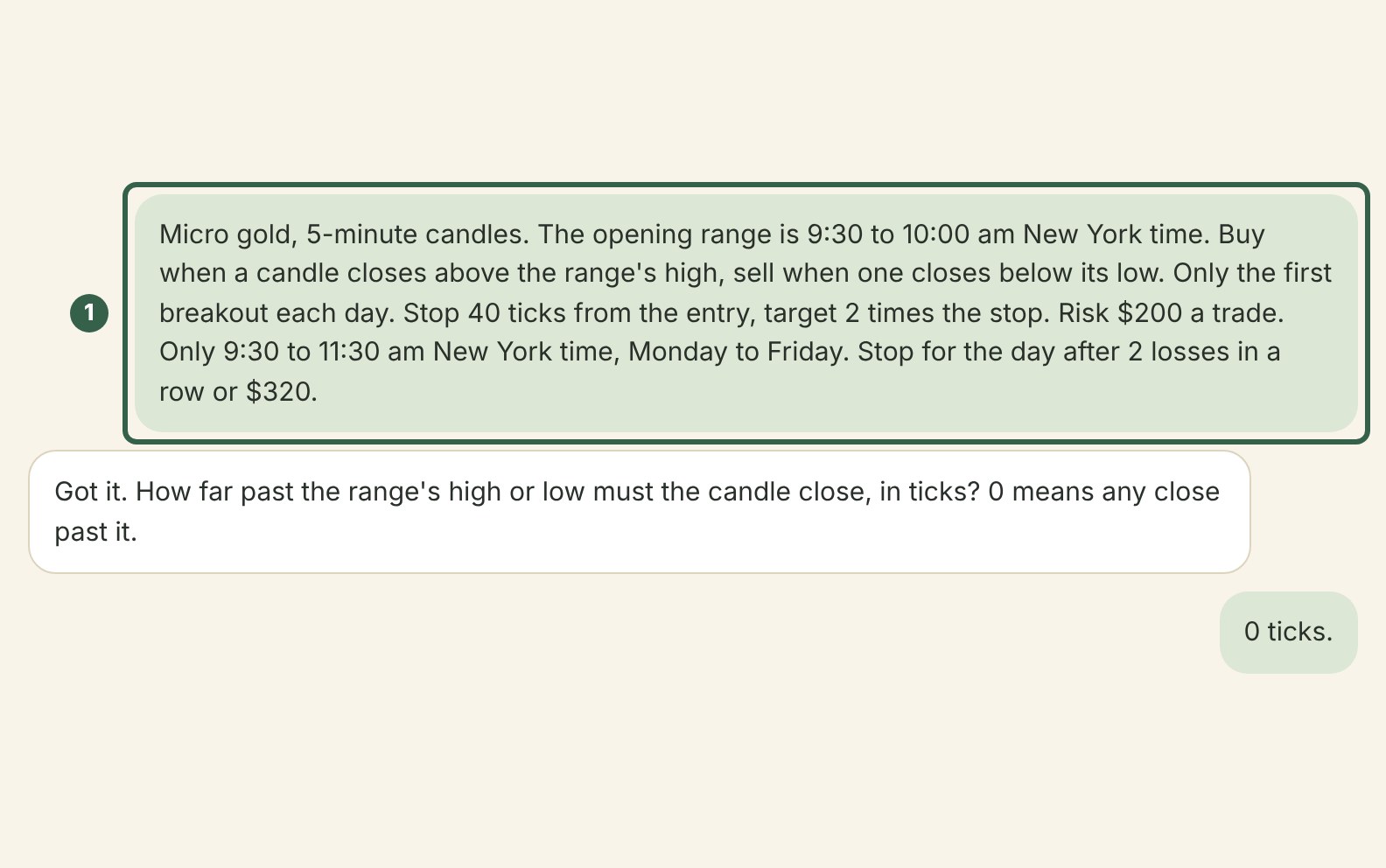
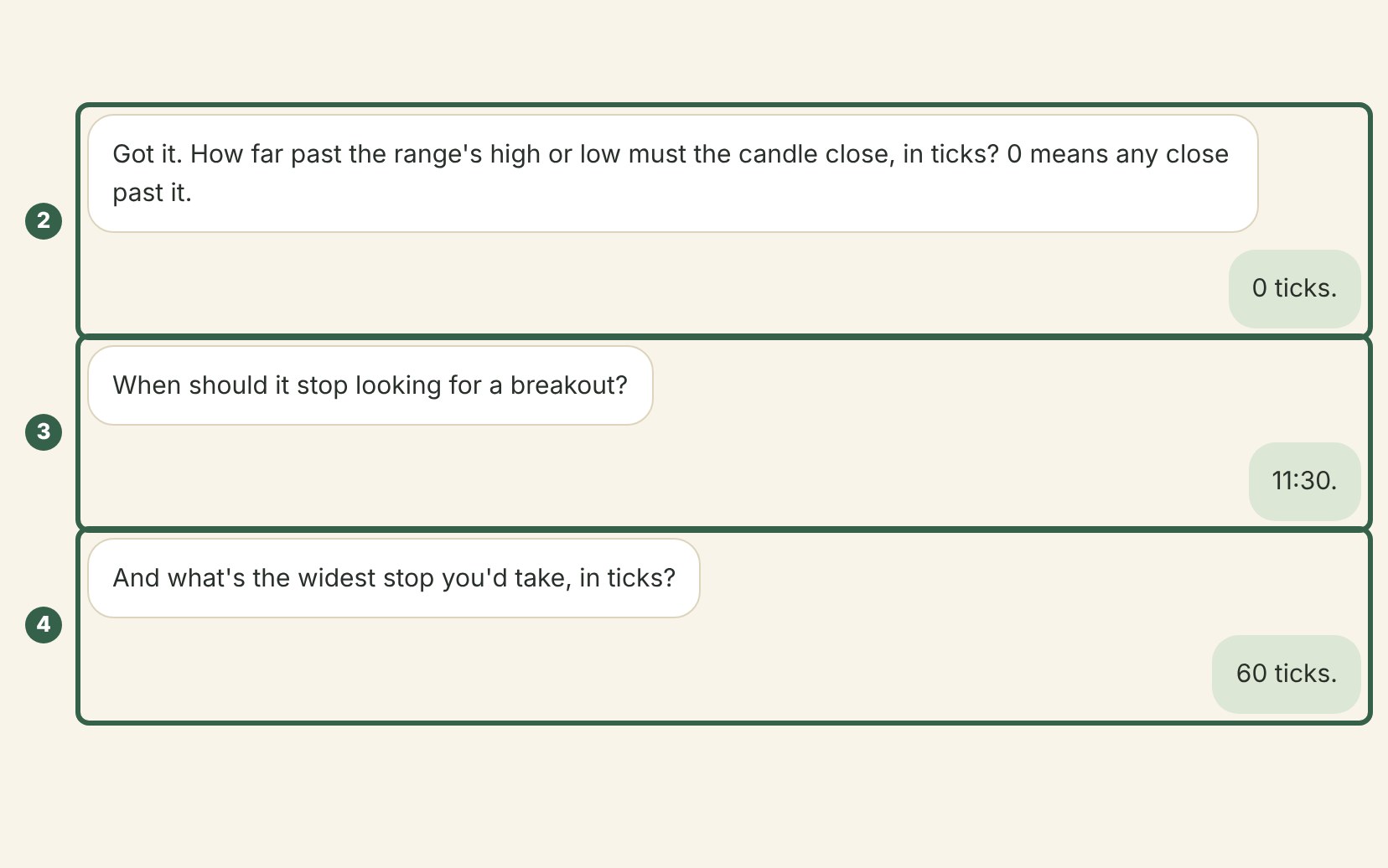
- Describe your opening range in your own words: the window, which closes count, your stop, target, risk and hours. Answer every question, then press Check my rules.
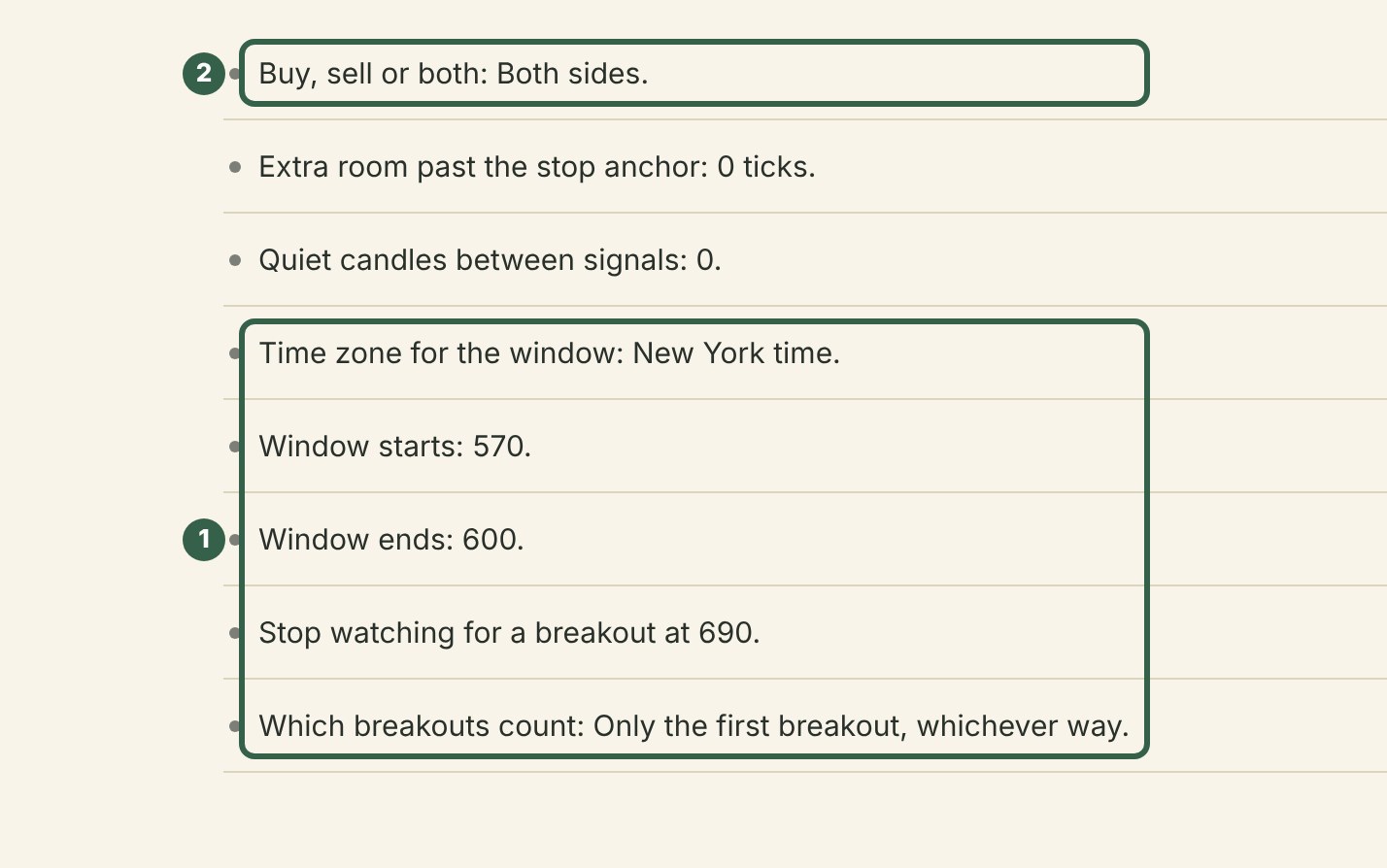
- Read the window back in minutes after midnight, and fill in lines 1, 2 and 4.
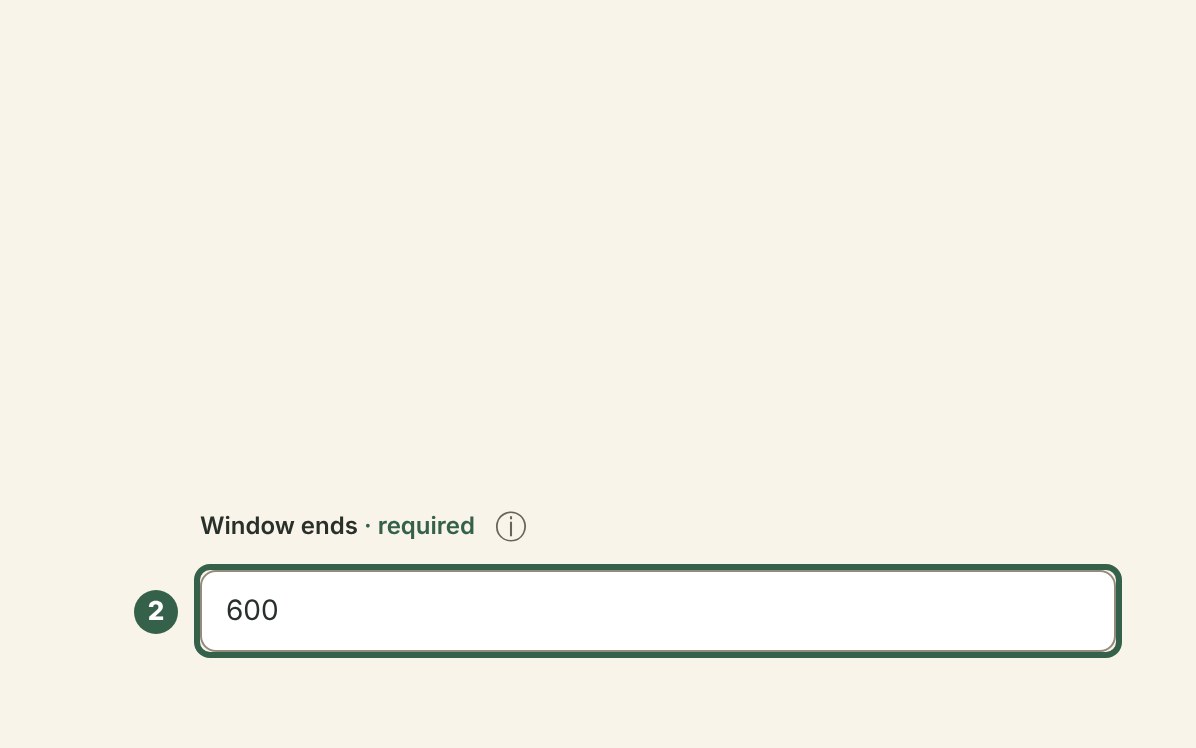
- Open your strategy in Strategies and press Change a rule. Press the Signal step and click into Window ends.
- Press Help me choose, type three window ends under Try a few, and press Run.
- Make the plain entry. On your strategy press Change a rule. On the Signal step press ⋯, then Change, and pick Signal at a clock time. Type 600 in Time of the signal, pick The way that candle closed, and press Save. Run it in Backtest on the Practice chart, and that's your line 5.
- Fill in lines 6 and 7. Take about $8 a trade off Try a few's profit for fees.
- Help article Describe your strategy in your own words
- Help article The moving average touch and time window range blocks
- Help article Signal at a clock time, and exit at a clock time
- Help article Help me choose a setting
Quick check
1. Sam's window ends at 10:00 New York time. What does Window ends read?
2. On the same days, what did the plain 10:00 entry do before fees?
3. Try a few shows 68 trades and $2,984 before fees. About how much is that after fees?
0 of 3 answered.
Finished this lesson?
Tick it off and keep your place
Read the full notes
An opening range breakout trades the first close past the high or low of the first minutes of a session. In Wildflower, open Strategies, press Get started, and describe it in your own words: the window, which closes count, your stop, target, risk and hours. Press Check my rules, and read the window back. Then press Change a rule, open the Signal step, click into Window ends and press Help me choose. Try a few runs three window ends on the free practice chart, side by side, without saving anything. The London breakout is the same setup on the London clock.
What you're building. These lessons share one goal: a setup card for every setup you trade: described in your own words in Wildflower, every number yours, one box tried three ways on the practice chart, and compared with a plain entry. Today you fill in all seven lines for the opening range. Next lesson starts a card for a sweep or a fade at a range edge.
| My setup card |
|---|
| 1. The setup: … (what price must do, and where) |
| 2. Its clock or its levels: … |
| 3. The box I test: …, tried at …, … and … |
| 4. Stop … ticks, target … times the stop, $… a trade, … to … New York |
| 5. A plain entry at 10:00 each day, same stop and target: … trades, $… after fees |
| 6. What the test showed: … trades, … won, $… after fees |
| 7. My pick, and why: … |
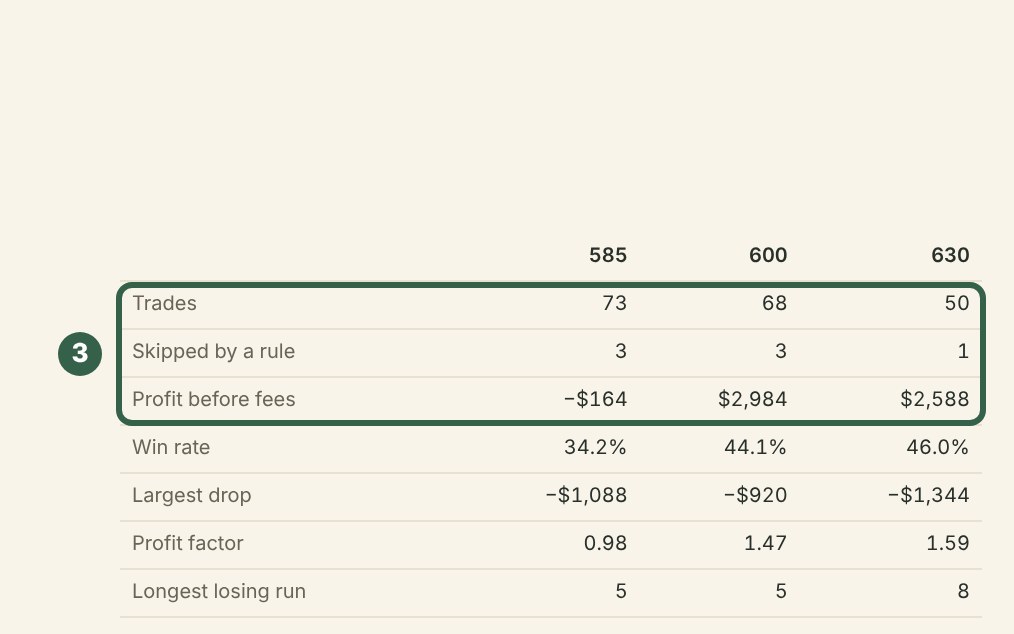
Why. Sam is made up, and so are his numbers. They're real runs of Wildflower's engine on the free practice chart's made-up prices. His 15-minute window lost $164 before fees. The 30-minute window made $2,984 on the same days. One box moved the result by over $3,000. How the setup works: The idea behind the opening range and Common opening range breakout rules.
| Sam's number | Sam's value | How he gets it |
|---|---|---|
| Account | $20,000 | His demo account |
| Risk a trade | $200 | 1% of $20,000 |
| Stop | 40 ticks | $40 a contract, at $1 a tick |
| Contracts | 4 | Wildflower leaves room for slippage, so $200 buys 4, not 5 |
| At the stop | $160 | 4 × 40 ticks × $1 |
| At the target | $320 | 2 times the stop, 80 ticks, 4 contracts |
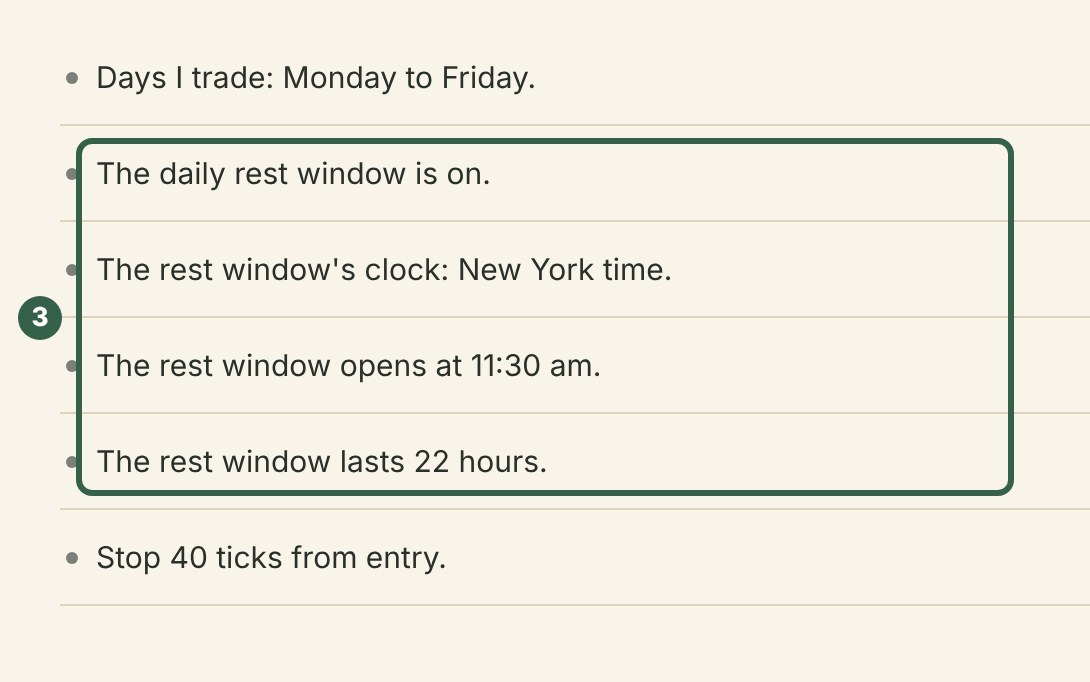
| Hours | 9:30 to 11:30 am New York | Monday to Friday |
| Fees | About $8 a trade | 4 contracts × $1.90 |
| Run | Trades | Won | Before fees | After fees | Largest drop |
|---|---|---|---|---|---|
| Plain 10:00 entry | 75 | 22 (29.3%) | −$1,952 | −$2,526.50 | −$1,952 |
| Window ends 585 (9:45) | 73 | 25 (34.2%) | −$164 | −$723.18 | −$1,088 |
| Window ends 600 (10:00) | 68 | 30 (44.1%) | +$2,984 | +$2,463.12 | −$920 |
| Window ends 630 (10:30) | 50 | 23 (46.0%) | +$2,588 | +$2,205 | −$1,344 |
The plain entry. The first row is the same strategy with its signal changed to Signal at a clock time: 10:00 New York each day, taking the way that 5-minute candle closed, with the same stop, target, risk and hours. A setup earns its place on your card only if it does something a plain entry doesn't. Build it as another version of the same strategy, so it reads the same made-up prices.
How traders set an opening range. We can't tell you which to choose. These are the common choices. The first 15 minutes, for the early burst. The first 30 or 60 minutes, a wider range (What the initial balance is). Or another market's open on its own clock: the London breakout is the same setup with Time zone for the window set to London time (The idea behind a London breakout).
Worked example
Made-up numbersSam's opening range card
Sam is made up. $20,000 account, micro gold at $1 a tick for each contract, $200 a trade with a 40-tick stop, 4 contracts.
- Lines 1 and 2: the first close past the high or low of 9:30 to 10:00 New York, the first breakout only.
- Line 3: Window ends, tried at 585, 600 and 630.
- Line 4: stop 40 ticks, target 2 times, $200 a trade, 9:30 to 11:30 New York. $160 at the stop, $320 at the target.
- Line 6: at 600, 68 trades and 30 won. $2,984 before fees, minus about $8 × 68 = $521 in fees, is $2,463 after.
Line 7 is Sam's own pick. He keeps 600 for now and writes why: it's the window he watches. Made-up prices, an example, not advice.
Trading is risky. You can lose money. This lesson shows how Wildflower works. It isn't advice.