
Build a classic reversal setup
Wildflower Trading School · Lesson 3.2.29.14 · This exercise is free

Same goal as every lesson in this set: a setup card for every setup you trade: described in your own words in Wildflower, every number yours, one box tried three ways on the practice chart, and compared with a plain entry. By the end of today, you'll have Sam's turtle soup card filled in, and your own saved in Wildflower.
1 of 13
What you'll learn
- Describe your reversal in words from Strategies, then New strategy.
- Read the channel back on Check my rules, to see recent candles' high and low, and the sweep.
- Try three channel lengths with Help me choose, then Try a few.
- Read the largest drop against your account, not only the profit.
- Compare with a plain 10:00 entry on the same days, after fees.
Exercise
- Start a new setup card: copy the seven lines above onto paper or into a note.
- Open Strategies and press New strategy.
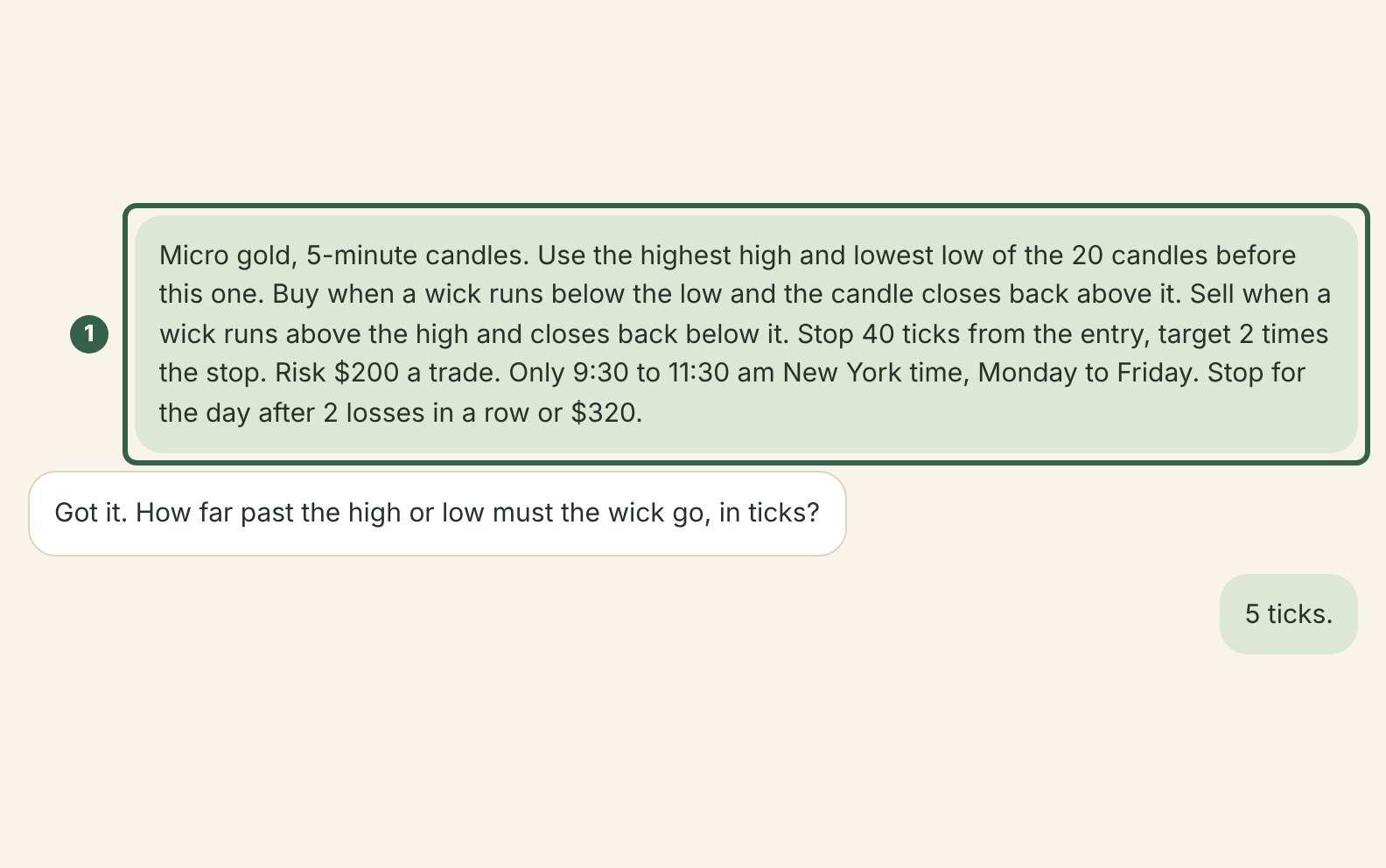
- Describe your reversal in your own words: which high and low, the sweep, your stop, target, risk and hours. Answer every question, then press Check my rules.
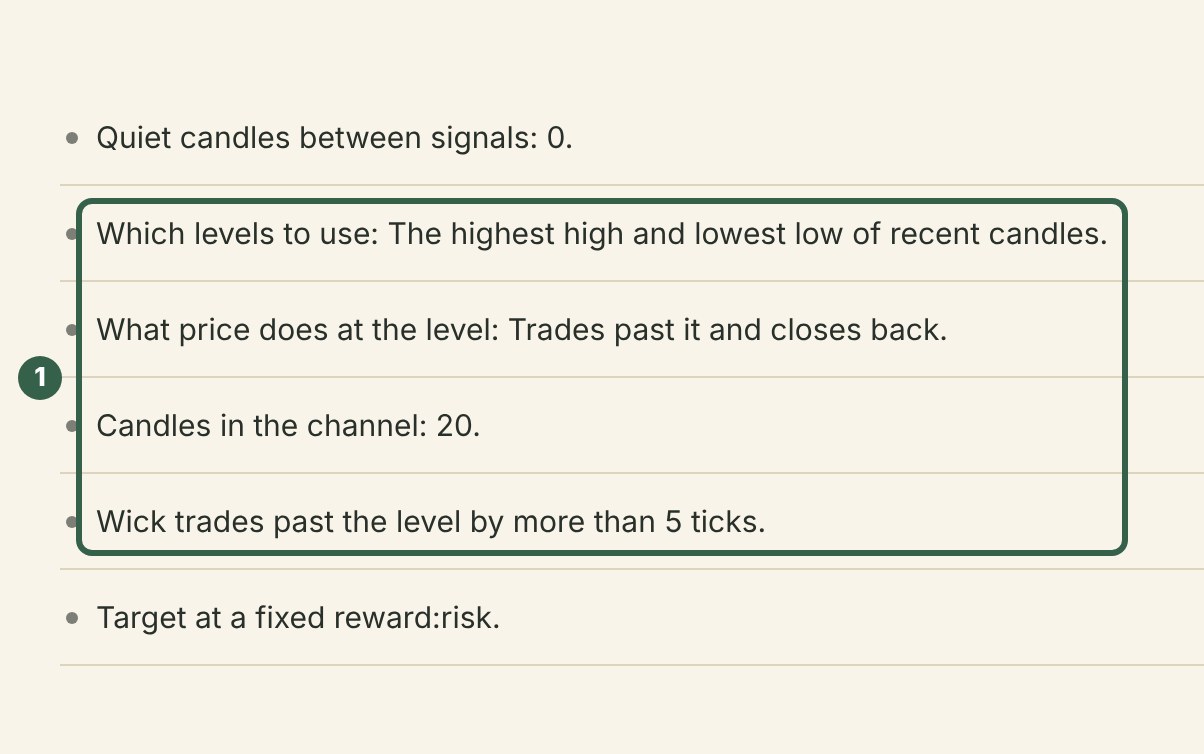
- Read the channel back, and fill in lines 1, 2 and 4.
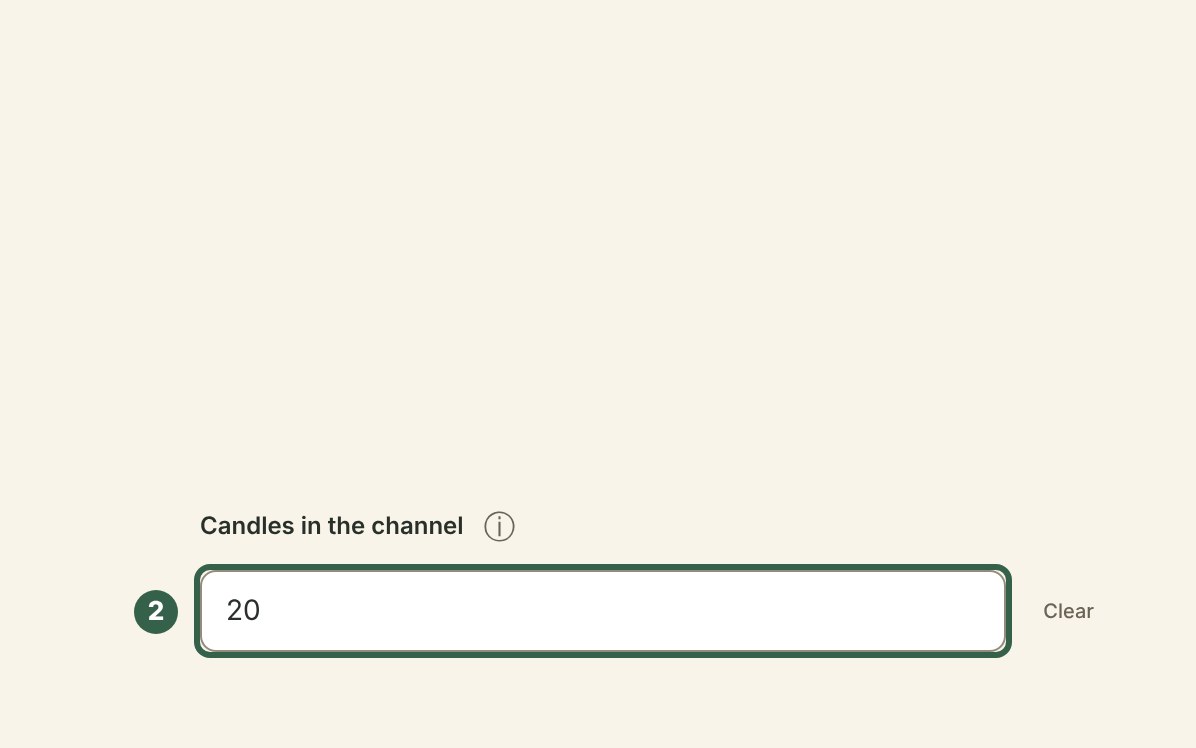
- Open your strategy in Strategies and press Change a rule. Press the Signal step and click into Candles in the channel.
- Press Help me choose, type three lengths under Try a few, and press Run.
- Make the plain entry. On your strategy press Change a rule. On the Signal step press ⋯, then Change, and pick Signal at a clock time. Type 600 in Time of the signal, pick The way that candle closed, and press Save. Run it in Backtest on the Practice chart, and that's your line 5.
- Fill in lines 6 and 7. Take about $8 a trade off Try a few's profit for fees, and note the largest drop.
- Help article Describe your strategy in your own words
- Help article The signal at a level
- Help article Equal highs and lows, liquidity sweeps, order blocks and breaker blocks
- Help article Help me choose a setting
Quick check
1. Sam's 20-candle run fell $7,636 from its high. About what share of his $20,000 account is that?
2. What does turtle soup trade?
3. At 20 candles, 102 trades lost $6,808 before fees. About what is that after fees?
0 of 3 answered.
Finished this lesson?
Tick it off and keep your place
Read the full notes
Turtle soup fades a breakout of the last 20 candles' high or low: a wick past it that closes back. In Wildflower, open Strategies, press New strategy and describe it in your own words: how many candles, the sweep, and your stop, target, risk and hours. Wildflower builds it as Signal at a level, with the highest high and lowest low of recent candles. Press Check my rules, then Change a rule, open the Signal step, click into Candles in the channel and try three lengths with Try a few on the free practice chart. The 2B and the opening range fade are built from the same kind of parts.
What you're building. These lessons share one goal: a setup card for every setup you trade: described in your own words in Wildflower, every number yours, one box tried three ways on the practice chart, and compared with a plain entry. Today you start a new card for a classic reversal, turtle soup. Last lesson built Candle Range Theory; next lesson builds a classic trend setup.
| My setup card |
|---|
| 1. The setup: … (what price must do, and where) |
| 2. Its clock or its levels: … |
| 3. The box I test: …, tried at …, … and … |
| 4. Stop … ticks, target … times the stop, $… a trade, … to … New York |
| 5. A plain entry at 10:00 each day, same stop and target: … trades, $… after fees |
| 6. What the test showed: … trades, … won, $… after fees |
| 7. My pick, and why: … |
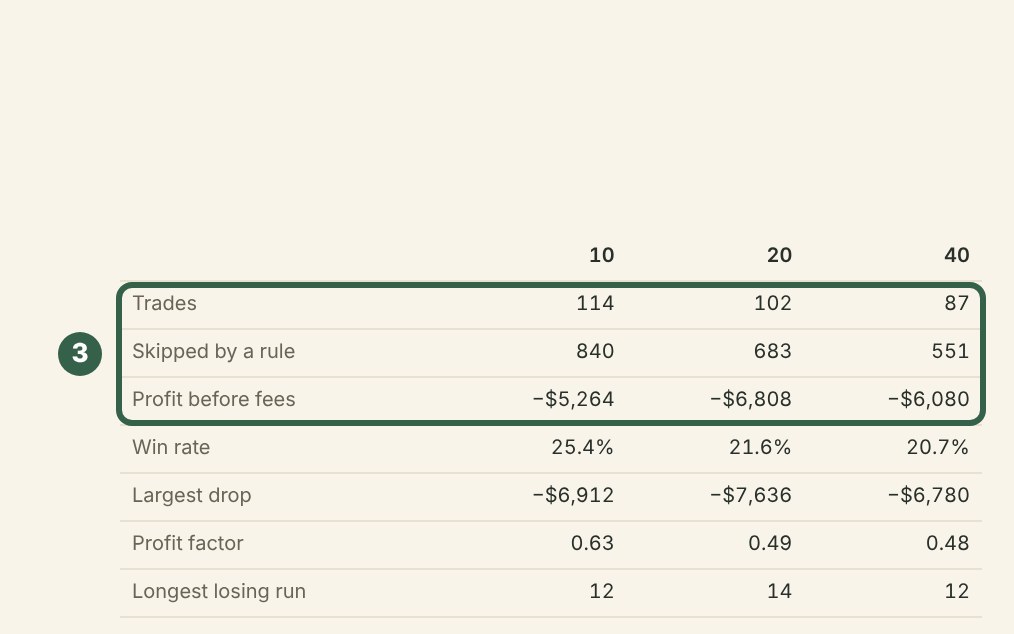
Why. Sam is made up, and so are his numbers. They're real runs of Wildflower's engine on the free practice chart's made-up prices. Every channel length lost over $5,000 before fees, and the worst fell $7,636 from its high, over a third of a $20,000 account. How it works: Turtle soup.
| Run | Trades | Won | Before fees | After fees | Largest drop |
|---|---|---|---|---|---|
| Plain 10:00 entry | 76 | 20 (26.3%) | −$3,088 | −$3,670.16 | −$3,700 |
| Channel 10 | 114 | 29 (25.4%) | −$5,264 | −$6,137.24 | −$6,912 |
| Channel 20 | 102 | 22 (21.6%) | −$6,808 | −$7,589.32 | −$7,636 |
| Channel 40 | 87 | 18 (20.7%) | −$6,080 | −$6,746.42 | −$6,780 |
The plain entry, and the drop. The first row is the same strategy with its signal changed to Signal at a clock time: 10:00 New York each day, the way that 5-minute candle closed, same stop, target, risk and hours. The reversal lost about twice as much. Its largest drop, over a third of the account, is the number to read first: daily limits cap one bad day, not a run of them.
How traders build a reversal. We can't tell you which to choose. These are the common choices. Turtle soup, a fade of the 20-candle high or low. The 2B, a failed break of a swing, with the Liquidity sweep block. Or the opening range fade, a poke past the opening range that closes back (The opening range fade).
Worked example
Made-up numbersSam's turtle soup card
Sam is made up. $20,000 account, micro gold at $1 a tick for each contract, $200 a trade with a 40-tick stop, 4 contracts.
- Line 1: a wick more than 5 ticks past the highest high or lowest low of recent candles, closing back.
- Line 3: Candles in the channel, tried at 10, 20 and 40.
- Line 6: at 20, 102 trades and 22 won. −$6,808 before fees, minus about $8 × 102 = $781 in fees, is −$7,589 after, with a largest drop of $7,636.
Line 7 is Sam's own pick. He writes that every length lost heavily on these prices, and he won't trade it. Made-up prices, an example, not advice.
Trading is risky. You can lose money. This lesson shows how Wildflower works. It isn't advice.