
Build a VWAP reversion
Wildflower Trading School · Lesson 3.2.29.11 · This exercise is free

Same goal as every lesson in this set: a setup card for every setup you trade: described in your own words in Wildflower, every number yours, one box tried three ways on the practice chart, and compared with a plain entry. By the end of today, you'll have Sam's VWAP card filled in, and your own saved in Wildflower.
1 of 13
What you'll learn
- Describe your VWAP reversion in words from Strategies, then New strategy.
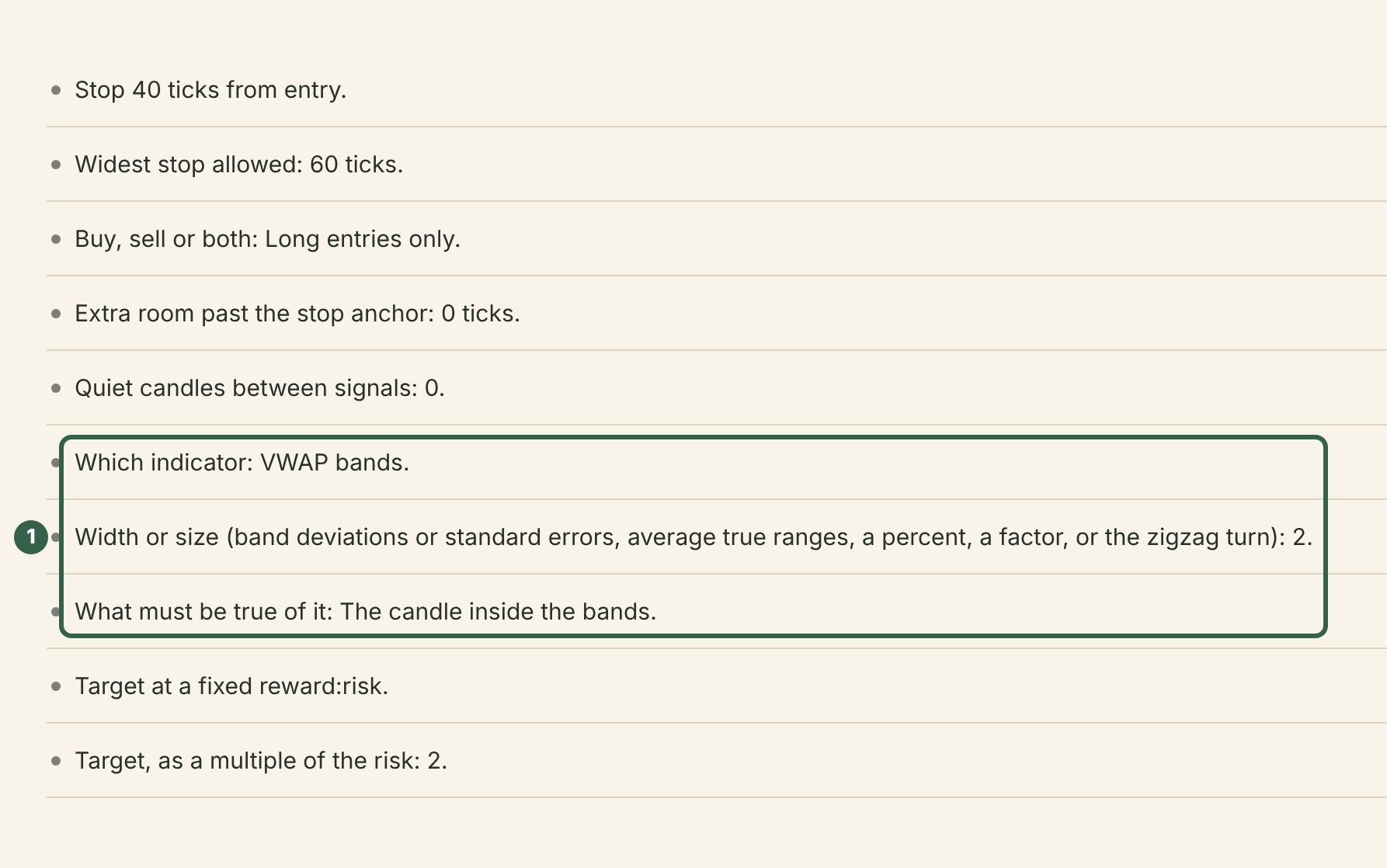
- Read the bands back on Check my rules, to see VWAP bands, and the candle inside them.
- Try three band widths with Help me choose, then Try a few.
- Losing less than a plain entry is still losing.
- Compare with a plain 10:00 buy on the same days, after fees.
Exercise
- Start a new setup card: copy the seven lines above onto paper or into a note.
- Open Strategies and press New strategy.
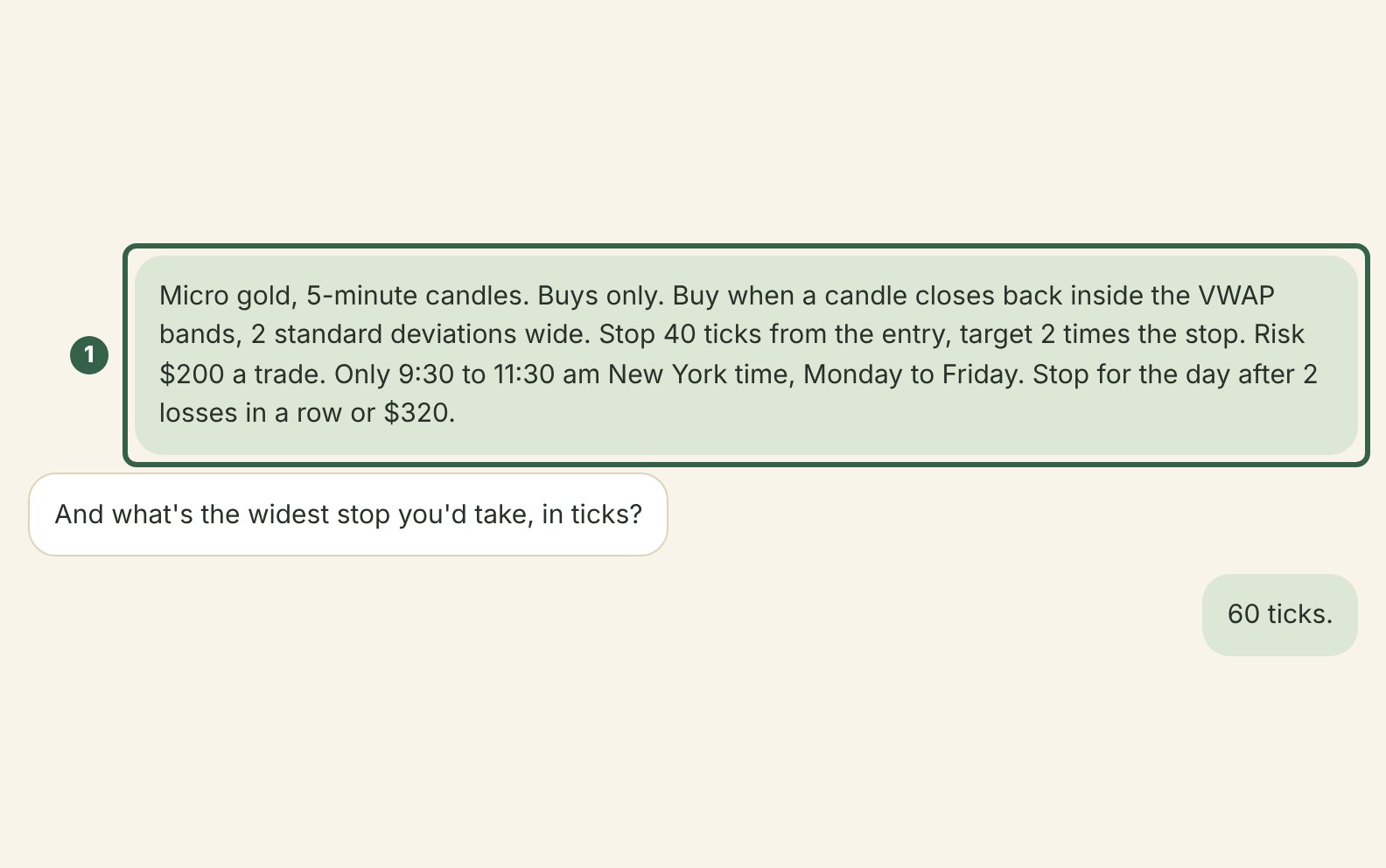
- Describe your VWAP reversion in your own words: buys, sells or both, the band width, your stop, target, risk and hours. Answer every question, then press Check my rules.
- Read the bands back, and fill in lines 1, 2 and 4.
- Open your strategy in Strategies and press Change a rule. Press the Signal step and click into Band width (standard deviations from VWAP).
- Press Help me choose, type three widths under Try a few, and press Run.
- Make the plain entry. On your strategy press Change a rule. On the Signal step press ⋯, then Change, and pick Signal at a clock time. Type 600 in Time of the signal, pick Always a long, and press Save. Run it in Backtest on the Practice chart, and that's your line 5.
- Fill in lines 6 and 7. Take about $8 a trade off Try a few's profit for fees.
- Help article Describe your strategy in your own words
- Help article Volume indicators: VWAP, OBV and relative volume
- Help article The indicator condition gate
- Help article Help me choose a setting
Quick check
1. Why did bands 3 wide give only 13 trades?
2. Every width beat the plain buy. Did any make money after fees?
3. Width 1 lost $272 before fees on 61 trades. About what is that after fees?
0 of 3 answered.
Finished this lesson?
Tick it off and keep your place
Read the full notes
VWAP is the day's average price, weighted by volume, and its bands sit a number of standard deviations either side. A VWAP reversion buys when price stretches outside a band and closes back inside. In Wildflower, open Strategies, press New strategy and describe it in your own words: buys only, the band width, and your stop, target, risk and hours. Wildflower builds it as an Indicator signal on VWAP bands. Press Check my rules, then Change a rule, open the Signal step, click into Band width and try three widths with Try a few on the free practice chart.
What you're building. These lessons share one goal: a setup card for every setup you trade: described in your own words in Wildflower, every number yours, one box tried three ways on the practice chart, and compared with a plain entry. Today you start a new card for a VWAP reversion. Last lesson traded the opening gap; next lesson trades yesterday's value area.
| My setup card |
|---|
| 1. The setup: … (what price must do, and where) |
| 2. Its clock or its levels: … |
| 3. The box I test: …, tried at …, … and … |
| 4. Stop … ticks, target … times the stop, $… a trade, … to … New York |
| 5. A plain entry at 10:00 each day, same stop and target: … trades, $… after fees |
| 6. What the test showed: … trades, … won, $… after fees |
| 7. My pick, and why: … |
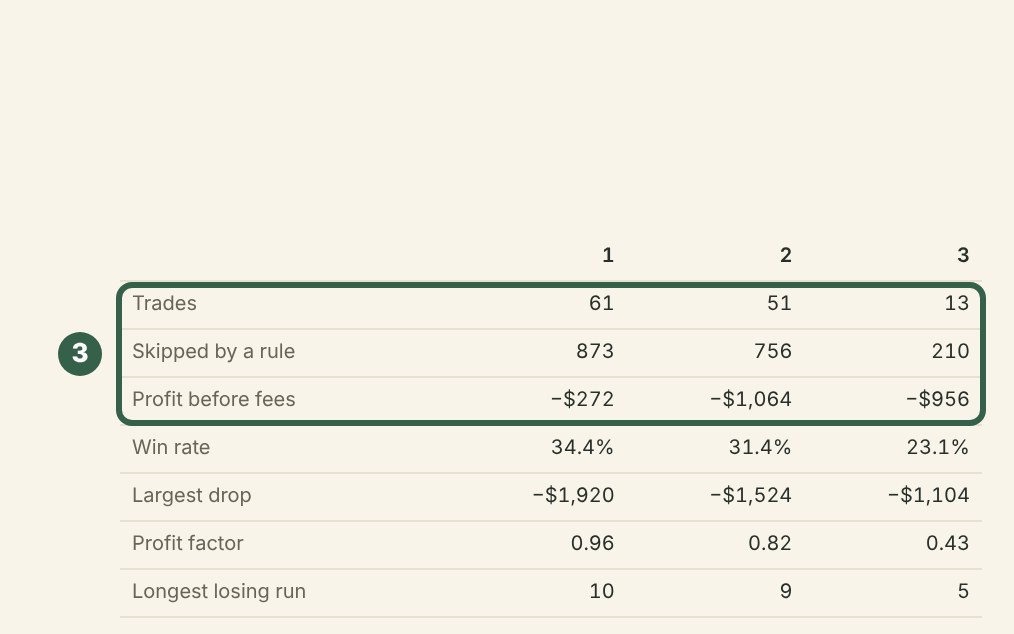
Why. Sam is made up, and so are his numbers. They're real runs of Wildflower's engine on the free practice chart's made-up prices. With bands 1 standard deviation wide, his reversion lost $272 before fees; 3 wide, it lost $956. A plain 10:00 buy lost $1,764. How it works: What VWAP is and why traders watch it and The idea of reverting to VWAP.
| Run | Trades | Won | Before fees | After fees | Largest drop |
|---|---|---|---|---|---|
| Plain 10:00 buy | 77 | 24 (31.2%) | −$1,764 | −$2,353.82 | −$2,512 |
| Band width 1 | 61 | 21 (34.4%) | −$272 | −$739.26 | −$1,920 |
| Band width 2 | 51 | 16 (31.4%) | −$1,064 | −$1,454.66 | −$1,524 |
| Band width 3 | 13 | 3 (23.1%) | −$956 | −$1,055.58 | −$1,104 |
The plain buy. Sam's setup buys only, so the first row does too: Signal at a clock time, 10:00 New York each day, Always a long, same stop, target, risk and hours. Every band width lost less than it, and every one still lost money. Both go on line 7.
How traders set a VWAP reversion. We can't tell you which to choose. These are the common choices. Bands 1 to 3 standard deviations wide. An Indicator condition filter so buys come only below VWAP, since a close back inside counts from either band. And an exit back at VWAP with the condition exit, instead of a fixed target.
Worked example
Made-up numbersSam's VWAP card
Sam is made up. $20,000 account, micro gold at $1 a tick for each contract, $200 a trade with a 40-tick stop, 4 contracts.
- Line 1: buys only, on the first close back inside the VWAP bands.
- Line 3: Band width, tried at 1, 2 and 3.
- Line 6: at 1, 61 trades and 21 won. −$272 before fees, minus about $8 × 61 = $467 in fees, is −$739 after.
Line 7 is Sam's own pick. He writes that it beat the plain buy but lost at every width, so he'll test the VWAP filter before anything else. Made-up prices, an example, not advice.
Trading is risky. You can lose money. This lesson shows how Wildflower works. It isn't advice.