
Build a classic trend or breakout setup
Wildflower Trading School · Lesson 3.2.29.15 · This exercise is free

Same goal as every lesson in this set: a setup card for every setup you trade: described in your own words in Wildflower, every number yours, one box tried three ways on the practice chart, and compared with a plain entry. By the end of today, you'll have Sam's Holy Grail card filled in, and your own saved in Wildflower.
1 of 13
What you'll learn
- Describe your trend setup in words from Strategies, then New strategy.
- Read the signal and filter back on Check my rules, to see the touch, and ADX above a level.
- Try three ADX levels on the Filter step with Help me choose, then Try a few.
- A stricter filter can turn a loss into a small gain on far fewer trades.
- Compare with a plain 10:00 entry on the same days, after fees.
Exercise
- Start a new setup card: copy the seven lines above onto paper or into a note.
- Open Strategies and press New strategy.
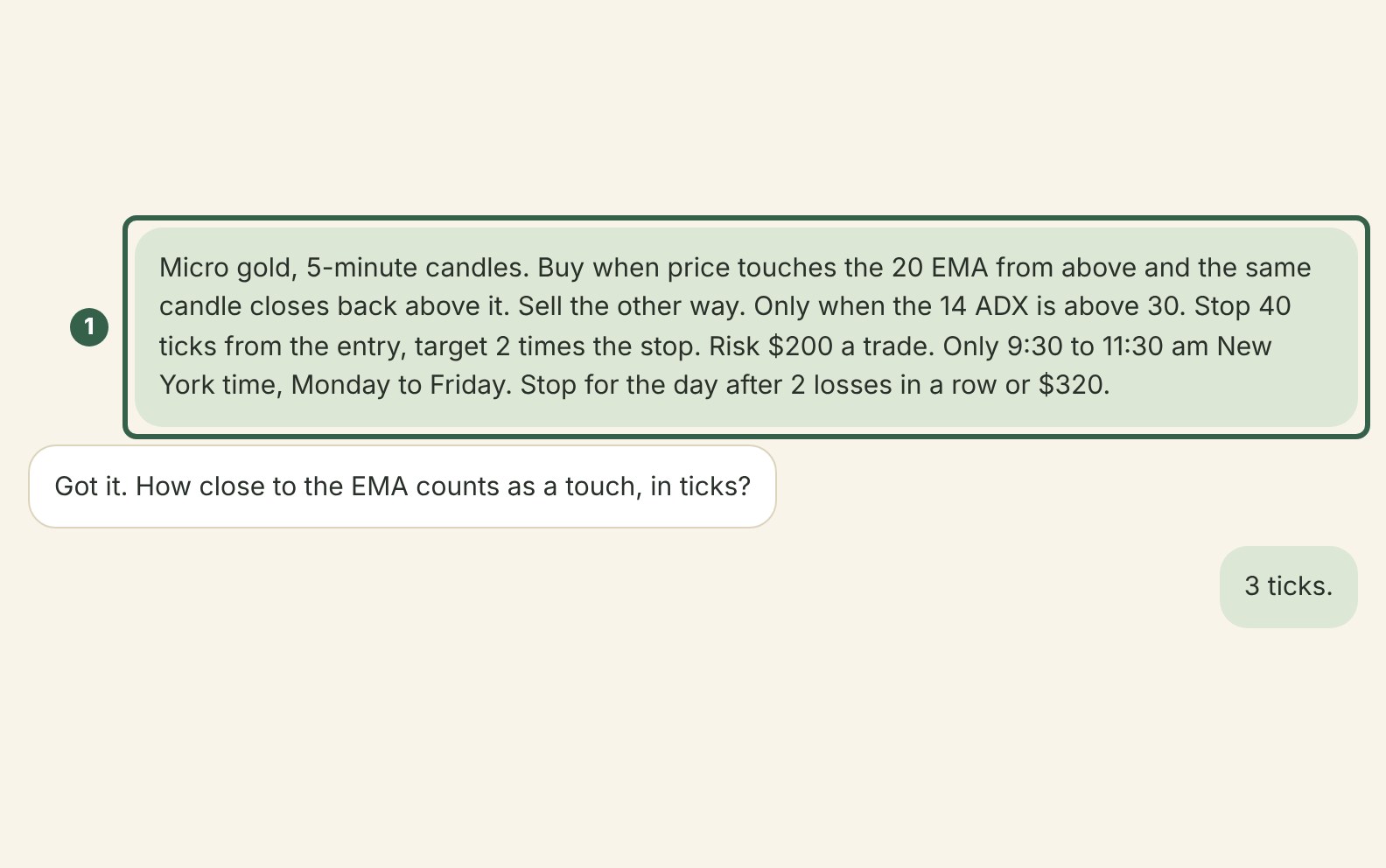
- Describe your trend setup in your own words: the signal, the trend filter and its level, your stop, target, risk and hours. Answer every question, then press Check my rules.
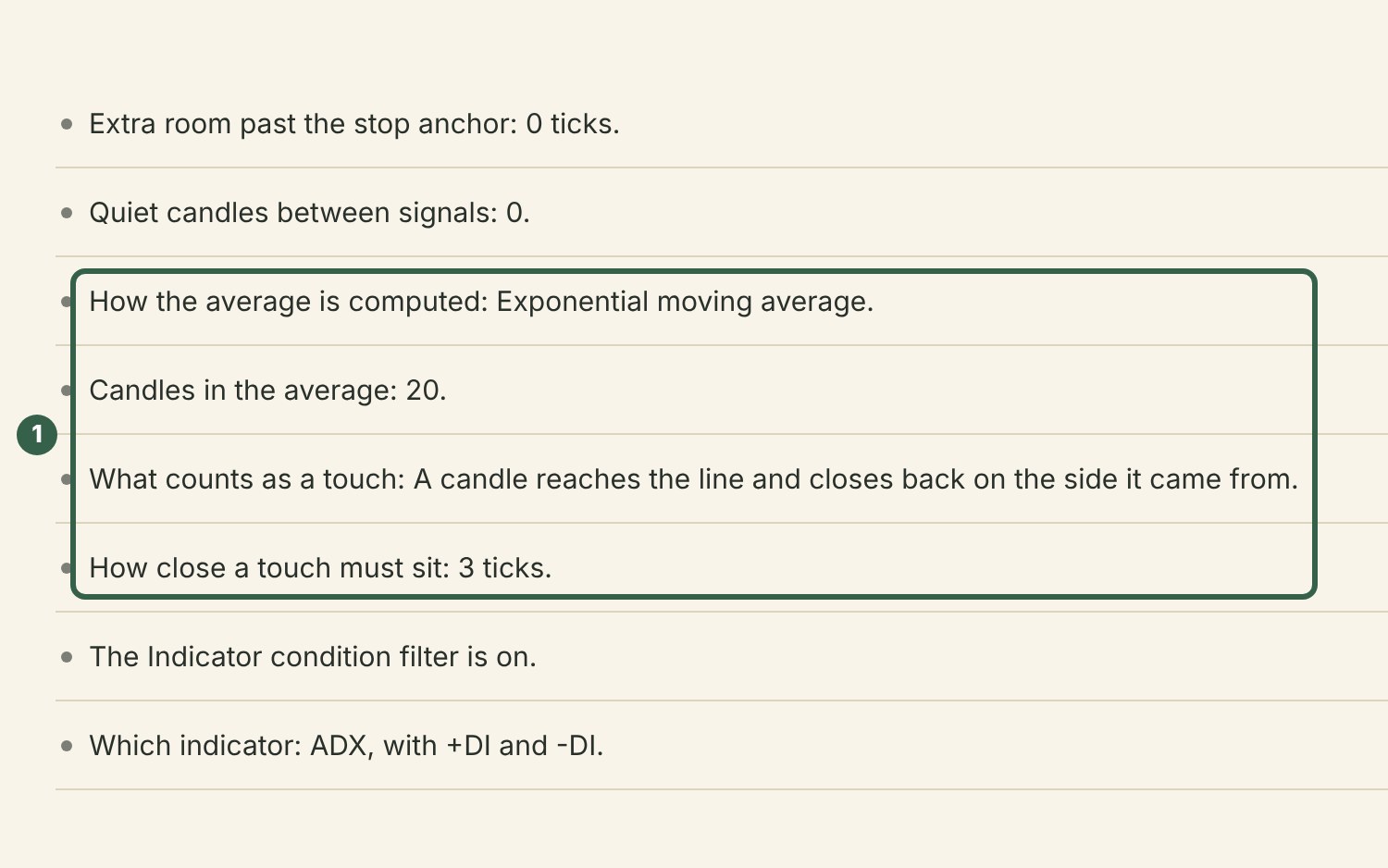
- Read the signal and filter back, and fill in lines 1, 2 and 4.
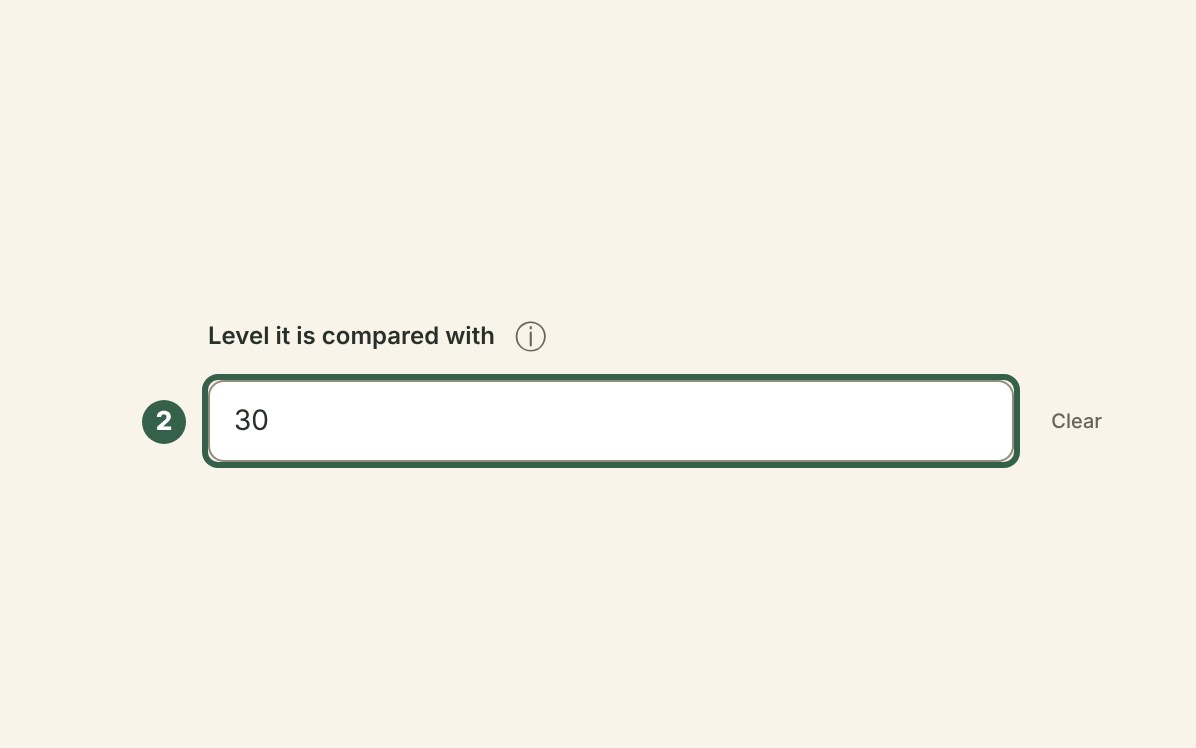
- Open your strategy in Strategies and press Change a rule. Press the Filter step and click into Level it is compared with.
- Press Help me choose, type three levels under Try a few, and press Run.
- Make the plain entry. On your strategy press Change a rule. On the Signal step press ⋯, then Change, and pick Signal at a clock time. Type 600 in Time of the signal, pick The way that candle closed. On the Filter step press ⋯, then Remove, so the plain entry has no filter. Press Save. Run it in Backtest on the Practice chart, and that's your line 5.
- Fill in lines 6 and 7. Take about $8 a trade off Try a few's profit for fees.
- Help article Describe your strategy in your own words
- Help article The indicator condition gate
- Help article The moving average touch and time window range blocks
- Help article Help me choose a setting
Quick check
1. At ADX above 30, the Holy Grail made $72 before fees on 52 trades. What about after fees?
2. Which step holds the box Sam tests in this lesson?
3. At 40, 25 trades made $416 before fees. About what is that after fees?
0 of 3 answered.
Finished this lesson?
Tick it off and keep your place
Read the full notes
The Holy Grail buys a pullback to the 20 EMA while ADX shows a strong trend, and sells the same way down. In Wildflower, open Strategies, press New strategy and describe it in your own words: the touch of the average, the ADX level, and your stop, target, risk and hours. Wildflower builds it as Price touching or bouncing off a moving average, with an Indicator condition filter. Press Check my rules, then Change a rule, open the Filter step, click into Level it is compared with and try three levels with Try a few on the free practice chart. The turtle rules and other classic trend setups are built from a signal and filters the same way.
What you're building. These lessons share one goal: a setup card for every setup you trade: described in your own words in Wildflower, every number yours, one box tried three ways on the practice chart, and compared with a plain entry. Today you start a new card for a classic trend setup, the Holy Grail. Last lesson built a reversal; next lesson trades last week's and last month's levels.
| My setup card |
|---|
| 1. The setup: … (what price must do, and where) |
| 2. Its clock or its levels: … |
| 3. The box I test: …, tried at …, … and … |
| 4. Stop … ticks, target … times the stop, $… a trade, … to … New York |
| 5. A plain entry at 10:00 each day, same stop and target: … trades, $… after fees |
| 6. What the test showed: … trades, … won, $… after fees |
| 7. My pick, and why: … |
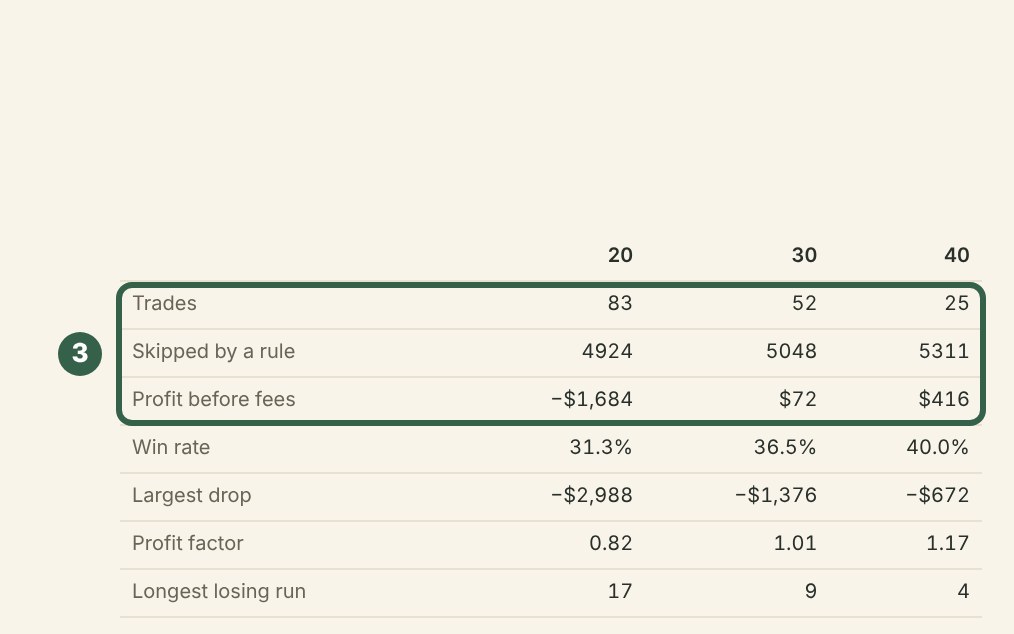
Why. Sam is made up, and so are his numbers. They're real runs of Wildflower's engine on the free practice chart's made-up prices. With ADX above 20, 83 trades lost $1,684 before fees. Above 40, 25 trades made $416. How it works: The Holy Grail pullback and Choosing an ADX level.
| Run | Trades | Won | Before fees | After fees | Largest drop |
|---|---|---|---|---|---|
| Plain 10:00 entry | 76 | 28 (36.8%) | +$728 | +$145.84 | −$2,156 |
| ADX above 20 | 83 | 26 (31.3%) | −$1,684 | −$2,319.78 | −$2,988 |
| ADX above 30 | 52 | 19 (36.5%) | +$72 | −$326.32 | −$1,376 |
| ADX above 40 | 25 | 10 (40.0%) | +$416 | +$224.50 | −$672 |
The plain entry. The first row is the same strategy with its signal changed to Signal at a clock time and the filter removed: 10:00 New York each day, the way that 5-minute candle closed, same stop, target, risk and hours. Only ADX above 40 beat it after fees, by about $80, on 25 trades.
How traders build a trend setup. We can't tell you which to choose. These are the common choices. The Holy Grail, a pullback to the 20 EMA while ADX is above 30. The turtle rules, a 20 or 55-candle breakout (The turtle trading rules). Or momentum and the triple screen, a signal with a filter on a bigger timeframe. A filter reads the same for buys and sells, so a rule that only buys in an uptrend needs a buys-only strategy and a sells-only one.
Worked example
Made-up numbersSam's Holy Grail card
Sam is made up. $20,000 account, micro gold at $1 a tick for each contract, $200 a trade with a 40-tick stop, 4 contracts.
- Line 1: a touch of the 20 EMA within 3 ticks that closes back, only when the 14 ADX on 5-minute candles is above a level.
- Line 3: Level it is compared with, tried at 20, 30 and 40.
- Line 6: at 40, 25 trades and 10 won. $416 before fees, minus about $8 × 25 = $192 in fees, is $225 after.
Line 7 is Sam's own pick. He writes that 40 only just beat the plain entry, on 25 trades, so he'll test more days first. Made-up prices, an example, not advice.
Trading is risky. You can lose money. This lesson shows how Wildflower works. It isn't advice.