
Build a trade at Gann, Murrey Math or extension levels
Wildflower Trading School · Lesson 3.2.29.23

In the levels course you met Gann square of 9 levels and Murrey Math lines, and in the strategy library the initial balance and its extensions. In Wildflower, all three are now levels in Signal at a level. By the end of this class you'll know how each is drawn, and you'll have built one with every box filled in.
1 of 7
What you'll learn
- Pick the levels. Gann, Murrey Math or a range's extensions.
- Pick what price does. Bounce, sweep, break or retest.
- Fill in the one number each reads. Degrees, candles or share.
- Compare versions. Change one box at a time.
Exercise
- Open Studio and open a strategy of your own, or start a new one.
- Choose + Add setup, pick Signal at a level and set Minutes per candle to the candles you watch.
- Set Which levels to use to Gann square of 9 levels from yesterday's close, and type Degrees between Gann levels.
- Pick what price does at the level, fill in the box it asks for, and save.
- Run it in Backtest on the Practice chart. Then save a version with Murrey Math lines or the extension lines and run it too.
- Write down the trades, largest drop and longest losing run for each.
- Help article The signal at a level
- Help article Help me choose a setting
Quick check
1. Where do the Gann levels start from?
2. What does the Murrey Math candles box set?
3. The initial balance runs 5,000 to 5,010. Where's the upper line at a share of 0.5?
0 of 3 answered.
Finished this lesson?
Tick it off and keep your place
Read the full notes
Signal at a level can draw Gann square of 9 levels from yesterday's close, Murrey Math lines on the candles you type, and extension lines beyond a time window's range, such as the initial balance. Then a bounce, sweep, break or retest at one is the signal.
Signal at a level has three more kinds of level: Gann square of 9 levels from yesterday's close, Murrey Math lines and extension lines beyond a time window's range. The ideas are in Gann square of 9 levels, Murrey Math lines and Common rules and variations for the initial balance.
- Gann square of 9. From yesterday's close: its square root, plus and minus the step for the degrees you pick, squared again. Eight levels each side. 180 degrees adds 1 to the root, 90 a half, 45 a quarter, 360 two.
- Murrey Math lines. Thirteen lines, −2/8 to +2/8, framed on the high and low of the number of candles you type before this one, by the published rule. When the frame changes, the lines move.
- Extension lines. A time window's range, such as the initial balance from 9:30 to 10:30 New York, then two lines the share you type of its height above its high and below its low. They're read once the window has ended.
- What price does. A bounce, a sweep, a break or a retest, the same as every level. When several levels answer on one candle, the nearest to the close is taken.
- The target. The extension lines come as a pair, so a bounce or a sweep can target the other line or the middle.
One rule everywhere. Each runs the same in Backtest, on your strategy's chart and in the Bot, and the script you copy to a platform draws the same lines.
More in the help articles The signal at a level and Help me choose a setting.
Worked example
Made-up numbersSam's Gann trade, in numbers
These are made-up Micro S&P 500 prices, where one tick is 0.25, worth $1.25 a contract. Yesterday closed at 4,900, so the first 90-degree level above is 4,970.25.
- A candle trades up to 4,970.50 and closes at 4,966.75, back below the level. It's a sell at 4,966.75.
- The stop is the candle's high, 4,970.50. That's 15 ticks, $18.75 a contract.
- His 2x target is 30 ticks away, at 4,959.25, $37.50 a contract. All before fees.
A sell from 4,966.75 with $18.75 at risk against $37.50. Numbers made up to show the sums.
Every box, filled in by Sam
Sam is made up. These are Sam's numbers. Choose your own.
| Box | Sam's choice | Why |
|---|---|---|
| Widest stop allowed | 60 ticks | He won't trade a stop wider than 15 points |
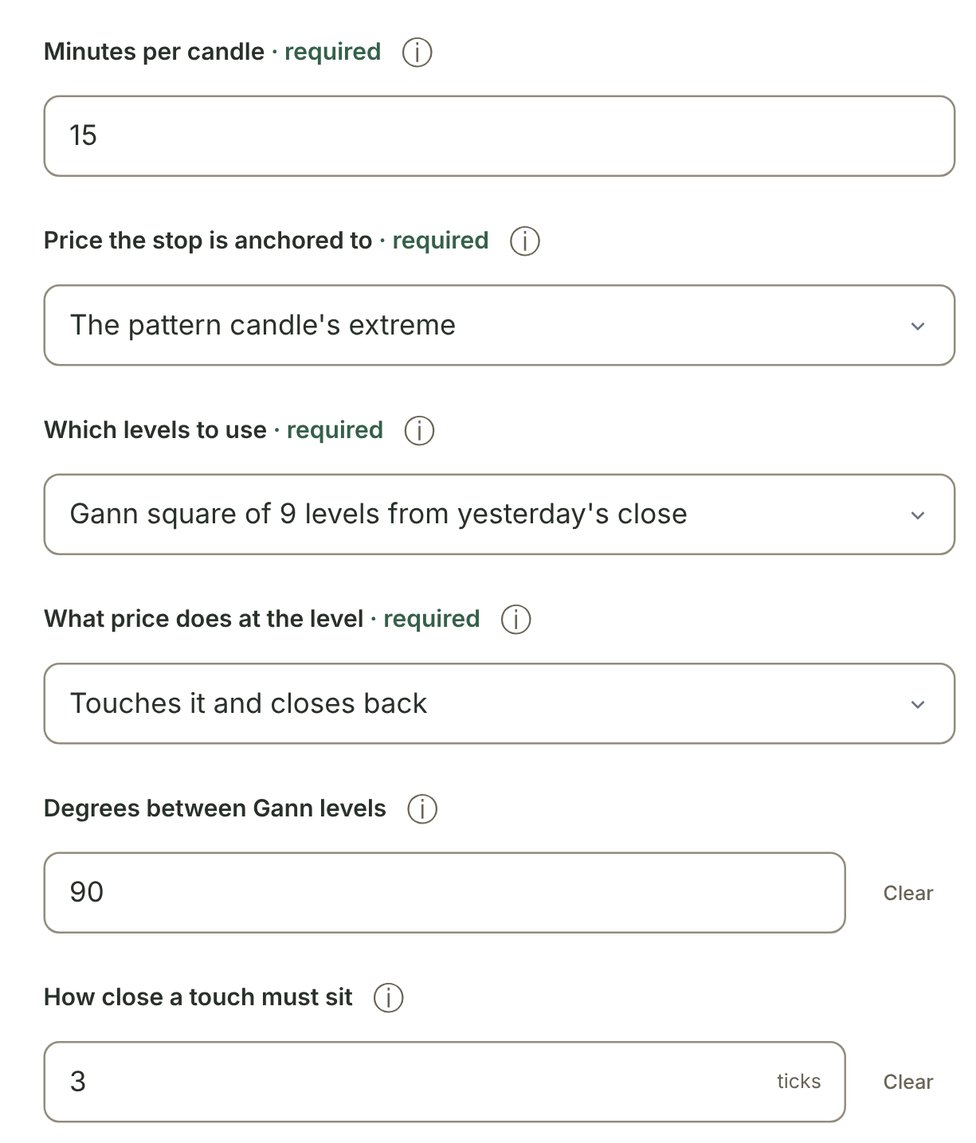
| Minutes per candle | 15 | The candles he watches for the signal |
| Buy, sell or both | Both sides | Levels above sell, levels below buy |
| Price the stop is anchored to | The pattern candle's extreme | The high or low of the candle that touched |
| Which levels to use | Gann square of 9 levels from yesterday's close | The idea he's testing |
| What price does at the level | Touches it and closes back | A turn at the level |
| Degrees between Gann levels | 90 | A half on the square root |
| How close a touch must sit | 3 ticks | Near enough to count |
How to choose your own
- Write the rule in words first, from the lessons. Which levels, what price must do, and where the stop goes.
- Save each change as its own version, such as 90 degrees and 45, and run them in Backtest on the practice chart.
- Compare the trades, the largest drop and the longest losing run, and read the drop and the run first.
Trading is risky. You can lose money. This lesson shows how Wildflower works. It isn't advice.