
Try a few values for a pattern's numbers
Wildflower Trading School · Lesson 2.3.6.5 · This exercise is free

This is the fifth of eight lessons towards your own chart pattern strategy. Today is line four of your rule: the numbers behind the book's words.
1 of 8
What you'll learn
- Write line 4. Your shape's numbers, like how far a flat line may move.
- Flat and near are numbers you choose. Sam's 10 ticks is 1 point of gold.
- Measure on your own chart before you type a number.
- Set each box under Which chart pattern on the Chart pattern step.
- Try three values with Try a few. Nothing is saved until you change the box.
Exercise
- Write line 4 of your chart pattern rule.
- Open your strategy in Strategies, press Change a rule, then the Chart pattern step.
- Set your shape's numbers under Which chart pattern, then press Save if you changed them.
- Click into one box, press Help me choose, type three values under Try a few, and press Run.
- Help article Chart patterns and harmonic patterns
- Help article Help me choose a setting
Quick check
1. Micro gold moves in ticks of 0.1. How many points is 10 ticks?
2. Sam loosens Flat line moves at most from 10 to 20 ticks. What happened on the practice chart?
3. Where are a chart pattern's own numbers?
0 of 3 answered.
Finished this lesson?
Tick it off and keep your place
Read the full notes
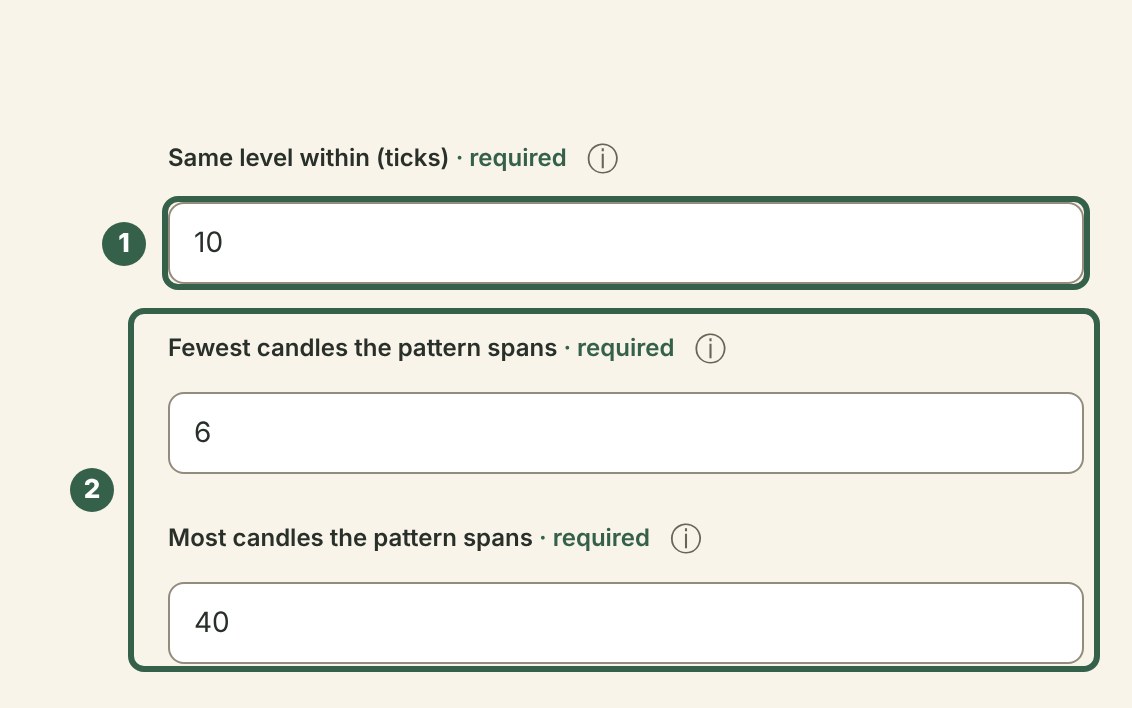
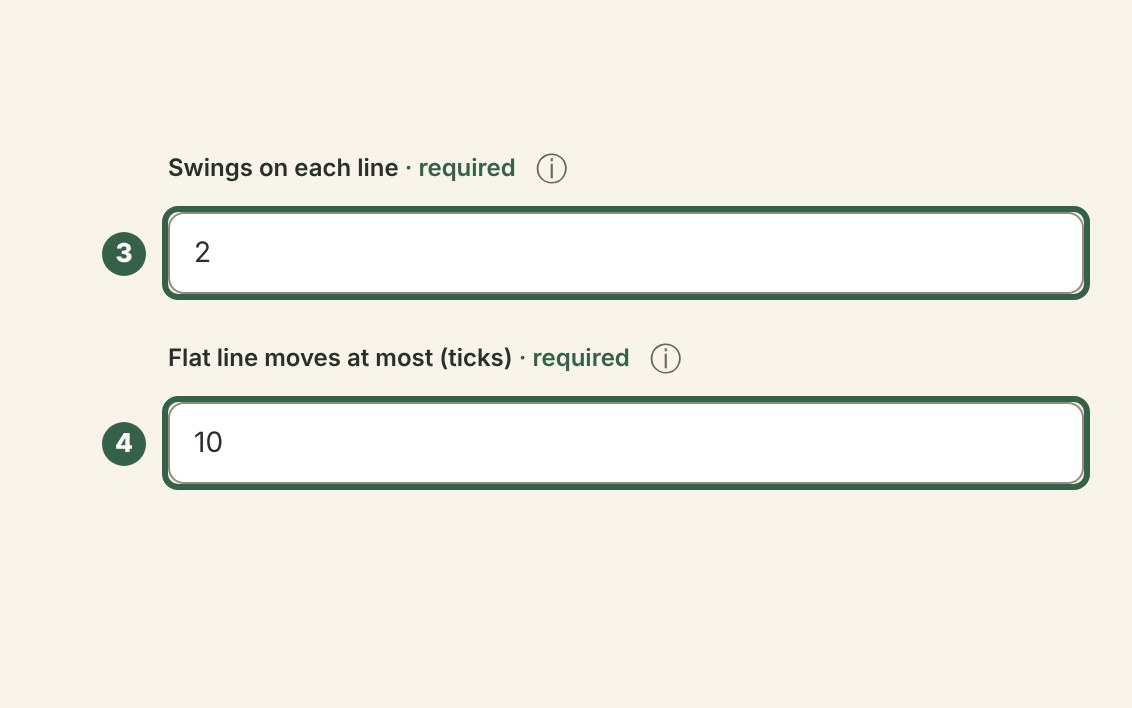
Books describe chart patterns in words like flat, near and a few weeks. Wildflower needs numbers, so you choose them. In Wildflower, press Change a rule, open the Chart pattern step, and set the boxes under Which chart pattern: how near counts as the same level, the fewest and most candles, the swings on each line, and how far a flat line may move. Help me choose under a box shows Sam's example and opens Try a few, which runs three values on the free practice chart without saving anything.
What you're building. The fifth of eight lessons towards your own chart pattern strategy. Last lesson was line 5. Today is line 4. Next lesson checks it all, trade by trade.
| My chart pattern rule |
|---|
| 1. The shape: … (top, bottom, or both) |
| 2. A break or a bounce: … |
| 3. Swings: … candles each side, the break within … candles |
| 4. Its numbers: flat … ticks, same level … ticks, … to … candles |
| 5. Harmonics only: each ratio's smallest … and largest … |
| 6. Stop … ticks, target … times, $… a trade, …-minute candles, … to … New York |
| 7. Checked: … trades gone through, and on my platform: … |
Why. Sam is made up, and so are his numbers. Flat and near are numbers you choose. Sam's 10 ticks is 1 point of micro gold. Measure on your own chart before you type. The same steps for a candle pattern: Find a pattern's numbers with Try a few.
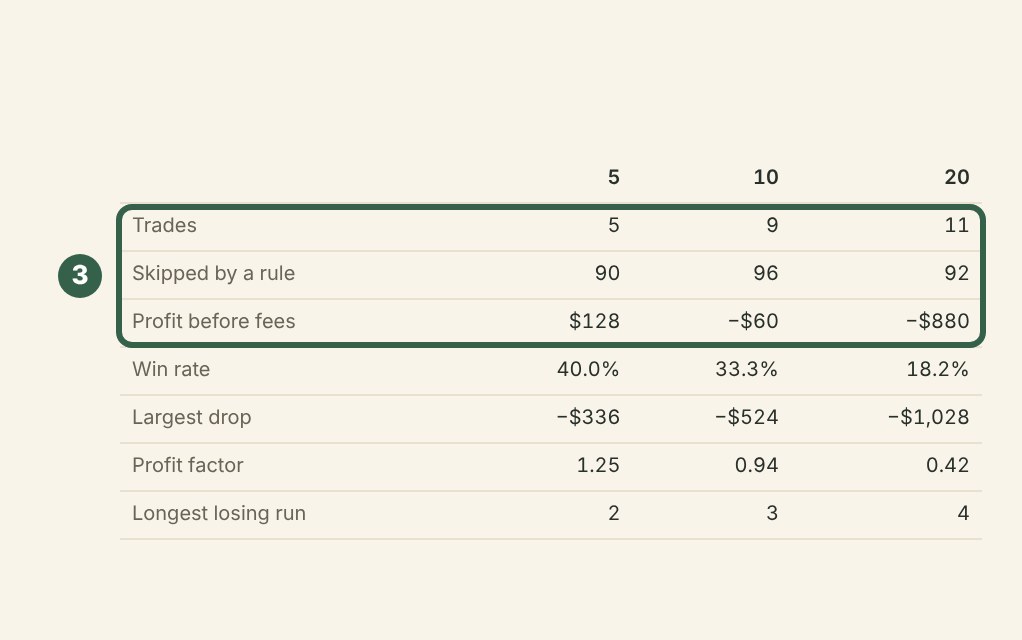
| Flat line moves at most (ticks) | 5 | 10 | 20 |
|---|---|---|---|
| Trades | 5 | 9 | 11 |
| Profit before fees | $128 | −$60 | −$880 |
How traders pick these numbers. We can't tell you which to choose. These are the common choices. Measured off their own charts. The book's word as a small number. Or wider for a fast market.
Worked example
Made-up numbersIs this top flat to Sam?
Sam is made up. Micro gold moves in ticks of 0.1. A triangle's two highs are at 1,812.0 and 1,812.7.
- The difference is 0.7, which is 7 ticks.
- Same level within 10 ticks: 7 is inside, so the two highs are one level.
- Flat line moves at most 10 ticks: the top moved 7, so it's flat.
Flat to Sam. With 5 ticks, it wouldn't be, and this triangle wouldn't count.
Trading is risky. You can lose money. This lesson shows how Wildflower works. It isn't advice.