
Set a harmonic pattern's ratio bands
Wildflower Trading School · Lesson 2.3.6.4 · This exercise is free

This is the fourth of eight lessons towards your own chart pattern strategy. Today is line five of your rule, for harmonic patterns: the band you allow for each ratio. If your shape isn't a harmonic, write none on line five, and watch how bands work anyway.
1 of 10
What you'll learn
- Write line 5 if your shape is a harmonic. Each ratio's smallest and largest.
- The ratios are the pattern, so the bands decide what counts.
- A wide band finds more shapes, and more rough ones.
- Each ratio has two boxes on the Harmonic pattern step, smallest and largest.
- Try three values with Try a few and read the trade count first.
Exercise
- Write line 5 of your chart pattern rule, or none if your shape isn't a harmonic.
- Describe a harmonic strategy in words from Strategies, or press Change a rule on one you have and open its Harmonic pattern step.
- Set each ratio's smallest and largest, then press Save if you changed them.
- Click into one box, press Help me choose, type three values under Try a few, and press Run.
- Help article Chart patterns and harmonic patterns
- Help article Help me choose a setting
Quick check
1. Sam lowers CD / AB: smallest from 0.9 to 0.8. What usually happens?
2. Sam describes a second strategy in words with no paid plan. What does it use?
3. AB is 40 ticks and CD is 44 ticks. What is CD / AB?
0 of 3 answered.
Finished this lesson?
Tick it off and keep your place
Read the full notes
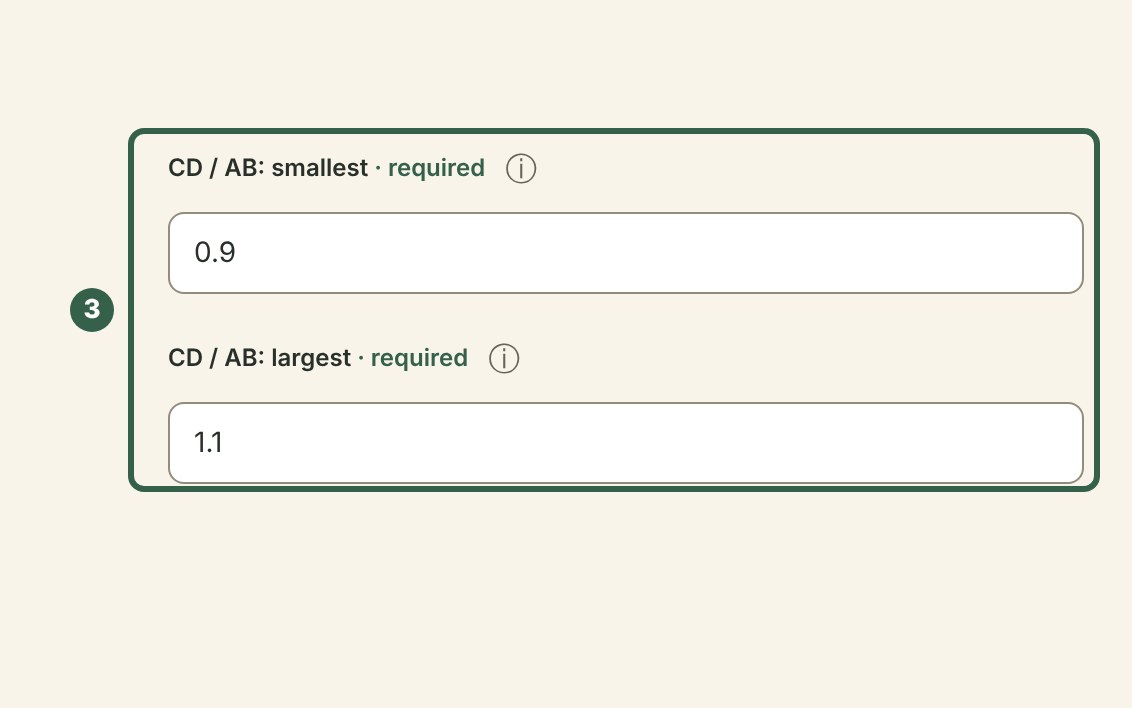
A harmonic pattern is its ratios: each leg as a share of another. So the bands you type for each ratio decide what counts as the pattern. A wide band finds more shapes, and more rough ones. In Wildflower, describe a harmonic strategy in your own words, or press Change a rule and open its Harmonic pattern step. Each ratio has a smallest and a largest box. Help me choose under a box opens Try a few, which runs three values on the free practice chart without saving anything.
What you're building. The fourth of eight lessons towards your own chart pattern strategy. Last lesson was line 3. Today is line 5, for harmonic patterns. Not trading a harmonic? Write none. Next lesson is line 4.
| My chart pattern rule |
|---|
| 1. The shape: … (top, bottom, or both) |
| 2. A break or a bounce: … |
| 3. Swings: … candles each side, the break within … candles |
| 4. Its numbers: flat … ticks, same level … ticks, … to … candles |
| 5. Harmonics only: each ratio's smallest … and largest … |
| 6. Stop … ticks, target … times, $… a trade, …-minute candles, … to … New York |
| 7. Checked: … trades gone through, and on my platform: … |
Why. Sam is made up, and so are his numbers. A harmonic pattern is its ratios, so the bands decide what counts. The same bands give the same shapes whatever the pattern is called. More in Harmonic patterns: the idea, AB=CD and Testing harmonic patterns honestly.
| Ratio | Smallest | Largest |
|---|---|---|
| BC / AB | 0.38 | 0.89 |
| CD / BC | 1.27 | 1.62 |
| CD / AB | 0.9 | 1.1 |
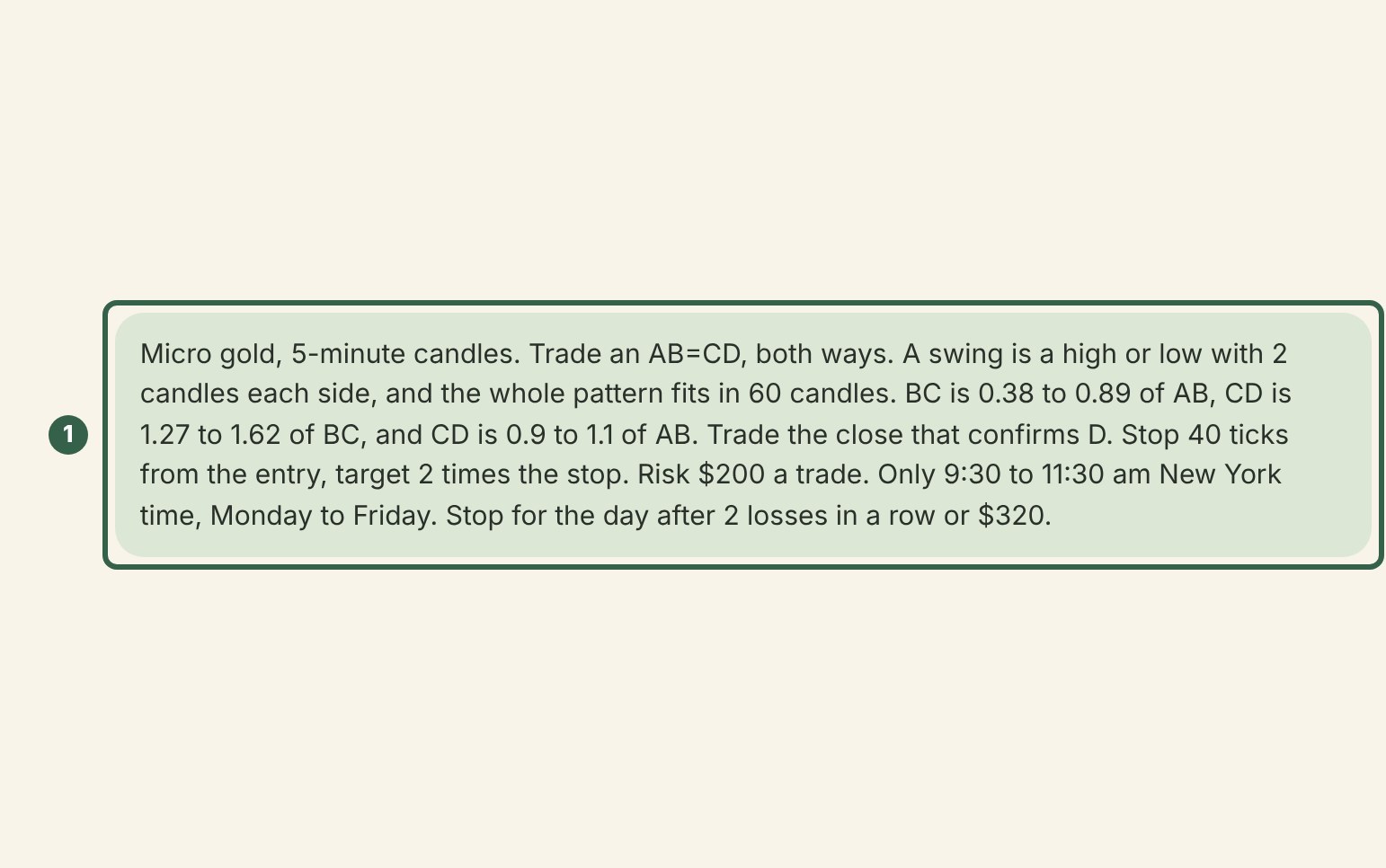
A second strategy. Sam describes Sam's gold AB=CD as a new strategy. With no paid plan, that uses one of the 3 free descriptions a month. Changing a strategy later never counts.
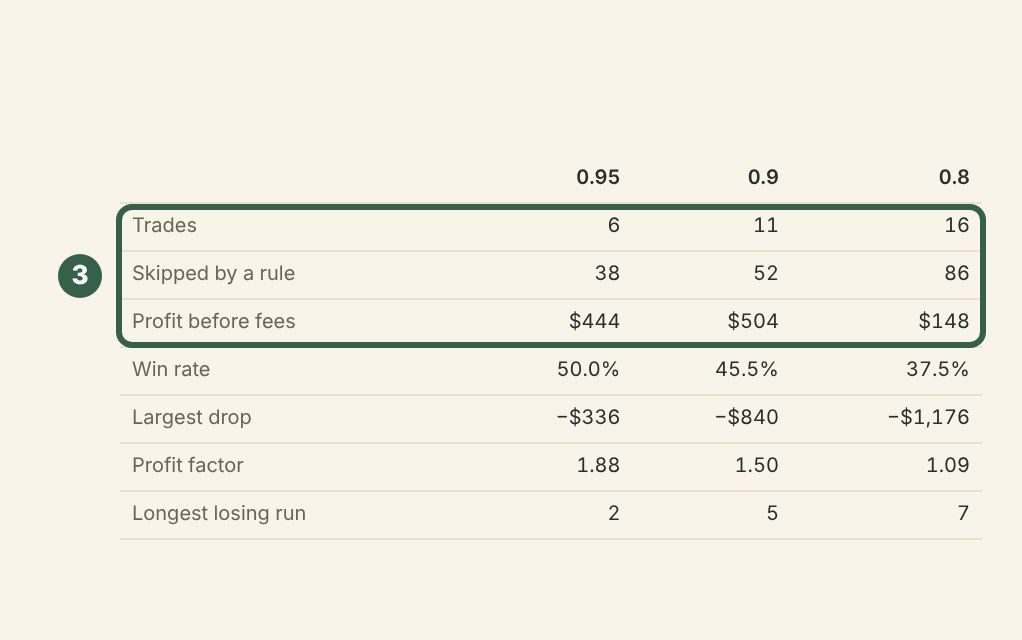
| CD / AB: smallest | 0.95 | 0.9 | 0.8 |
|---|---|---|---|
| Trades | 6 | 11 | 16 |
| Profit before fees | $444 | $504 | $148 |
How traders set the bands. We can't tell you which to choose. These are the common choices. The book's ratios as written. A little room around each one. Or the ratio the shape is named for held tight, and the others loose.
Worked example
Made-up numbersDoes this AB=CD count?
Sam is made up. AB is 40 ticks, BC is 20 ticks, CD is 34 ticks.
- BC / AB = 20 ÷ 40 = 0.5. Inside 0.38 to 0.89.
- CD / BC = 34 ÷ 20 = 1.7. Above 1.62, so outside.
- CD / AB = 34 ÷ 40 = 0.85. Below 0.9, so outside too.
Not Sam's AB=CD. With CD / AB from 0.8 and CD / BC up to 1.75, it would be. That's what a wider band lets in.
Trading is risky. You can lose money. This lesson shows how Wildflower works. It isn't advice.