
Swing width, and why the signal comes late
Wildflower Trading School · Lesson 2.3.6.3 · This exercise is free

This is the third of eight lessons towards your own chart pattern strategy. Today is line three of your rule: how wide a swing is, and how soon the break must come.
1 of 8
What you'll learn
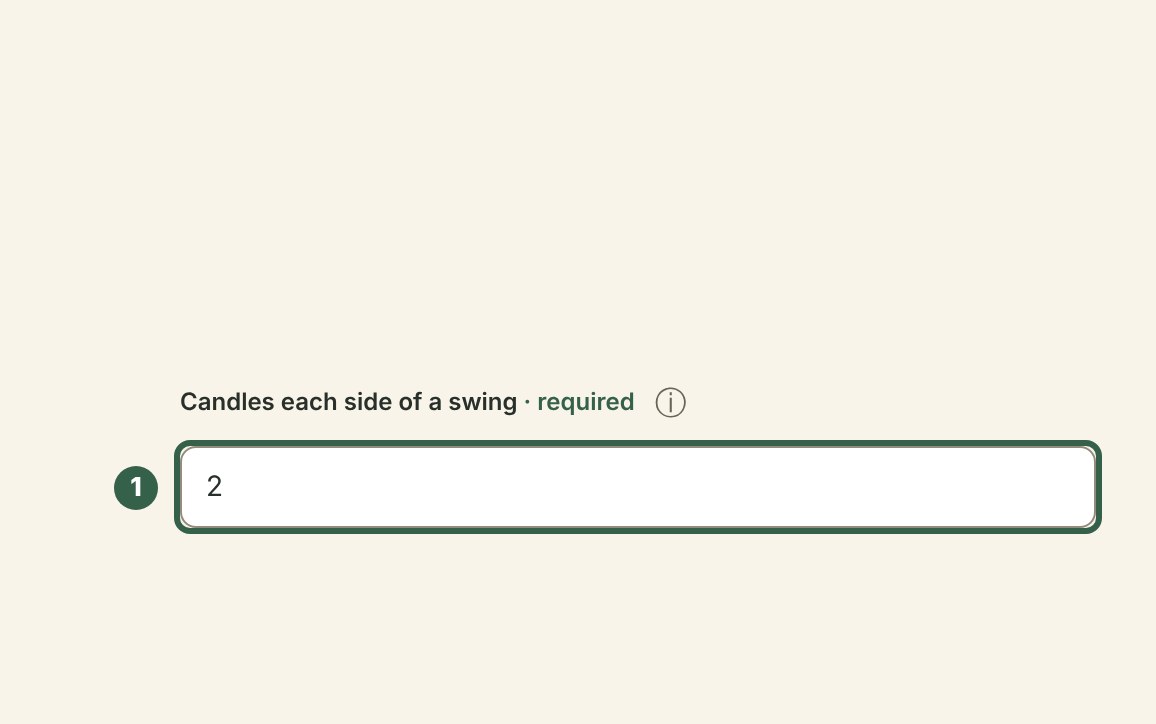
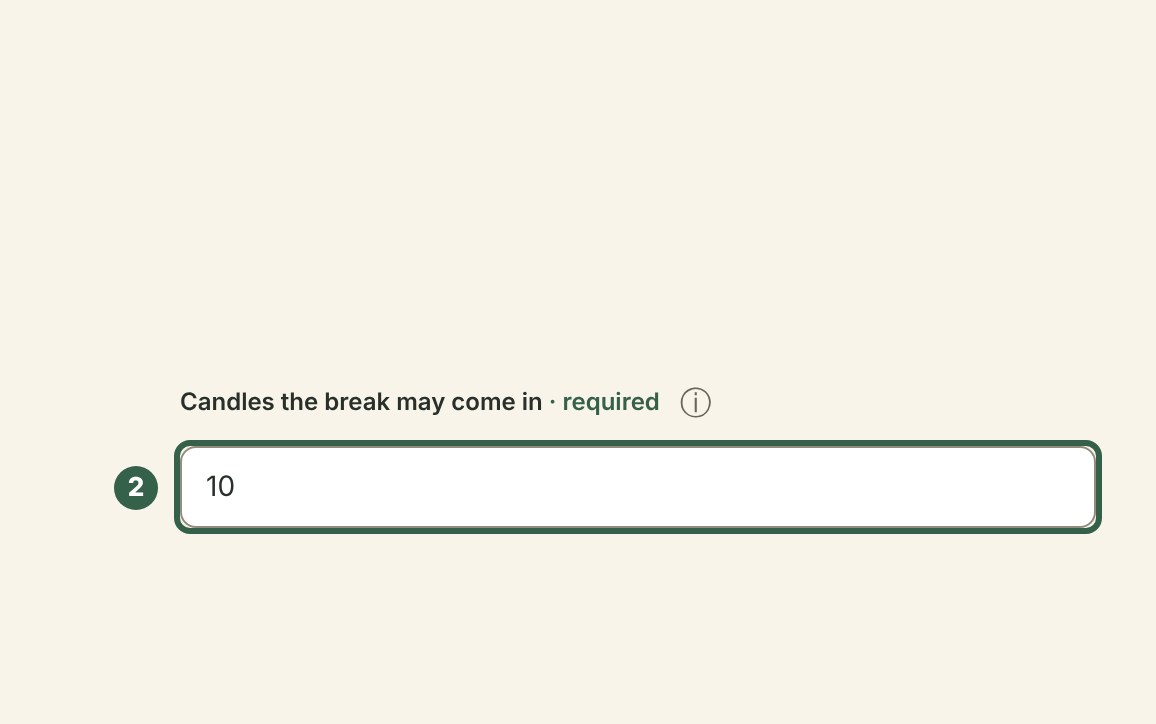
- Write line 3. Candles each side of a swing, and how soon the break must come.
- A swing is known only after the candles beside it close.
- Sam's 2 candles each side on 5-minute candles means each swing is known 10 minutes late.
- Wider swings find bigger, rarer shapes. Sam's went from 9 trades to 2.
- Set both boxes on the Chart pattern step, and try three widths with Try a few.
Exercise
- Write line 3 of your chart pattern rule.
- Open your strategy in Strategies, press Change a rule, then the Chart pattern step.
- Set Candles each side of a swing and Candles the break may come in, then press Save if you changed them.
- Click into the swing box, press Help me choose, type three widths under Try a few, and press Run.
- Help article Chart patterns and harmonic patterns
- Help article Help me choose a setting
Quick check
1. Sam uses 2 candles each side on 5-minute candles. How long after a swing low is it known?
2. Sam raises Candles each side of a swing from 2 to 5. What usually happens?
3. When is a pattern dropped?
0 of 3 answered.
Finished this lesson?
Tick it off and keep your place
Read the full notes
A chart pattern is drawn from swings, and a swing is only known once the candles after it have closed. With 2 candles each side on 5-minute candles, a swing low is known 10 minutes after it. So a pattern's signal always comes a little after the shape looks done. In Wildflower, press Change a rule, open the Chart pattern step, and set Candles each side of a swing and Candles the break may come in. Try a few runs three swing widths on the free practice chart, and wider swings find bigger, rarer shapes.
What you're building. The third of eight lessons towards your own chart pattern strategy. Last lesson was line 2. Today is line 3. Next lesson is line 5, for harmonic patterns.
| My chart pattern rule |
|---|
| 1. The shape: … (top, bottom, or both) |
| 2. A break or a bounce: … |
| 3. Swings: … candles each side, the break within … candles |
| 4. Its numbers: flat … ticks, same level … ticks, … to … candles |
| 5. Harmonics only: each ratio's smallest … and largest … |
| 6. Stop … ticks, target … times, $… a trade, …-minute candles, … to … New York |
| 7. Checked: … trades gone through, and on my platform: … |
Why. Sam is made up, and so are his numbers. Every line in a pattern joins swings, and a swing is known only when the candles after it close. With 2 candles each side on 5-minute candles, that's 10 minutes after the swing. More in Swing points, fractals and ZigZag and Drawing patterns without cheating.
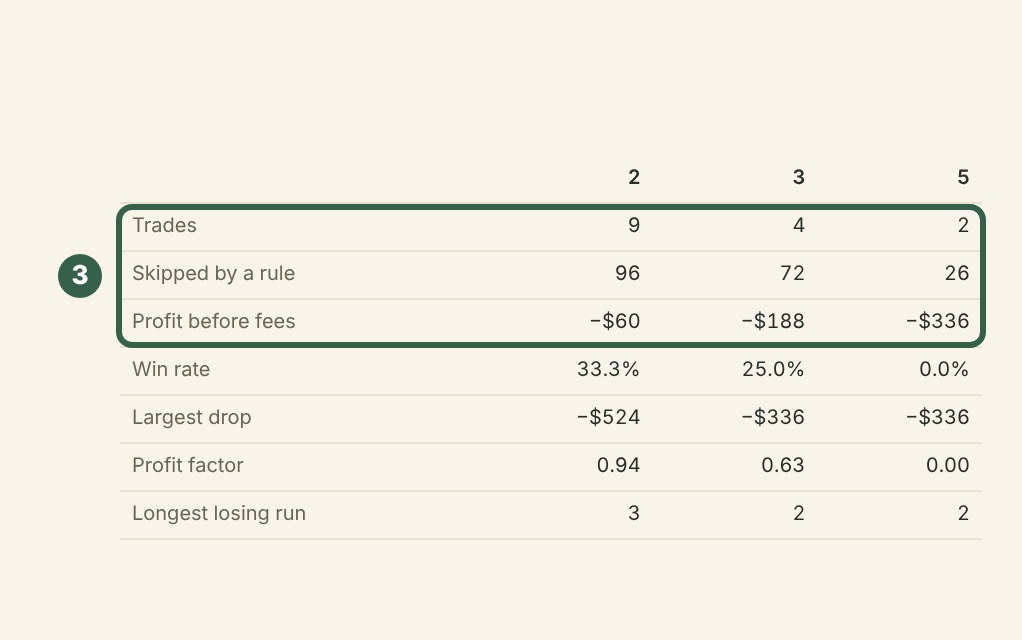
| Candles each side of a swing | 2 | 3 | 5 |
|---|---|---|---|
| Trades | 9 | 4 | 2 |
| Profit before fees | −$60 | −$188 | −$336 |
How traders pick a swing width. We can't tell you which to choose. These are the common choices. 2, for quick shapes and more of them. 3 to 5, for bigger shapes. Or matched to the candles they watch.
Worked example
Made-up numbersWhen Sam's swing low is known
Sam is made up. 5-minute candles, 2 candles each side of a swing. A low forms on the 10:00 candle.
- The 10:05 candle closes without a lower low.
- The 10:10 candle closes without a lower low. The 10:00 low is now a swing.
- That's 10 minutes after the low. With 5 candles each side, it would be 25 minutes.
Sam's swing is known at 10:10, two candles after it. Every pattern drawn from it can only signal after that.
Trading is risky. You can lose money. This lesson shows how Wildflower works. It isn't advice.