
Set what counts as a swing
Wildflower Trading School · Lesson 7.12.1.3 · This exercise is free

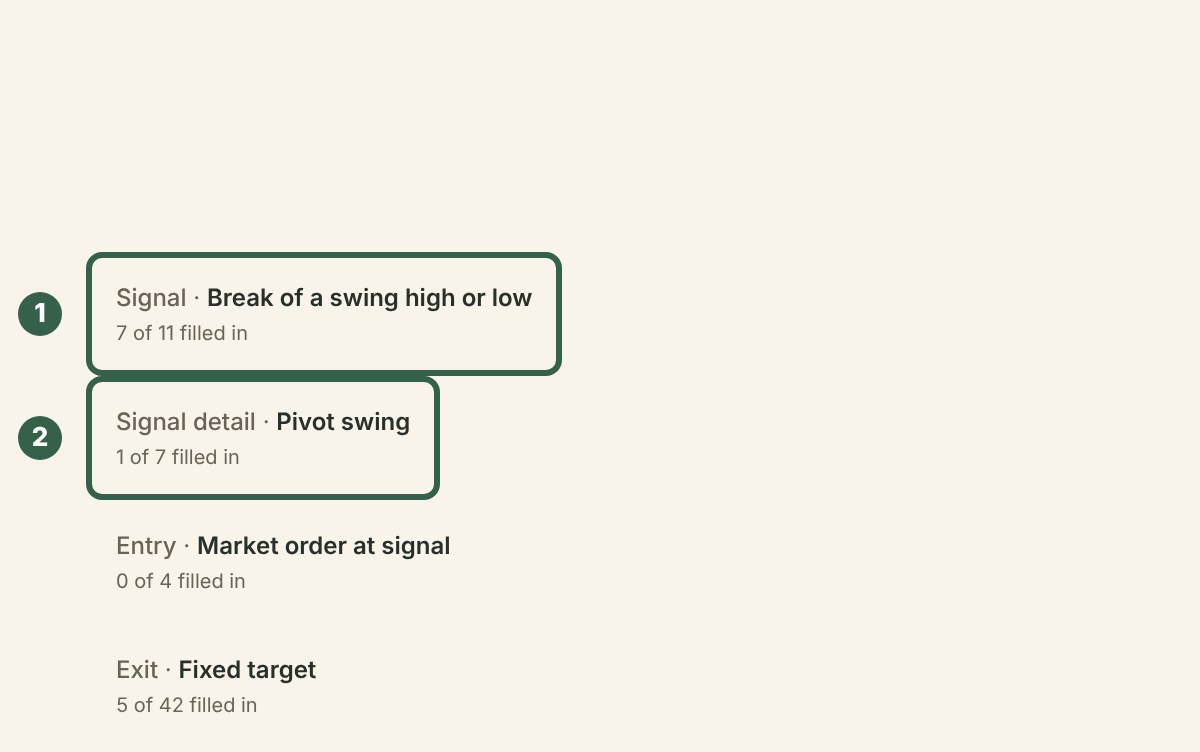
Last time you changed a box in the Signal. Today you open a Signal detail, a part of the signal you set on its own. By the end, you'll have line four of your log.
1 of 11
What you'll learn
- A Signal detail holds one part of the signal, set on its own.
- Pivot swing says what counts as a swing.
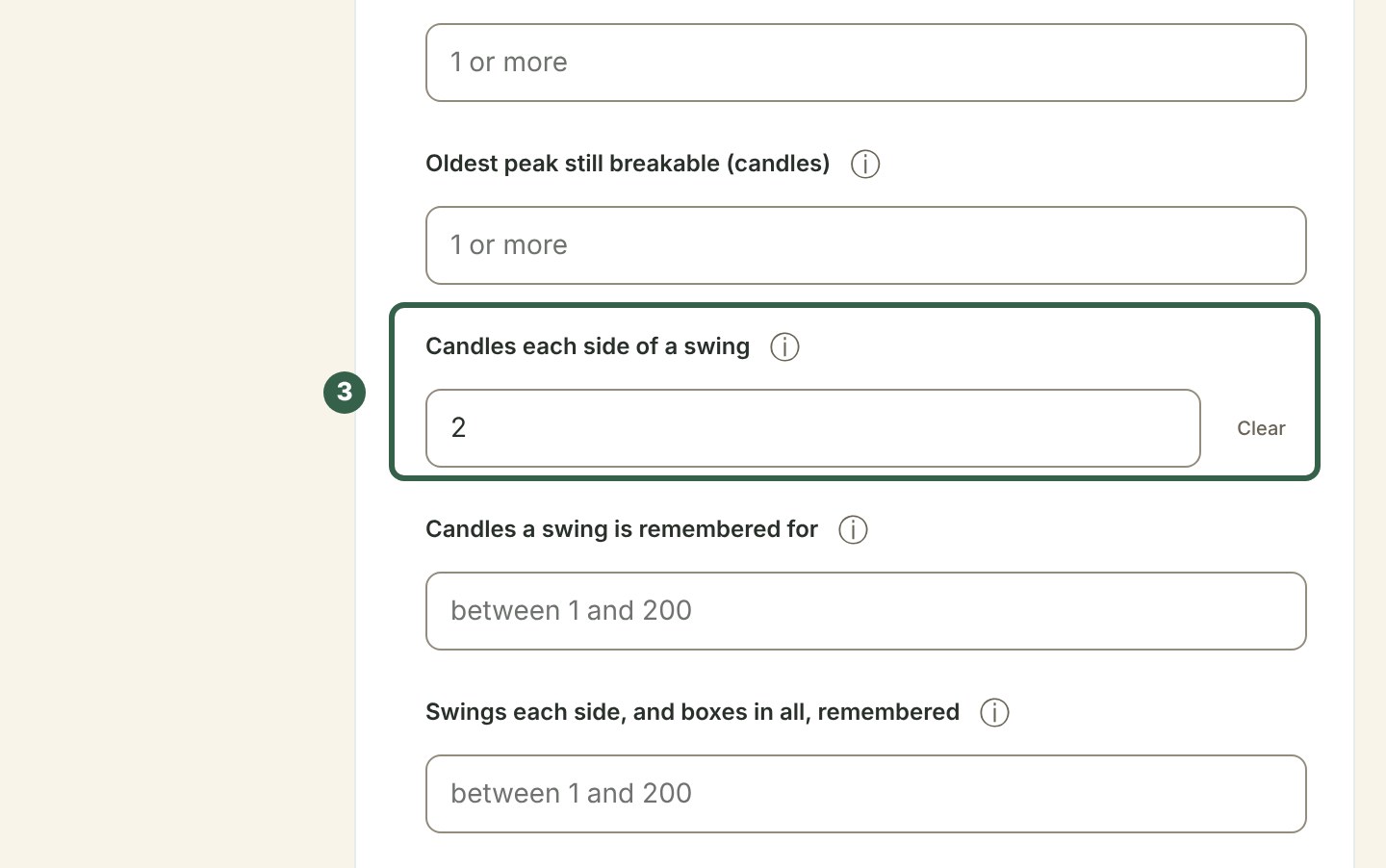
- Candles each side of a swing sets how big a swing must be.
- Try three values with Try a few.
- Distrust a result that flips between neighbouring values.
Exercise
- Open your strategy in Strategies and press Change a rule.
- Look for a Signal detail card under your Signal. No card? Press + Add a step: if Signal detail is listed, your signal has parts. If not, describe a swing break in your own words to practise.
- Click the detail, then a box such as Candles each side of a swing, then Help me choose.
- In Try a few, type 2, 3 and 5, and press Run.
- Write line 4: all three results, and whether the middle value agrees with its neighbours.
- Help article Detectors, and the parts inside them
- Help article Describe your strategy in your own words
- Help article Help me choose a setting
Quick check
1. What does Candles each side of a swing set?
2. Sam's 2 and 5 candles made money and 3 lost. What does that suggest?
3. When does + Add a step list Signal detail?
0 of 3 answered.
Finished this lesson?
Tick it off and keep your place
Read the full notes
Some signals have parts you set on their own, in a Signal detail step under the Signal. A swing break buys when a candle closes above the last swing high, and its Signal detail, Pivot swing, says what a swing is: a high above the candles on each side of it. Candles each side of a swing sets how many. A small number finds many small swings; a big number finds only the clear turns. In Wildflower, describe the strategy in words, press Change a rule, click the Signal detail card and find Candles each side of a swing. Press Help me choose and use Try a few to run three values side by side. If the value in the middle loses while both sides of it make money, the result hangs on one number.
What you're building. These six lessons share one goal: your strategy read block by block: every part of your words found in its block, and one box in each kind of block changed and tried against the strategy as you described it. Today you fill in line 4.
| My under-the-hood log |
|---|
| 1. Each part of my words, and the block it became: … |
| 2. Buys only $…, sells only $…, both $… |
| 3. Signal: … changed from … to …: $… against $… |
| 4. Signal detail: … tried at …, … and …: … |
| 5. Filter: … : $… against $… |
| 6. Exit: … : $… against $… |
| 7. Whole account: … : $… against $… |
| 8. What I keep, and why: … |
Why. Sam is made up, and so are his numbers. They're real runs of Wildflower's engine on the free practice chart's made-up prices. A swing high is a high above the candles on each side of it (Swing highs and swing lows). How many candles you ask for decides which turns count.
| Candles each side | Trades | Won | Before fees | After fees | Largest drop |
|---|---|---|---|---|---|
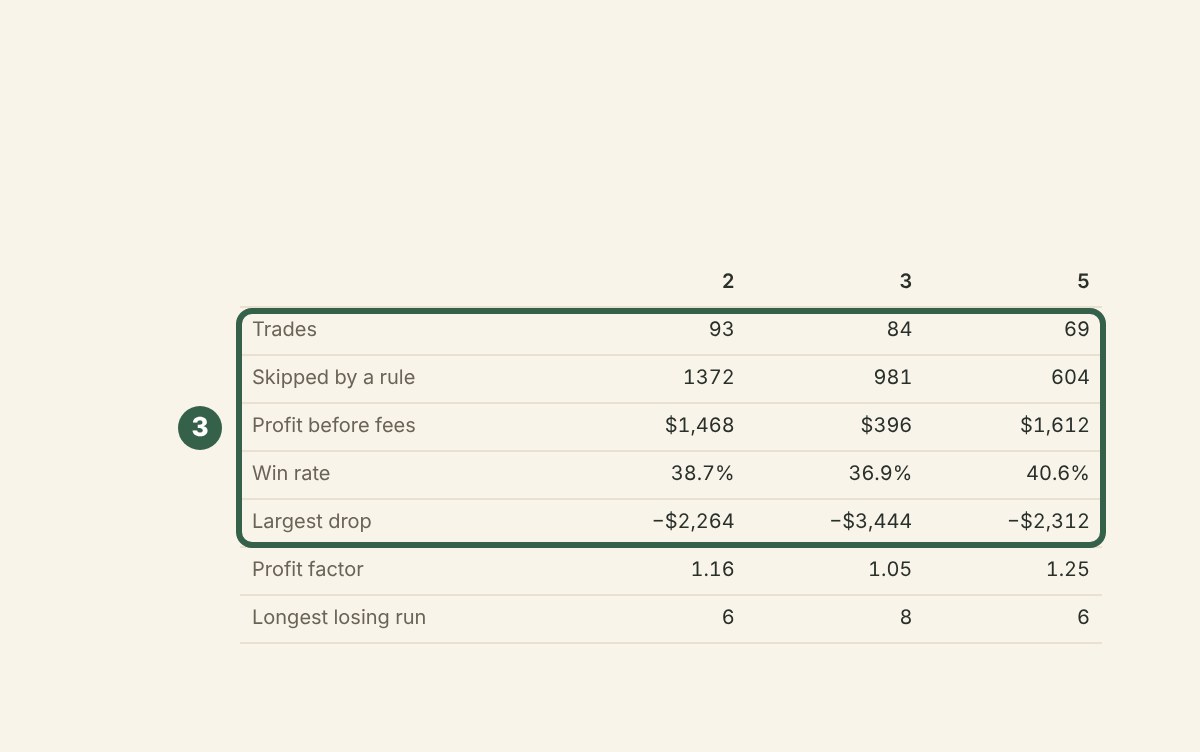
| 2, as he wrote it | 93 | 38.7% | +$1,468 | +$724 | −$2,264 |
| 3 | 84 | 36.9% | +$396 | −$276 | −$3,444 |
| 5 | 69 | 40.6% | +$1,612 | +$1,060 | −$2,312 |
- Signal detail is one part of a signal, set on its own. + Add a step lists it only when your signal has parts.
- Pivot swing marks swing highs and lows by the candles on each side. Other details mark gaps, levels or patterns, depending on the signal.
- A setting whose neighbours disagree is often fitted to the prices you tested (When a filter helps and when it overfits).
How traders read a swing setting. We can't tell you which to choose. These are the common choices. Small swings give more trades and more noise. Big swings give fewer trades on the clear turns. And a result that flips between neighbouring values is tested on held-back days before anyone trusts it (Add a filter, then test it on days you held back).
Worked example
Made-up numbersSam's line 4
Sam is made up. Sam's gold swing break, on its practice chart, 3 Feb to 26 May 2026, $2.00 a contract.
- 2 candles, as he described it: +$1,468 before fees − 93 × $8 = +$724.
- 3 candles: +$396 − 84 × $8 = −$276.
- 5 candles: +$1,612 − 69 × $8 = +$1,060.
Line 4: "Signal detail: Candles each side tried at 2, 3 and 5: +$724, −$276, +$1,060." The middle loses, so the result hangs on one number. Made-up prices, an example, not advice.
Trading is risky. You can lose money. This lesson shows how Wildflower works. It isn't advice.