
Find your words in the blocks
Wildflower Trading School · Lesson 7.12.1.1 · This exercise is free

Most people never need the blocks: they describe a strategy in words and Wildflower writes it. This course is for when you want to look under the hood. These six lessons share one goal: your strategy read block by block: every part of your words found in its block, and one box in each kind of block changed and tried against the strategy as you described it. By the end of today, you'll have lines one and two of your log.
1 of 12
What you'll learn
- Describe your strategy in words first. The blocks are written for you.
- Press Change a rule to open the blocks.
- Read Markets, Whole account, then each setup from top to bottom.
- Find each part of your words in a box.
- Try each side on its own with Buy, sell or both.
Exercise
- Start your log: copy the eight lines above onto paper or into a note.
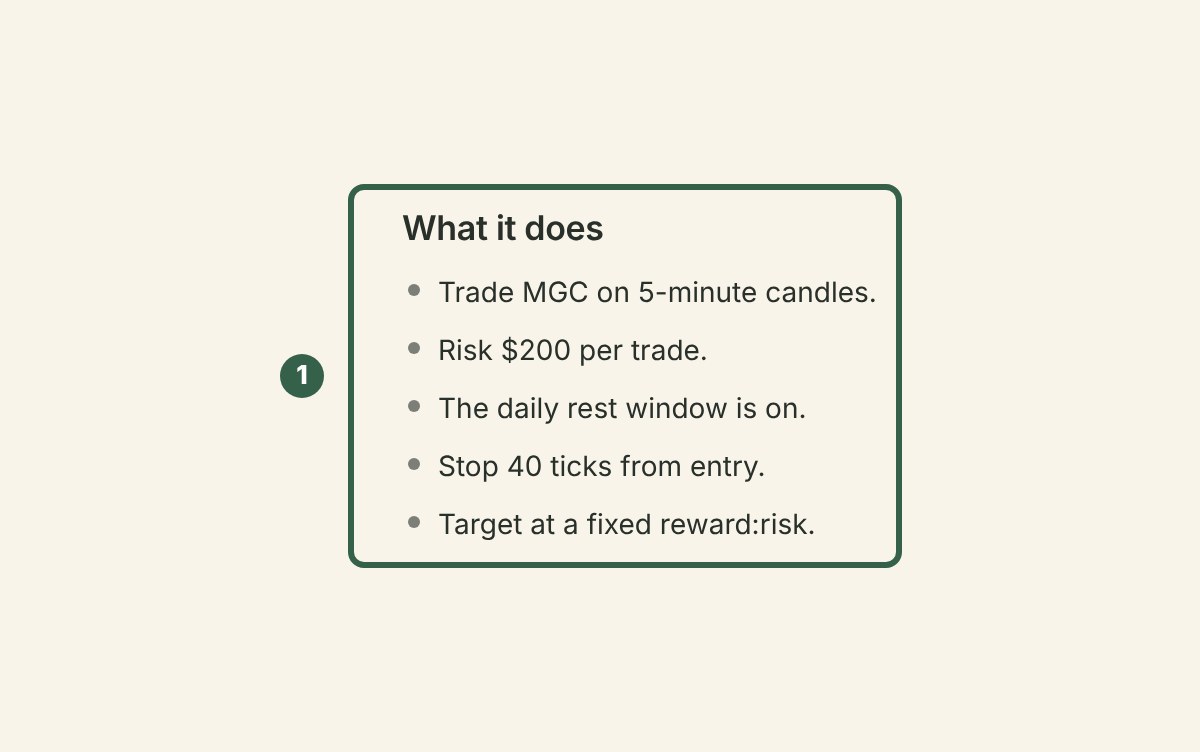
- Open your strategy in Strategies and read What it does. No strategy yet? Choose Get started and describe it in your own words.
- Press Change a rule. Find each part of your words in Markets, Whole account or Setup 1. That's line 1.
- Click your Signal card, then the box Buy, sell or both, then Help me choose.
- In Try a few, pick Both sides, Long entries only and Short entries only, and press Run. Write each profit in line 2.
- Help article Describe your strategy in your own words
- Help article The block builder
- Help article Help me choose a setting
Quick check
1. Which block holds Sam's "only the first breakout each day"?
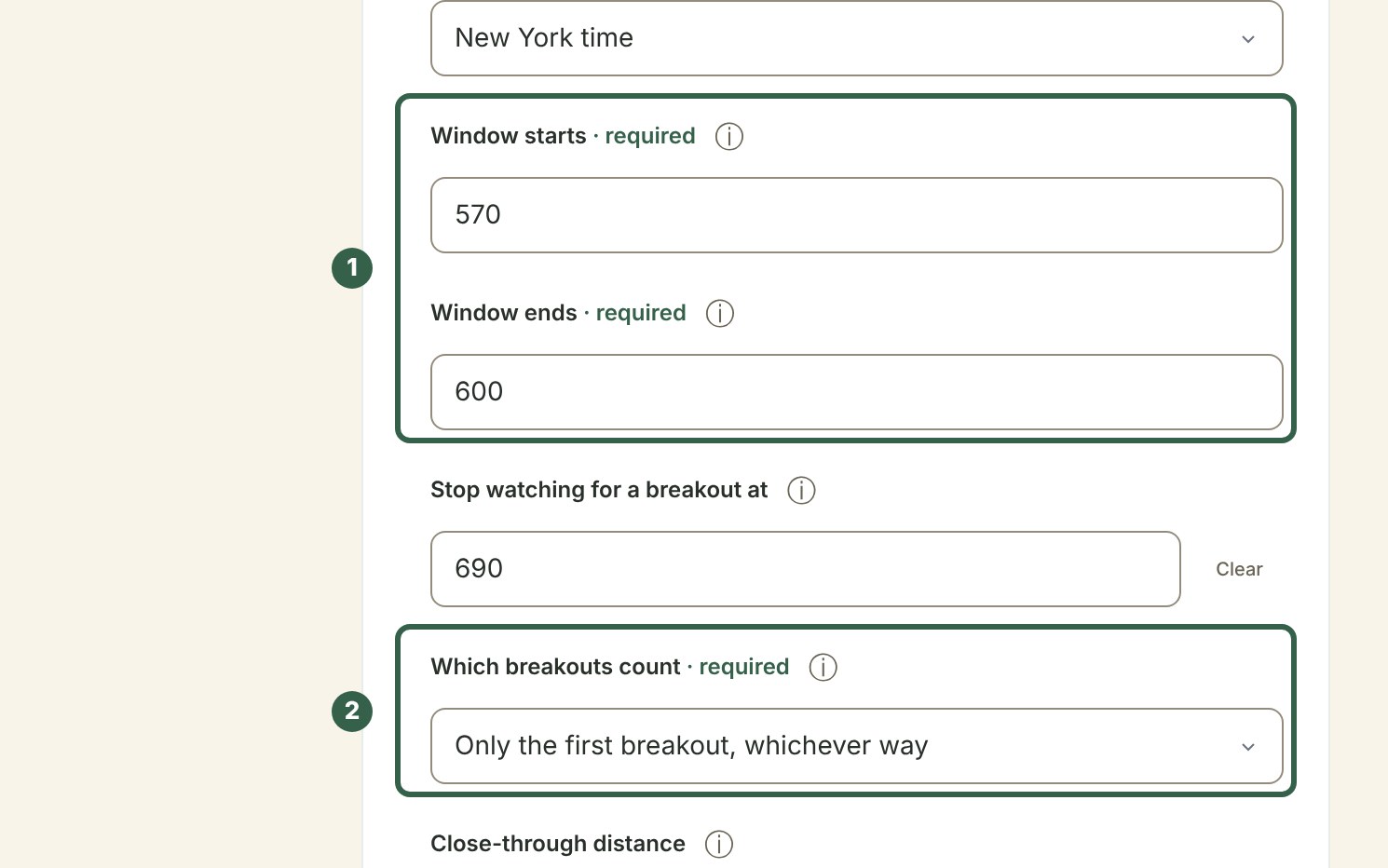
2. Window starts reads 570. What time is that?
3. Buys alone made $836 and sells alone $1,604 after fees. What did both sides make together?
0 of 3 answered.
Finished this lesson?
Tick it off and keep your place
Read the full notes
Most traders describe a strategy in words and never open its blocks. If you want to look under the hood, the blocks show exactly what Wildflower will trade. In Wildflower, open your strategy, read What it does, and press Change a rule. The builder shows Markets, Whole account, and each setup's steps: its Signal, Entry and Exit. Click a step and every part of your words is a box. Then change one box and run Try a few on the practice chart: Buy, sell or both, set to both sides, long entries only and short entries only, shows what each side of your strategy does on its own.
What you're building. These six lessons share one goal: your strategy read block by block: every part of your words found in its block, and one box in each kind of block changed and tried against the strategy as you described it. Today you fill in lines 1 and 2. Sam's strategy is the one he described in Build an opening range or London breakout.
| My under-the-hood log |
|---|
| 1. Each part of my words, and the block it became: … |
| 2. Buys only $…, sells only $…, both $… |
| 3. Signal: … changed from … to …: $… against $… |
| 4. Signal detail: … tried at …, … and …: … |
| 5. Filter: … : $… against $… |
| 6. Exit: … : $… against $… |
| 7. Whole account: … : $… against $… |
| 8. What I keep, and why: … |
Why. Sam is made up, and so are his numbers. They're real runs of Wildflower's engine on the free practice chart's made-up prices. Every part of your words becomes a box, and every box trades your money. Reading them checks Wildflower wrote what you meant (Turning rules into exact logic).
| Sides | Trades | Won | Before fees | After fees |
|---|---|---|---|---|
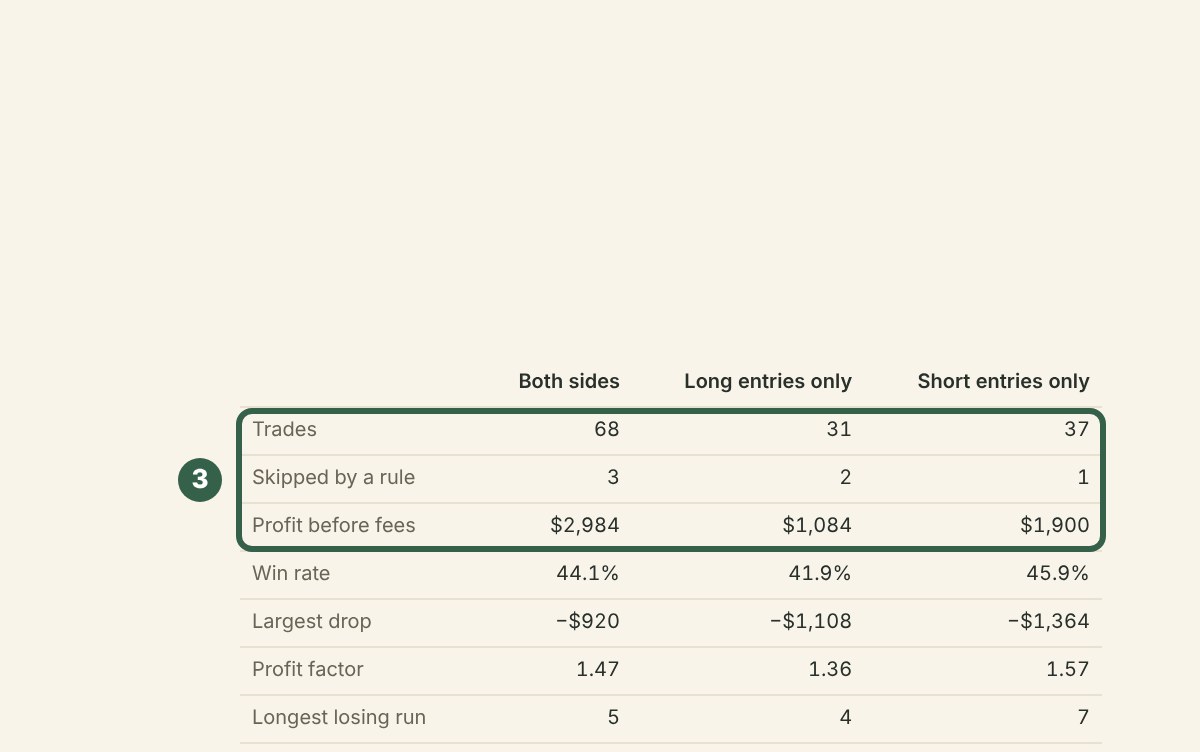
| Both, as he wrote it | 68 | 44.1% | +$2,984 | +$2,440 |
| Long entries only | 31 | 41.9% | +$1,084 | +$836 |
| Short entries only | 37 | 45.9% | +$1,900 | +$1,604 |
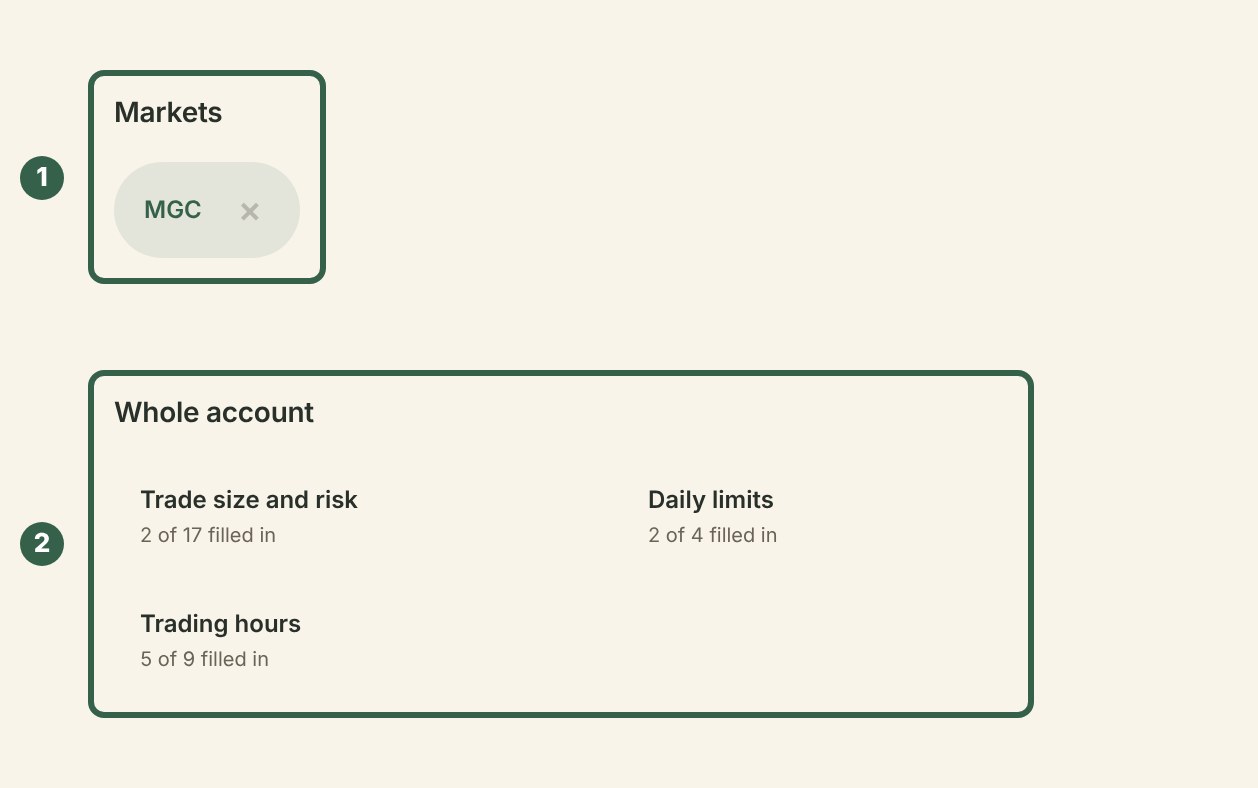
- Markets. The markets the strategy trades.
- Whole account. Trade size and risk, Daily limits and Trading hours, plus News and Long and short at once if you add them. They apply to every setup.
- A setup, top to bottom. Signal (spots the trade), Signal detail (one part of the signal, set on its own), Filter (skips trades that fail it), Minimum score, Entry (how the order goes in), Exit (how the trade ends) and Stop management. + Add a step adds the ones you don't have.
- Try a few changes nothing in your strategy. It runs up to three values side by side on the free practice chart.
How traders use each side's numbers. We can't tell you which to choose. These are the common choices. Keep both sides when each makes money on its own. Drop a side that loses, then test that on days held back. Or split them into two setups with their own boxes.
Worked example
Made-up numbersSam's lines 1 and 2
Sam is made up. Sam's gold opening range, on the practice chart, 3 Feb to 26 May 2026, $2.00 a contract.
- Line 1: "9:30 to 10:00" is Window starts 570 and ends 600 in the Signal. "Only the first breakout" is Which breakouts count. "$200 a trade" is Trade size and risk.
- Line 2: both sides +$2,984 before fees. 68 trades × $8 = $544 in fees, so +$2,440 after.
- Buys only: +$1,084 − 31 × $8 = +$836. Sells only: +$1,900 − 37 × $8 = +$1,604.
Each side makes money on its own, so Sam keeps both. Made-up prices, an example, not advice.
Trading is risky. You can lose money. This lesson shows how Wildflower works. It isn't advice.