
Add a filter, then test it on days you held back
Wildflower Trading School · Lesson 4.4.4.1 · This exercise is free

These three lessons share one goal: your own version of the strategy: one filter tested on days you held back, one of your own choices tried as a rule, and a size and daily limit your account can take. By the end of today, you'll have lines one to three of your version log.
1 of 12
What you'll learn
- Hold some dates back before you look, and leave them alone.
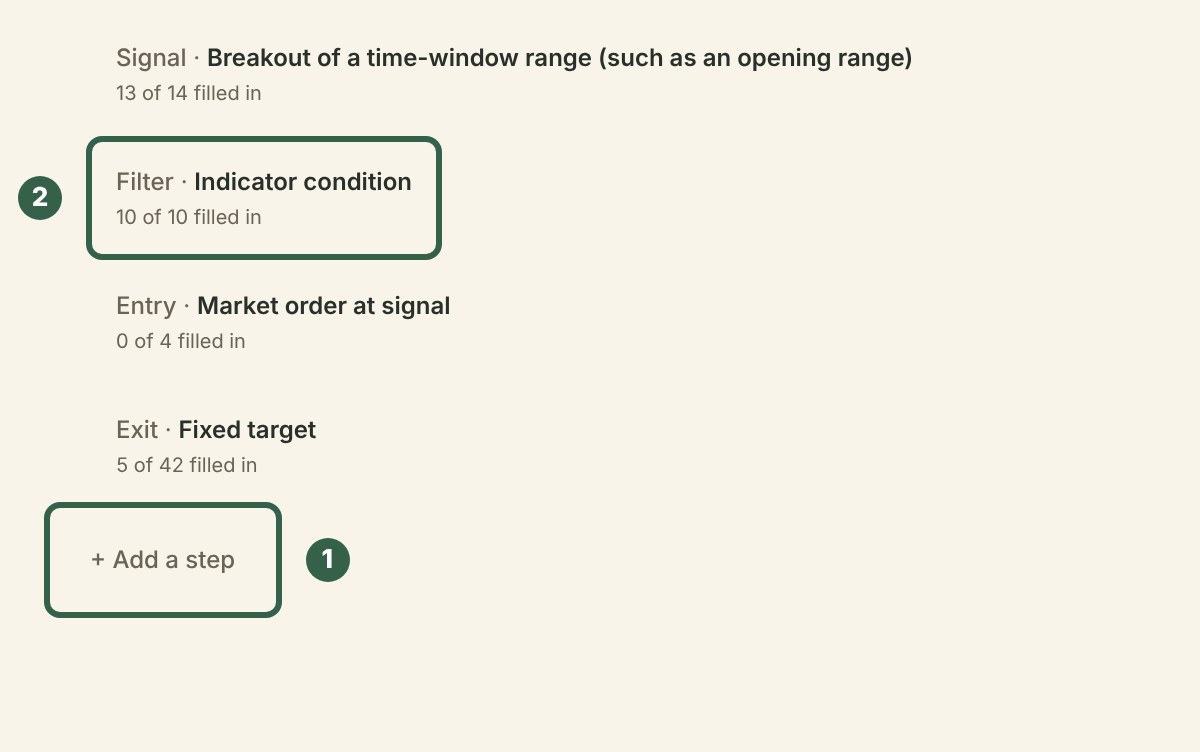
- Add a filter with Change a rule, then + Add a step.
- Compare on the studied dates first, with the filter and without.
- Test once on the held-back dates, then compare again.
- Keep a filter only if it holds on the days you held back.
Exercise
- Start your version log: copy the seven lines above onto paper or into a note.
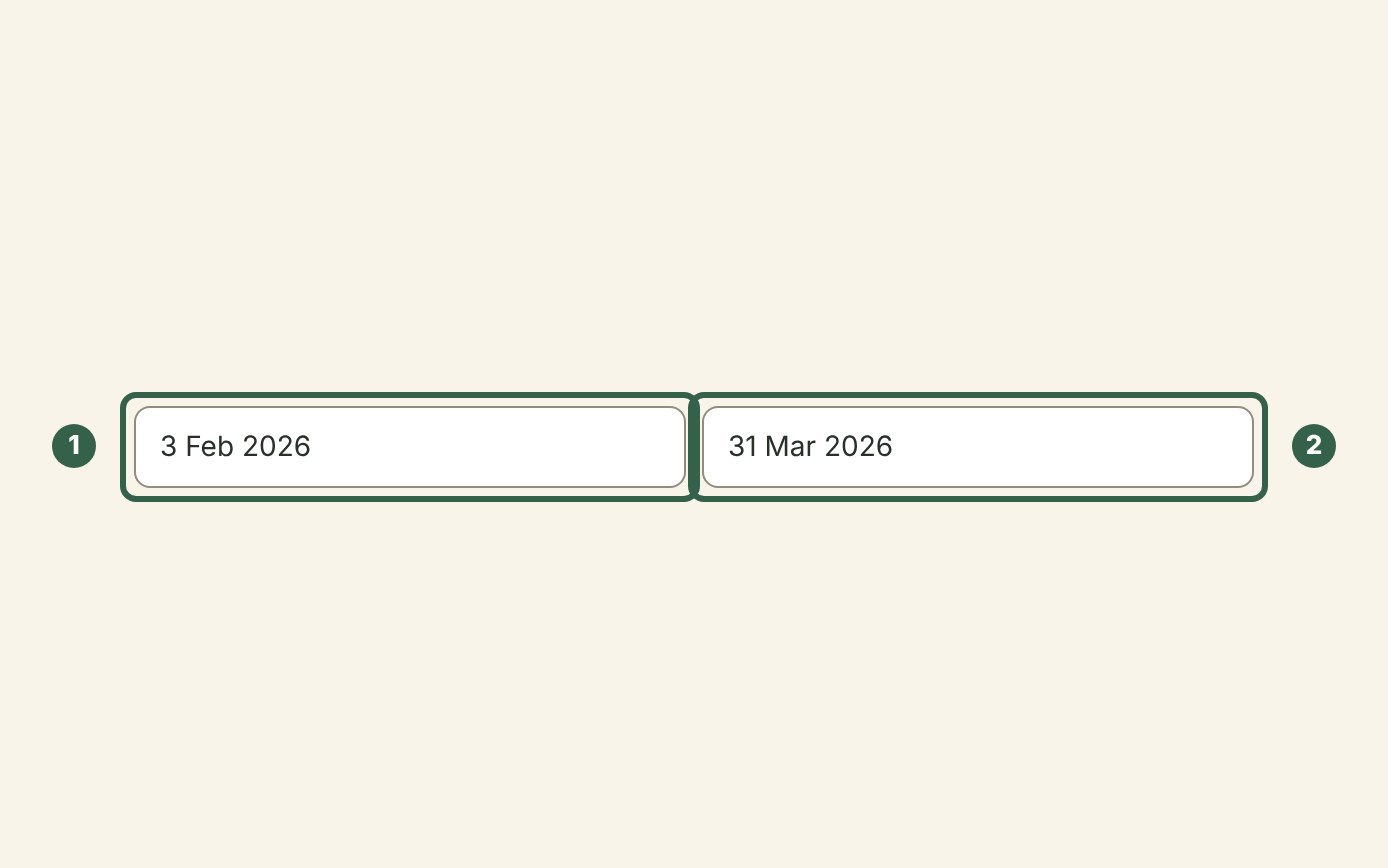
- Split your dates before you look: the days you study and the days you hold back. That's line 1.
- Test the days you study in Backtest, with your fee.
- Open your strategy in Strategies, press Change a rule, then + Add a step and Filter. Fill in every box and press Save.
- Test the new version on the same dates, then press Compare.
- Run both versions once on the held-back dates and compare again. Fill in lines 2 and 3.
- Help article Entry gates and score floors
- Help article The indicator condition gate
- Help article Backtest your strategy
Quick check
1. Why hold some dates back?
2. Sam's gap filter made $2,508 on the studied days. What did it do on the held-back days?
3. You change the filter after seeing the held-back results, then test those dates again. What happens?
0 of 3 answered.
Finished this lesson?
Tick it off and keep your place
Read the full notes
Hold some dates back before you look, add a filter, test it on the dates you studied, then test it once on the dates you held back. In Wildflower, pick the studied dates on Backtest's chart step. Then open your strategy, press Change a rule, press + Add a step, pick a Filter and fill in every box, and press Save for a new version. Compare the two versions on the studied dates, then run both once on the held-back dates and compare again. A filter that only helps on the days you studied has learned those days.
What you're building. These three lessons share one goal: your own version of the strategy: one filter tested on days you held back, one of your own choices tried as a rule, and a size and daily limit your account can take. Today you fill in lines 1 to 3. Sam's strategy is the one he built in Build an opening range or London breakout and tested with costs in Test your strategy with costs in Wildflower.
| My version log |
|---|
| 1. Days I study: … to … Days I hold back: … to … |
| 2. The filter I add: … Studied $…, held back $… |
| 3. Keep it? … because … |
| 4. A choice I keep making: … As a rule, studied $…, held back $… |
| 5. Keep it? … because … |
| 6. Risk $… a trade, stop the day at $… Largest drop $… |
| 7. The version I run forward: Version … |
Why. Sam is made up, and so are his numbers. They're real runs of Wildflower's engine on the free practice chart's made-up prices. A gap filter made $2,508 on the days he studied and lost $112 on the days he held back. Any filter looks good on the trades it was made from (When a filter helps and when it overfits).
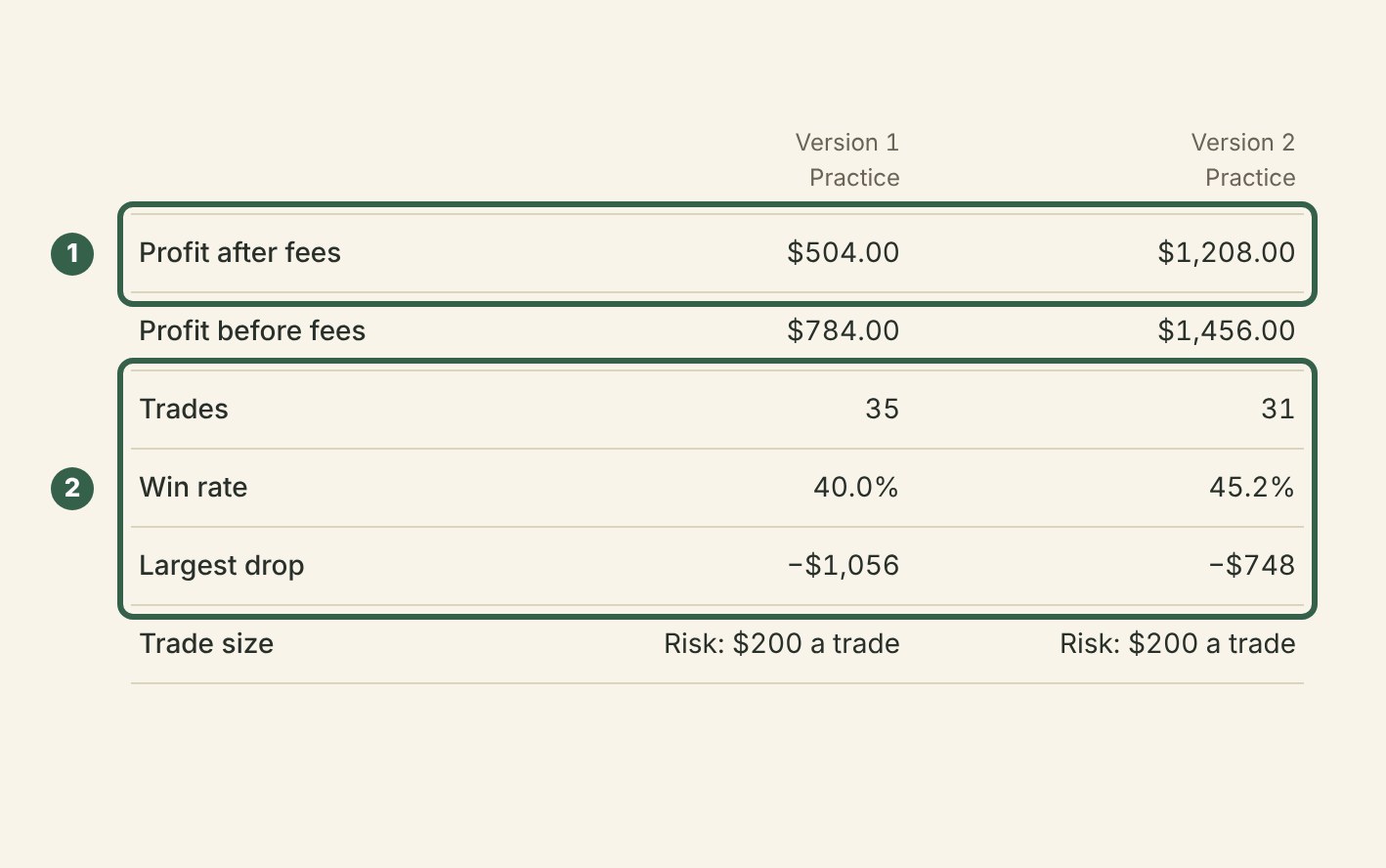
| Version | Studied, 3 Feb to 31 Mar | Held back, 1 Apr to 26 May |
|---|---|---|
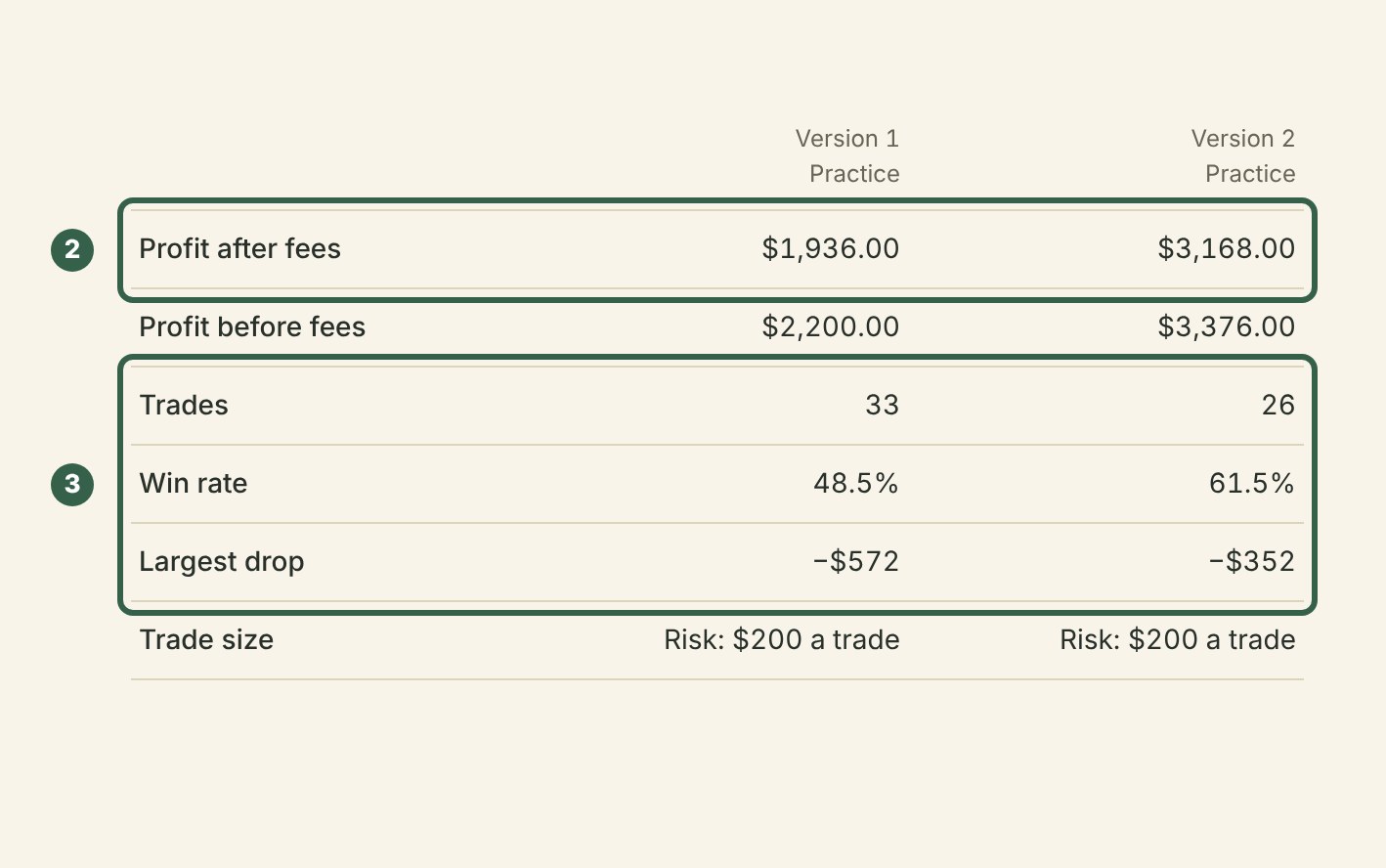
| 1, as built | 33 trades, 16 won, +$1,936, drop −$572 | 35 trades, 14 won, +$504, drop −$1,056 |
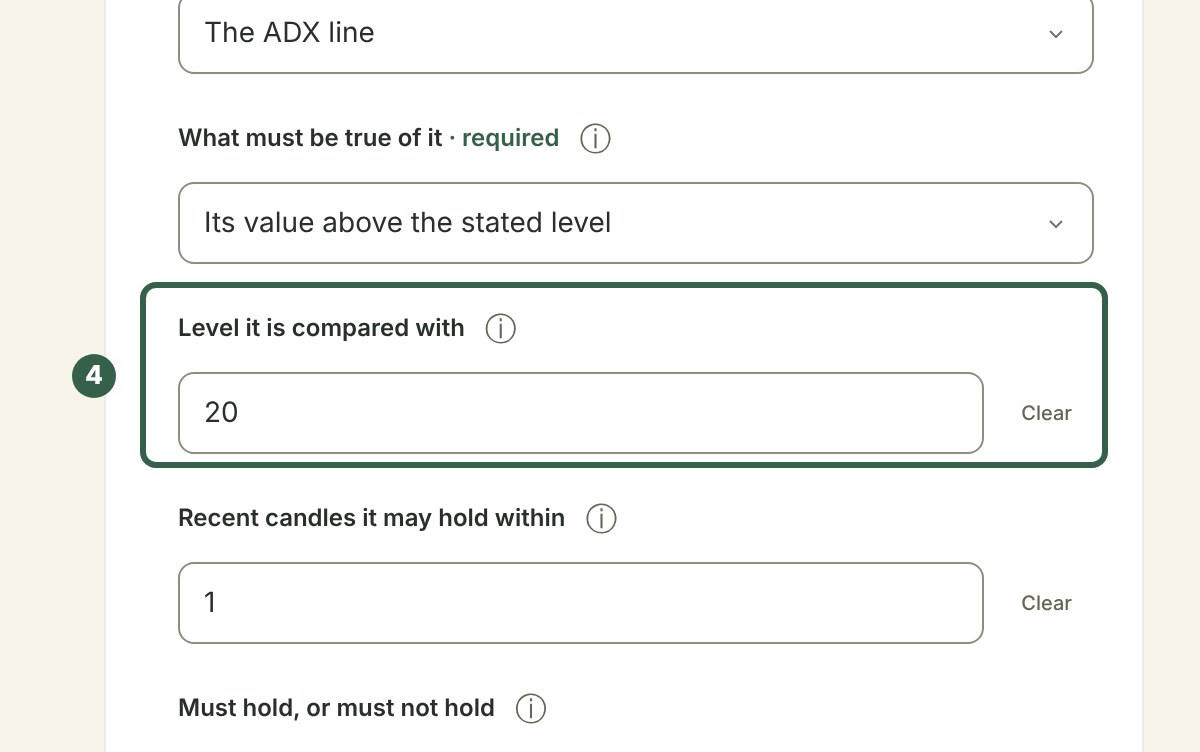
| 2, ADX above 20 | 26 trades, 16 won, +$3,168, drop −$352 | 31 trades, 14 won, +$1,208, drop −$748 |
| Opening gap filter, not saved | 16 trades, 11 won, +$2,508 | 22 trades, 8 won, −$112 |
- A filter is a step under your signal that lets a trade through only when it's true (Adding filters). + Add a step, then Filter, lists them, each with what it blocks.
- Save. The change is a new version. The version you tested is kept.
- Held-back dates count once for each idea. Change the filter after seeing them and test again, and they're no longer held back.
How traders hold days back. We can't tell you which to choose. These are the common choices. The last third of their dates. A whole season, such as the last 2 months. Or every day from now on, forward on a demo.
Worked example
Made-up numbersSam's lines 1 to 3
Sam is made up. Sam's gold opening range, Version 1, on the practice chart, 3 Feb to 26 May 2026, $2.00 a contract.
- Line 1: studies 3 Feb to 31 Mar, holds back 1 Apr to 26 May.
- Line 2: ADX above 20. Studied $3,168 against $1,936 without it. Held back $1,208 against $504.
- The gap filter he tried first: studied $2,508, held back −$112.
Line 3: Sam keeps the ADX filter as Version 2, because it held on days it wasn't made from. Made-up prices, an example, not advice.
Trading is risky. You can lose money. This lesson shows how Wildflower works. It isn't advice.