
Outside bar: what it is and how to spot one
By Bec, futures trader and founder of Wildflower · Updated
An outside bar is a candle whose high is above the high of the candle before it and whose low is below that candle’s low. Its range reaches past the last candle on both sides, wicks included. It’s the opposite of an inside bar.
What an outside bar is
An A candle whose high is above the high of the candle before it and whose low is below that candle’s low.More in the glossary is a two-candle A named shape made by one or a few candles in a row, such as a doji or an engulfing candle. The name describes candles that already closed.More in the glossary. The second candle trades above the first candle’s high and below its low. Its range covers the whole of the first candle, and more. It’s called “outside” because it reaches outside the last candle on both sides.
The name comes from bar charts, where each stretch of time is drawn as a bar with a high, a low, an open and a close. On a candle chart it means the same thing, and the The thin lines above and below a candle’s body. Their tips are the highest and lowest prices in that candle.More in the glossary count.
In plain words, within one candle price went past the last high and past the last low. Buyers and sellers both pushed beyond the last range before the candle closed. The pattern describes what happened. It doesn’t say which way price goes next.
How to identify an outside bar, step by step
1. Pick two candles in a row
Any two, on the timeframe you’re looking at.
2. Mark the first candle’s high and low
Use the tips of the wicks. Here that’s 114 and 108.
3. Check the second candle
Its high, 116, is above 114. Its low, 106.50, is below 108. Both must pass.
4. It’s an outside bar
The second candle reaches past the first on both sides. Then move along one candle and check the next pair.
Only the highs and lows decide it. The opens, the closes and the colours don’t make or break the pattern. Traders look at the close next, to name it.
Bullish and bearish outside bars
Bullish outside bar. An outside bar that closes higher than it opened. Some traders only call it bullish when it closes near its own high, or above the last candle’s high.
Bearish outside bar. An outside bar that closes lower than it opened. Some traders only call it bearish when it closes near its own low, or below the last candle’s low.
When an outside bar comes after a move one way and closes the other way, many traders call it an outside reversal. Both pictures above are one. On a daily chart you’ll hear “outside day”. A key reversal day is a close cousin: a day that makes a new high, then closes below the day before’s close (or the mirror, after a fall). Definitions of both differ on how far the close must go.
What counts, and what doesn’t
Both sides must pass. If only the high goes past, or only the low, it isn’t an outside bar. It’s a candle that went higher, or lower.
Equal isn’t past. A high that exactly matches the last high hasn’t gone above it. Wildflower’s Indicator doesn’t count it. Some traders allow an equal price on one side. It’s your call.
Wicks decide, not bodies. A candle with a small body is still an outside bar if its wicks reach past both ends. A candle whose body covers the last body, but whose wicks don’t reach past, isn’t one. That’s an A candle whose body covers the whole body of the candle before it, closing the other way.More in the glossary.
Size is your choice. One The smallest step a price can move. On many stock index futures that’s 0.25 of a point.More in the glossary past on each side is enough. Some traders only count outside bars bigger than a size they choose, or bigger than recent candles. There’s no single rule.
Timeframe matters. A 5-minute outside bar can be part of a 15-minute candle that isn’t one. Each chart has its own.
What traders watch after an outside bar
Many traders mark an outside bar and then decide how to read it. In the pictures, the green lines are the outside bar’s high and low. A few ways you’ll see it done:
- Its own close. The outside bar’s close gives it a direction: up or down. Some also ask where in its range it closed, such as near its high.
- A close past it. Others wait for a later candle to close above the outside bar’s high or below its low, often within a set number of candles.
- A wick isn’t a close. A candle that pokes past the high and closes back inside doesn’t count as a close past it, for traders who use closes.
Each of these is a choice. After an outside bar, price can carry on, turn back, or move sideways inside its range for a while. The pattern doesn’t tell you which will happen.
Where the name outside bar comes from
Western traders drew bar charts for most of the last century, so their names for price patterns use “bar”: inside bar, outside bar, outside day. Candle charts came from Japan and caught on in the West in the early 1990s, largely through Steve Nison’s books. The candle chart names for similar patterns, like engulfing, compare the bodies. The bar chart names compare the highs and lows.
Often confused with
Two-bar reversal. Two candles side by side that close opposite ways, the second closing back past where the first opened. The second doesn’t have to reach past the first candle’s high and low, so a Two candles side by side that close opposite ways, the second closing back past where the first opened. Definitions differ on how far past.More in the glossary isn’t always an outside bar. Definitions differ on how far past it must close.
Inside bar. The opposite: a candle whose high and low both stay within the last candle’s. Read about inside bars.
Engulfing candle. It compares bodies, and the two candles must close opposite ways. An outside bar compares the whole range, and colour doesn’t matter. A candle can be both. Read about engulfing candles.
Harami. A candle whose body sits inside the last candle’s body. That’s closer to an inside bar than an outside bar. Read about the harami.
Outside bar indicator for TradingView
Have every outside bar marked, to your own rules
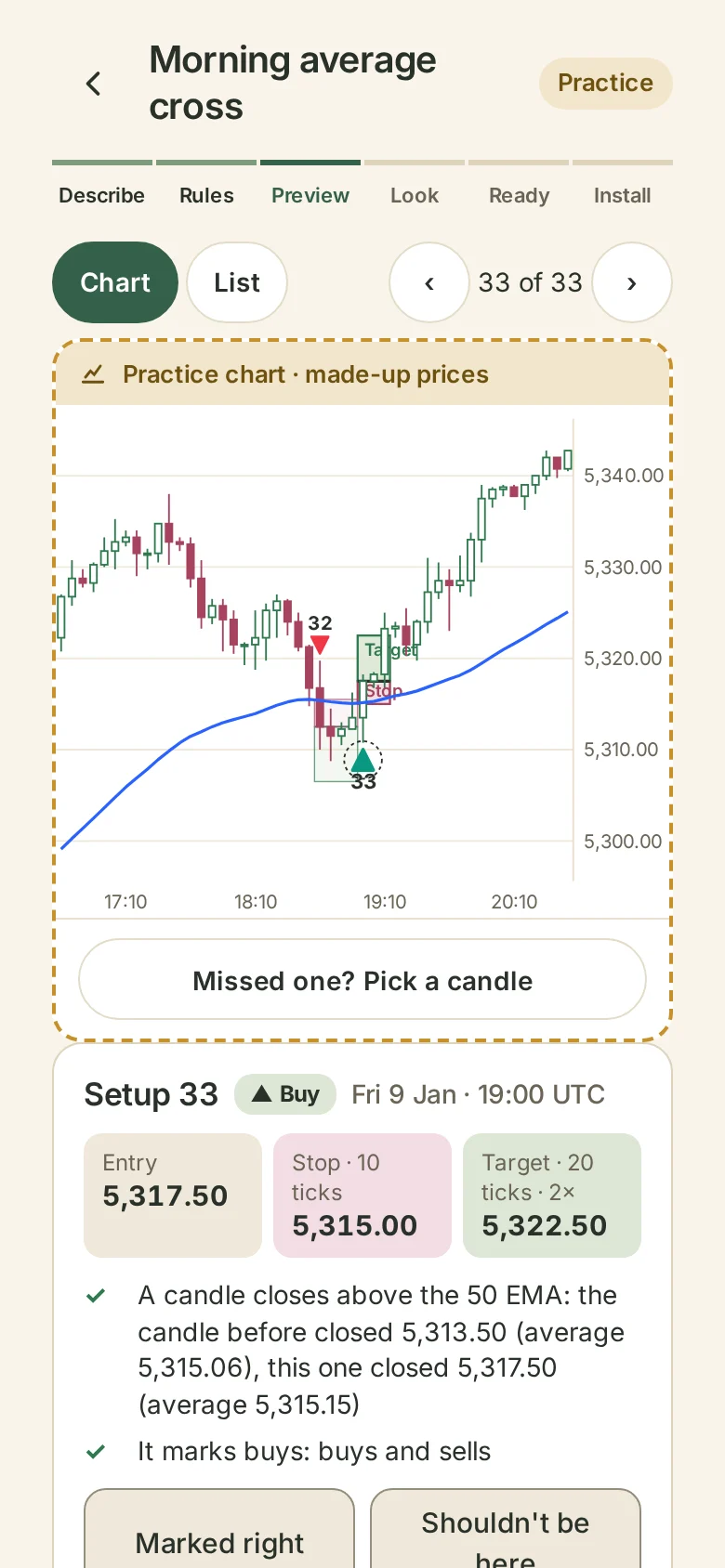
Tell Wildflower’s Indicator what you want in plain words, like “mark every outside bar, in the direction it closed”. It counts a candle as an outside bar when its high is above the last high and its low is below the last low, not level with them. You choose what marks the setup: the outside bar’s own close, in the direction it closed, or a later candle closing above its high or below its low, within a number of candles you type. An outside bar that closes where it opened has no direction, so its own close marks nothing. It can’t check where in its range the candle closed, set a smallest size, or mark a two-bar reversal. If you describe those, it tells you plainly. It marks every one on a chart so you can check it matches your rules, then gives you a script to add to TradingView, with a step-by-step guide.
Free to build
Common questions
What is an outside bar?
A candle whose high is above the last candle’s high and whose low is below the last candle’s low.
Is an outside bar bullish or bearish?
Neither on its own. Traders name it by its close: one that closes up is called bullish, one that closes down bearish.
What’s the difference between an outside bar and an engulfing candle?
An outside bar compares the highs and lows, and colour doesn’t matter. An engulfing candle compares the bodies and needs the two candles to close opposite ways.
What is an outside reversal?
An outside bar that comes after a move one way and closes the other way.
What is an outside day?
An outside bar on a daily chart: a day that traded above the day before’s high and below its low.
Does an outside bar count if the highs are equal?
Not in Wildflower’s Indicator: both the high and the low must go past. Some traders allow an equal price on one side.
What is the opposite of an outside bar?
An inside bar: a candle whose high and low both stay within the last candle’s. Read about inside bars.
Which timeframe is best for outside bars?
There’s no best one. They form on any timeframe, and each chart has its own.
Can I get an outside bar indicator for TradingView?
Yes. Describe your rules in plain words and Wildflower builds it. Preview it free on a chart, then pay only when you add it to TradingView. See the Indicator.
Learn it step by step in Wildflower Trading School, starting with the lesson “Inside bars and outside bars”.