
Inside bar: what it is and how to spot one
By Bec, futures trader and founder of Wildflower · Updated
An inside bar is a candle whose whole range fits inside the range of the candle before it. Its high is no higher than that candle’s high, and its low is no lower than that candle’s low. The bigger candle before it is often called the mother bar.
What an inside bar is
An A candle whose high and low both stay within the high and low of the candle before it.More in the glossary is a two-candle A named shape made by one or a few candles in a row, such as a doji or an engulfing candle. The name describes candles that already closed.More in the glossary. The second candle’s high and low both sit within the high and low of the first. It’s called “inside” because the whole candle, The thin lines above and below a candle’s body. Their tips are the highest and lowest prices in that candle.More in the glossary included, is inside the one before.
Traders call the first candle the The candle before an inside bar: the one whose range the inside bar fits inside.More in the glossary. The name comes from bar charts, where each stretch of time is a bar, not a candle, but it means the same thing.
In plain words, an inside bar is a candle where price didn’t go beyond the last candle’s high or low. Many traders read it as a pause. It describes what happened in that candle. It doesn’t say which way price goes next.
How to identify an inside bar, step by step
1. Pick two candles in a row
Any two, on the timeframe you’re looking at.
2. Mark the first candle’s high and low
Use the tips of the wicks. Here that’s 120 and 104.
3. Check the second candle
Its high, 119, isn’t above 120. Its low, 110, isn’t below 104. Both must pass.
4. It’s an inside bar
The second candle fits inside the first. Then move along one candle and check the next pair.
Only the highs and lows decide it. The opens, the closes, the colours and the size of the bodies don’t matter.
Inside bars after a rise and after a fall
An inside bar has no direction of its own. It can come after a rise or a fall, and it can be green or red. Some traders call one after a rise a bullish inside bar and one after a fall a bearish inside bar, but those names describe the move before it, not the inside bar.
On a daily chart, an inside bar is often called an inside day: a day whose high and low stayed within the day before.
What counts, and what doesn’t
Equal highs or lows. Definitions differ. Many count a candle whose high or low exactly matches the mother bar’s, and Wildflower’s Indicator does too. Some only count a candle that stays strictly inside. It’s your call.
One point out is out. If the high goes above the mother bar’s high, even by one The smallest step a price can move. On many stock index futures that’s 0.25 of a point.More in the glossary, it isn’t an inside bar.
Wicks count, not bodies. A candle whose body sits inside the last body, but whose wick pokes out, isn’t an inside bar. That’s closer to a harami, which only compares bodies.
Timeframe matters. A 5-minute inside bar can be part of a 15-minute candle that isn’t one. Each chart has its own.
Inside bar breakout: what traders watch after one
Many traders mark an inside bar and then watch for price to leave it. That’s an inside bar When price moves past a level, such as the top or bottom of a range, and keeps trading beyond it.More in the glossary. In the pictures, the solid green lines are the inside bar’s high and low, and the dashed line is the mother bar’s high. Traders set it up in different ways:
- Which range. Some watch the inside bar’s own high and low. Others wait for price to leave the mother bar’s wider range.
- Close or touch. Some count a candle that closes past the level. Others count any trade past it, even a wick.
- How far past. Some ask for a set number of ticks beyond the level, so a close a hair past doesn’t count.
- How long to wait. Some only count a break within a set number of candles after the inside bar.
Each of these is a choice. A break can go either way, and a break in one direction can be followed by a move the other way. The pattern doesn’t tell you which will happen.
Several inside bars in a row
Sometimes two, three or more candles in a row stay inside the same mother bar. There are two ways to count them:
Each inside the mother bar. Every candle stays within the first candle’s high and low. A candle can poke past the one just before it and still count.
Each inside the one before. Every candle fits inside the candle just before it, so the range gets narrower each time. This is stricter.
The two can give different counts on the same chart, so it helps to decide which one you mean before you look.
Often confused with
Outside bar. The opposite: a candle whose high is above the last high and whose low is below the last low. Read about outside bars.
Harami. A candle whose body sits inside the last candle’s body. It ignores the wicks, so a harami isn’t always an inside bar. Read about the harami.
Narrow range bar (NR4 or NR7). A candle whose high-to-low range is the smallest of the last four or seven. It’s about size, not position, so it doesn’t have to sit inside anything. Read about narrow range bars.
Engulfing candle. A candle whose body covers the whole body of the one before. Read about engulfing candles.
Inside bar indicator for TradingView
Have every inside bar breakout marked, to your own rules
Tell Wildflower’s Indicator what you want in plain words, like “mark it when a candle closes above an inside bar’s high or below its low”. It uses the inside bar’s own high and low, counts an equal high or low as inside, and asks within how many candles after the inside bar the close must come. You type every number. It can’t count a run of inside bars or watch the mother bar’s range instead. It marks every one on a chart so you can check it matches your rules, then gives you a script to add to TradingView, with a step-by-step guide.
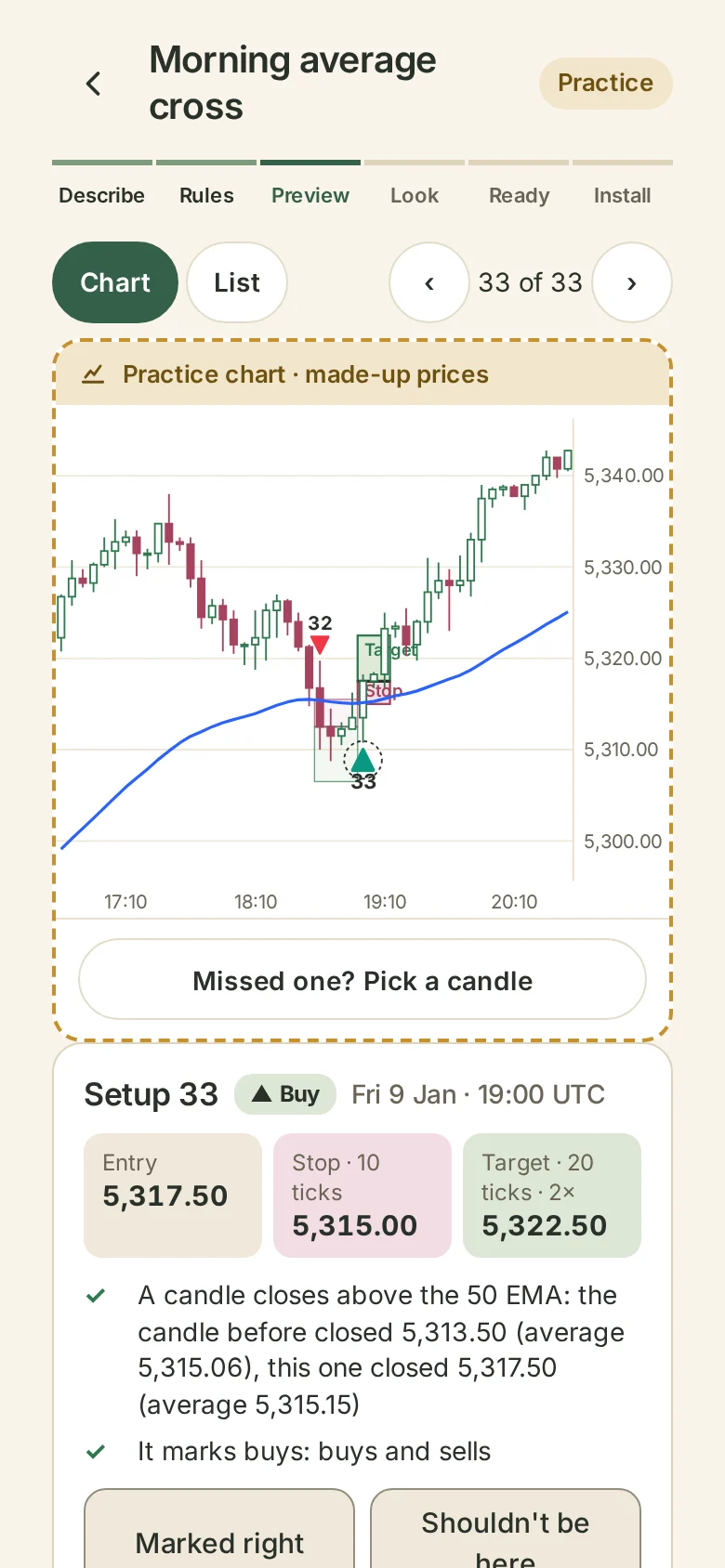
Try it free. You only pay when you add it to TradingView.
Common questions
What is an inside bar?
A candle whose high and low both stay within the high and low of the candle before it.
What is a mother bar?
The candle before an inside bar: the one whose range the inside bar sits in.
Does an inside bar count if the highs are equal?
In many definitions, yes, and in Wildflower’s Indicator. Some traders only count a candle that stays strictly inside.
Is an inside bar bullish or bearish?
Neither on its own. It has no direction. Some traders name it after the move that came before it.
What is an inside bar breakout?
When price leaves the inside bar’s range (or the mother bar’s), often counted when a candle closes past the high or low. More above.
What’s the difference between an inside bar and a harami?
An inside bar compares the whole candle, wicks included. A harami only compares the bodies.
Does the colour of an inside bar matter?
Not to the pattern. Only the highs and lows decide it.
What is an inside day?
An inside bar on a daily chart: a day that stayed within the high and low of the day before.
Which timeframe is best for inside bars?
There’s no best one. They form on any timeframe, and each chart has its own.
Can I get an inside bar indicator for TradingView?
Yes. Describe your rules in plain words and Wildflower builds it. Preview it free on a chart, then pay only when you add it to TradingView. See the Indicator.