
Your hours, your size and your days
Wildflower Trading School · Lesson 1.8.5.2 · This exercise needs a Trade subscription

This is the last of two lessons with one goal: write your risk plan, then make Wildflower hold you to it. Last time you wrote five lines of the plan and set them in Wildflower. Today you write lines three and seven, and your risk plan is done.
1 of 11
What you'll learn
- Work out your size. Divide risk per trade by what one contract loses at your stop, rounded down.
- Type Your hours and Size in Today's rules, and click off any day you don't trade.
- Know what each rule closes. A trade outside your hours, or bigger than your size, is closed.
- Keep trading inside them. Hours and Size close the one trade that breaks them, not the day.
- Loosen a rule the day before. A looser rule starts at 6 pm New York time.
Exercise
- Choose Trade or Automate on Plans, and connect your broker in Connections, if you haven't.
- Write lines 3 and 7 of your risk plan: your contracts at your usual stop, and your hours and days.
- Open Today's rules and pick the same account as last lesson.
- Type Your hours and Size, and click off any day you don't trade.
- Press Save. Your plan is done, and Wildflower holds you to it.
- Help article Today's rules
Quick check
1. Your Size rule is 4. You open 8 contracts. What happens?
2. You raise your Daily loss limit at 10 am. When does the new limit start?
3. Your risk per trade is $200. One contract loses $40 at your stop. What's the most contracts that fit?
0 of 3 answered.
Finished this lesson?
Tick it off and keep your place
Read the full notes
Your size is your risk per trade divided by what one contract loses at your stop, rounded down. In Wildflower, you open Today's rules, type your hours and your Size, click off any day you don't trade, and press Save. A trade opened outside your hours, or bigger than your size, is closed. A tighter rule starts now. A looser one waits for the next trading day, at 6 pm New York time.
What you're building. This is the last of two lessons with one goal: write your risk plan, then make Wildflower hold you to it. In Cap your day with Today's rules you wrote lines 1, 2, 4, 5 and 6 and set them in Wildflower. Today you write lines 3 and 7, and the plan is done.
| My risk plan |
|---|
| 1. Account size: $ |
| 2. Risk per trade: $ (… % of the account) |
| 3. Contracts at my usual stop: |
| 4. Daily loss limit: $ (… full losses) |
| 5. Losses in a row before I stop: |
| 6. Most trades a day: |
| 7. My hours and days: |
Why. Sam is made up, and so are his numbers. His plan says 4 micro gold at a 40-tick stop, $160. His $200 Risk per trade would still let the Place trade panel buy 5, and on a broker account a trade placed on the broker's own platform doesn't go through the panel at all. Size closes any trade bigger than 4, wherever it was placed. A trade outside the hours he gets ready for wasn't in his plan. A day he doesn't trade can't cost him money.
| Step | Sam's numbers |
|---|---|
| One contract at his 40-tick stop | 40 ticks × $1 = $40 |
| Risk per trade ÷ that | $200 ÷ $40 = 5 |
| Room for costs and slippage | He takes 4: 4 × $40 = $160 |
| Line 3 | 4 contracts at a 40-tick stop |
| Line 7 | 9:30 to 11:30 am New York time, Monday to Friday |
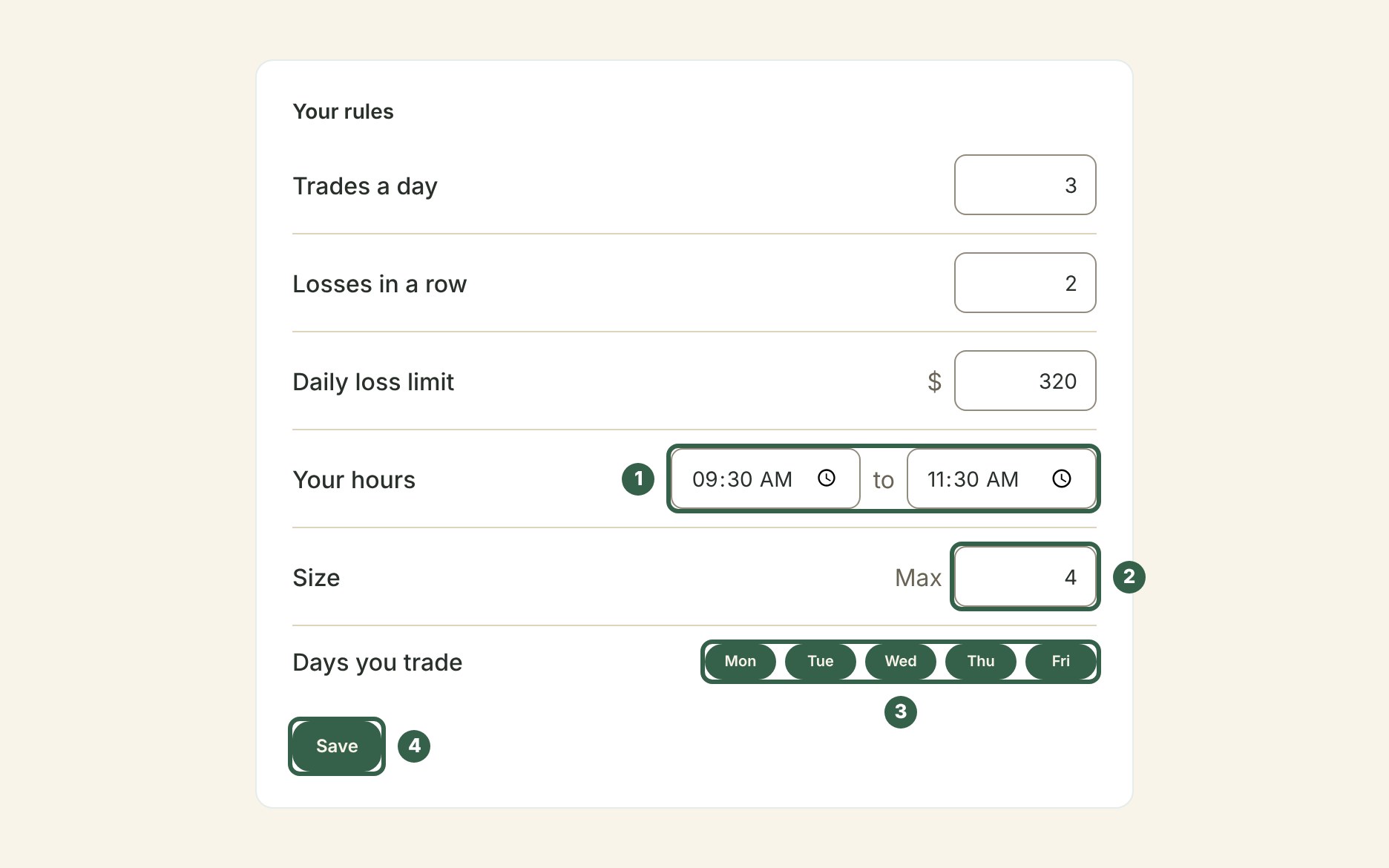
- Your hours. No new trades outside these times, in the time zone from your Settings. A trade opened outside them is closed. One opened inside them is left to its own stop and target.
- Size. The most contracts you can hold on one market. A bigger trade is closed in full, with its orders, and the page says, for example, Closed 8 contracts. Your size rule is 4.
- Hours and Size don't lock the day. They close the trade that breaks them, and you can keep trading inside them.
- Days you trade. All five start on. Click a day to turn it off. A day that's off is locked all day. With all five on, the page shows no days row.
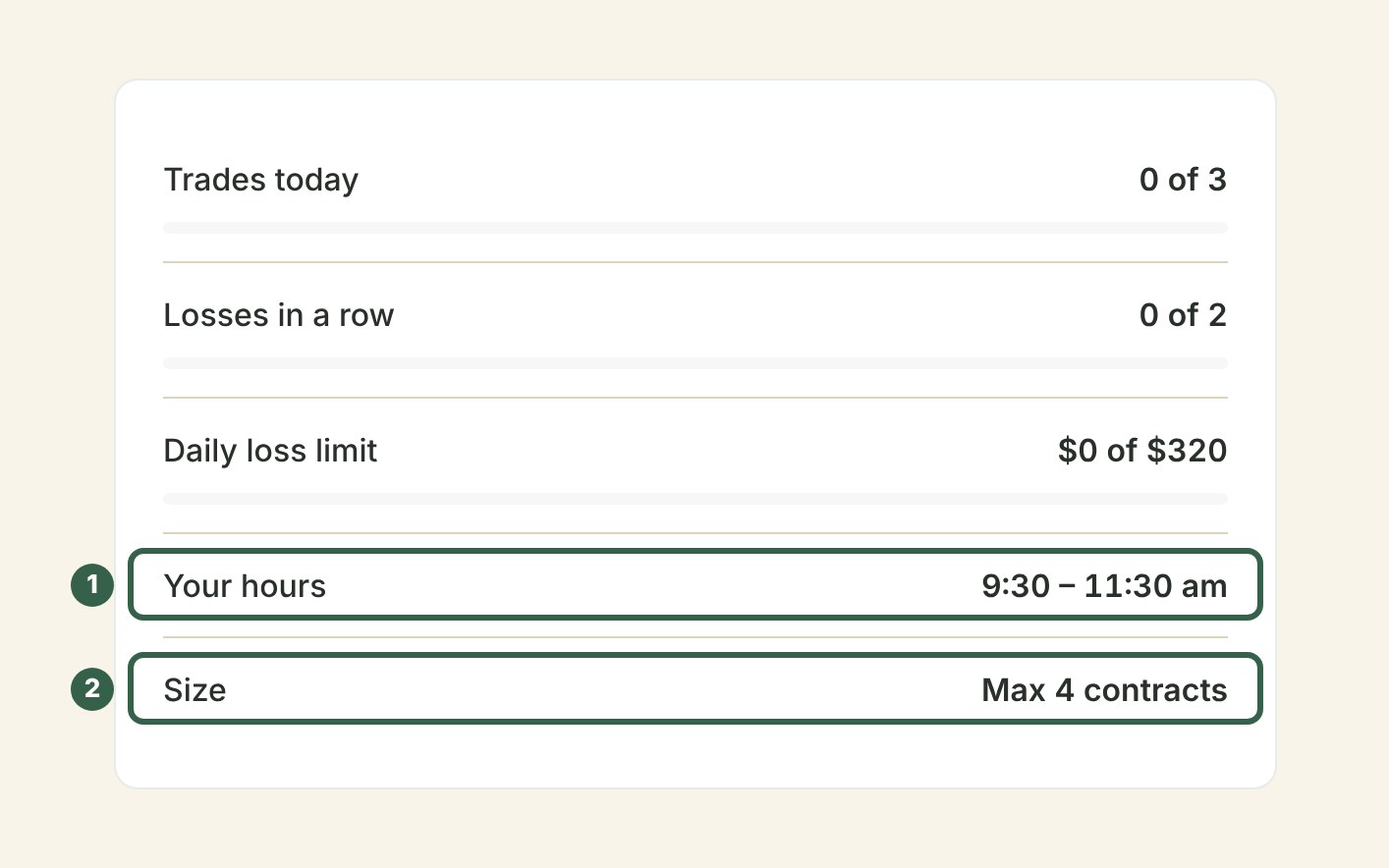
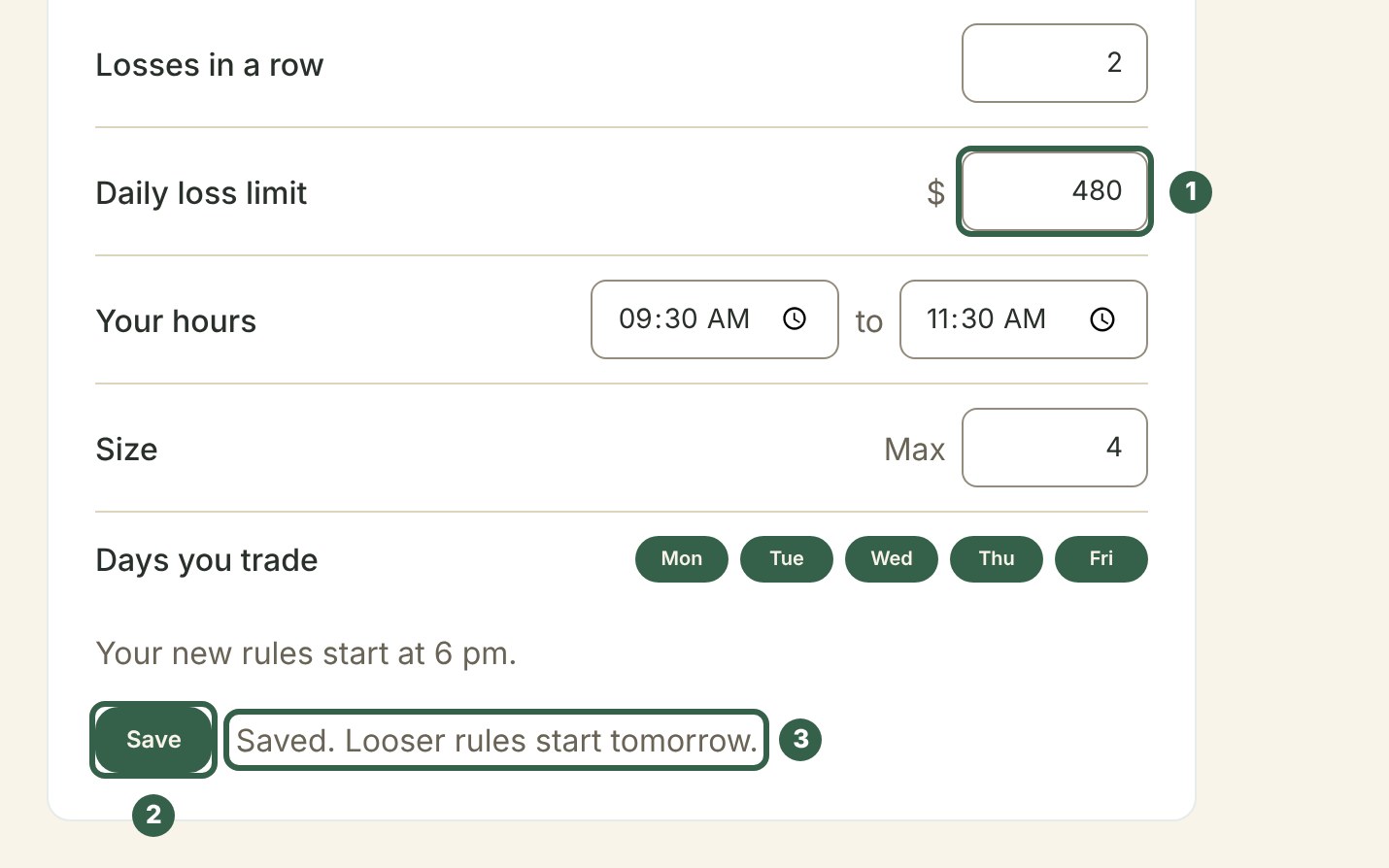
Tighter now, looser tomorrow. A new or stricter rule starts straight away. A looser one, or one switched off, starts at the next trading day, at 6 pm New York time, and the card says Saved. Looser rules start tomorrow. Until then, today's rules still hold.
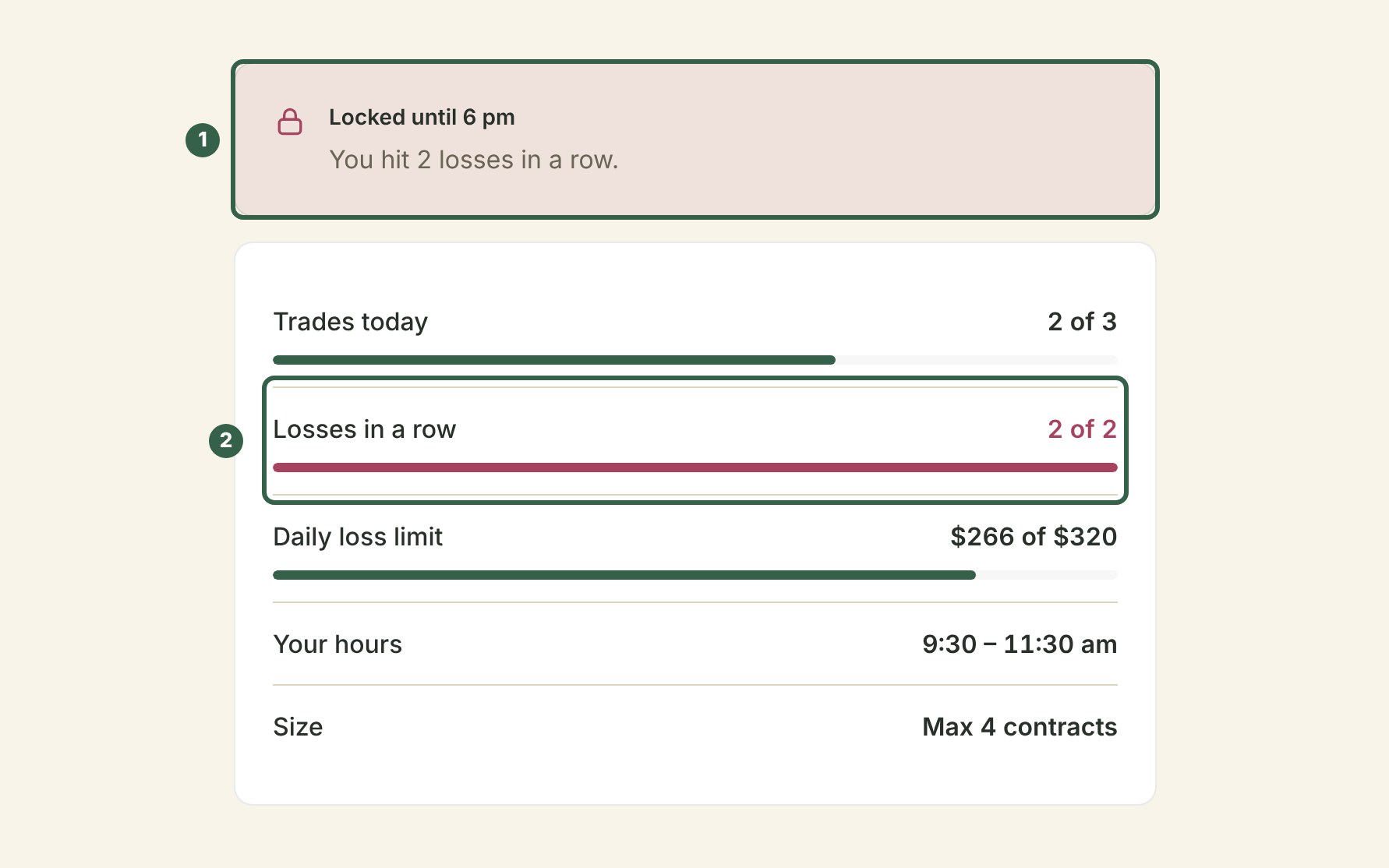
When you're locked. Locked until shows when the next trading day starts, in your own time zone. 6 pm in New York is when it starts. Anything Wildflower closed or cancelled is listed on the page with the time. More in the help article Today's rules.
How traders use them. We can't tell you which to choose. These are the common choices. Size: exactly what the risk per trade allows at the usual stop, one fewer so costs fit inside, or set from the closest usual stop. Hours: the window they get ready for, only the busiest hour of their market, or ending before big news. Days: all five, one day off to look back at the week, or a day with big news turned off before it starts.
Today's rules on a broker account come with the Trade subscription. No broker? Your rules go on your Practice account, free. Its Buy and Sell panel risks up to $100 a trade.
Worked example
Made-up numbersSam's lines 3 and 7
Sam is made up. Risk per trade $200. Micro gold, $1 a tick for each contract. Usual stop 40 ticks.
- One contract at the stop: 40 × $1 = $40.
- $200 ÷ $40 = 5. He takes 4, so costs and slippage fit inside: 4 × $40 = $160.
- He gets ready for 9:30 to 11:30 am New York time, and trades Monday to Friday.
- If he opens 5 contracts, 5 is more than 4, so the whole trade is closed.
Size 4, Your hours 9:30 to 11:30 am, all five days on. His risk plan is done, and Wildflower holds him to it.
Trading is risky. You can lose money. This lesson shows how Wildflower works. It isn't advice.