
Take part off, or set a time limit
Wildflower Trading School · Lesson 3.3.5.2 · Free to read · Exercise is free

In the last lesson you moved your stop. Now you'll take part of a trade off at a first target, and close trades that go nowhere. By the end of this lesson you'll know how to add a partial profit, a time cap and a clock-time exit, and what the partial and the time cap did to one strategy on the practice chart.
1 of 9
What you'll learn
- Set a partial. Choose where it's taken, how much closes and where the stop goes.
- Expect whole contracts. A one-contract trade closes in full at the first target.
- Count time cap candles. Each is 15 seconds, so 240 candles is one hour.
- Test each exit. Compare it with your stop and target alone, on the same dates.
Exercise
- Open your strategy in Strategies and choose Change a rule. No strategy yet? Choose Get started there and describe it in your own words.
- Test it as it is on the practice chart. Write down the result, best trade and largest drop.
- Choose + Add a step, then Exit, and pick Partial profit or Time cap. Switch it on, fill in your own numbers and save.
- Test again on the same chart and dates, and compare.
- If you used a partial, open the trades and check the size that closed.
- Help article Entries, exits and trade protection
- Help article Backtest your strategy
Quick check
1. A trade has 1 contract and the partial closes half. What happens?
2. A time cap of 240 candles is how long?
3. Sam's partial won more often. What happened to the best trade?
0 of 3 answered.
Finished this lesson?
Tick it off and keep your place
Read the full notes
Partial profit closes part of your position at a first target. Time cap closes a trade that hasn't moved far enough after a set time, and Exit at a clock time closes it at a time of day. You add each in Studio and test it on the free practice chart.
Partial profit closes part of your position at a first target. Time cap closes a trade that hasn't moved far enough after a set time. Exit at a clock time closes it at a time of day.
Why it matters. A partial makes your best trades smaller, and a stuck trade keeps your full risk on. A test shows what each costs and saves (Taking partial profits, Time-based exits).
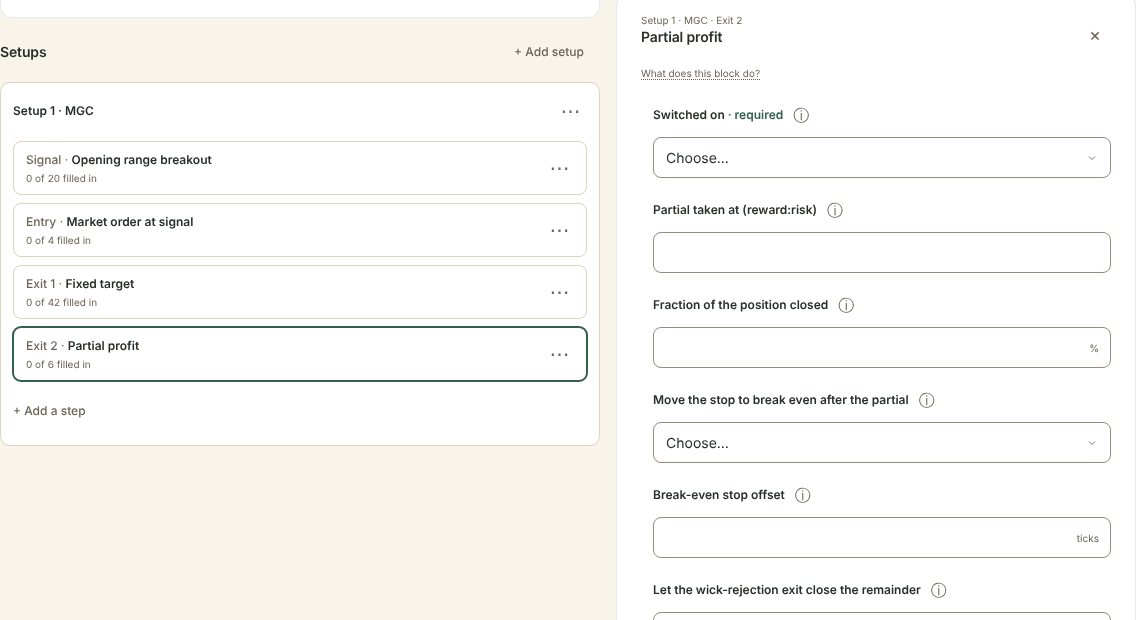
- Partial profit. Where it's taken (times the risk), how much closes (right now type 0.5 for half, even though the box shows %), and whether the stop then moves to break even. It rounds down to whole contracts, never below one, so a one-contract trade closes in full. Check a few trades after your test.
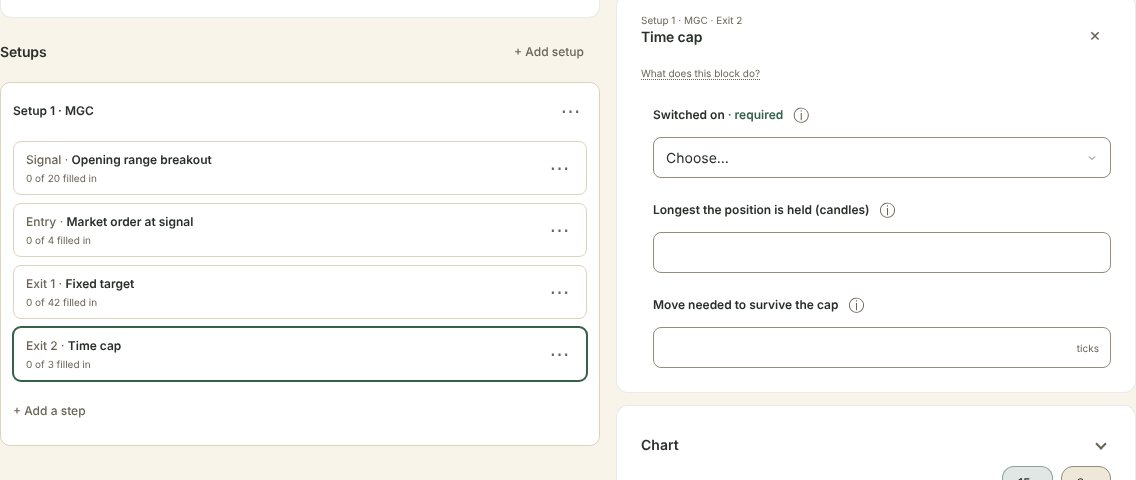
- Time cap. Longest the position is held, counted in 15-second candles (240 is one hour), and Move needed to survive the cap in ticks.
- Exit at a clock time. Time to close at in minutes after midnight (3 pm is 900), and the clock it's read on.
More in the help articles Entries, exits and trade protection and Backtest your strategy.
Worked example
Made-up numbersSam's partial on 3 contracts
Sam is made up. Sam has 3 contracts and closes half at 1 times the risk.
- Half of 3 is 1.5, which rounds down to 1 contract.
- So 1 contract closes at the first target, and 2 stay open.
- On a 1-contract trade, the whole trade would close at the first target.
On an odd number of contracts, half isn't half. Numbers made up to show the sum.
Practice-chart run
Sam is made up. Sam trades Micro Gold on 5-minute candles. The signal is a candle closing across the 200-candle EMA. The stop goes below the lowest low of the last 10 candles for a buy, and above the highest high for a sell. The target is twice the risk, Sam risks up to $200 a trade, and the stop is about 54 ticks on average. We tested Sam's strategy on the Micro Gold practice chart from February to May 2026. Fees were $1.90 a contract, in and out. We changed only the exit. Practice prices are made up, so this shows how a setting behaves, not what a real market does.
| Exit | Trades | Winners | Best trade | Largest drop | Result after fees |
|---|---|---|---|---|---|
| Stop and target only | 86 | 48 | +$366 | −$1,751 | +$6,656 |
| Half off at 1 times the risk, then break even | 98 | 63 | +$291 | −$1,751 | +$4,569 |
| Time cap, 240 candles (1 hour), needs 20 ticks | 103 | 54 | +$366 | −$1,368 | +$5,663 |
How to find your own numbers
- Name the number you want to change, like the largest drop, before you test.
- For a time cap, check how long your past winners took to reach the target.
- Test beside stop and target only, on the same chart and dates.
Trading is risky. You can lose money. This lesson shows how Wildflower works. It isn't advice.