
What is slippage in trading? Why orders fill at a different price
By Bec, futures trader and founder of Wildflower · Updated
Slippage is the difference between the price you expected and the price your order actually filled at. It happens when price moves before your order arrives, or when there aren’t enough orders waiting at the price you saw. Market and stop orders can slip. A limit order can’t fill at a worse price, but it may not fill at all.
What slippage is, and why it’s called that
When you place an order, you have a price in mind: the one on your screen. The price you actually get is your fill. The difference between the price you expected and the price your order filled at.More in the glossary is the gap between the two. The price “slipped” away from you between deciding and trading.
In futures, slippage is counted in The smallest step a price can move. On many stock index futures that’s 0.25 of a point.More in the glossary, the smallest step a price can move. If you expected 100.00 and filled at 100.50, on a market that moves in 0.25 steps, that’s 2 ticks of slippage.
Slippage is mostly talked about as a cost, because the fill was worse than expected. It can also go your way. That’s called positive slippage, and it’s covered below.
Why slippage happens: the queue of orders
Every price is a queue of real orders. Sellers wait at the ask prices, buyers at the bid prices. The list of them is the The list of every order waiting to buy or sell a contract, and at what price.More in the glossary. A An order to buy or sell straight away at the best price available. It fills, but the price isn’t promised.More in the glossary doesn’t wait: it takes whatever is for sale, cheapest first. If there isn’t enough at the best price, the rest fills at the next price up.
1. The orders waiting
Only 2 contracts are for sale at 100.25. More wait at 100.50 and 100.75.
2. You buy 5 at market
Your order takes what’s cheapest first.
3. It fills at two prices
2 contracts fill at 100.25. The other 3 fill at 100.50.
4. Your average price
(2 × 100.25 + 3 × 100.50) ÷ 5 = 100.40. Three of your contracts slipped a tick.
Slippage can also come from time. Your order takes a moment to reach the exchange. That delay is called The delay between a signal and your order reaching the market, measured in milliseconds.More in the glossary, and it’s measured in milliseconds. In a quiet market, prices barely move in that time. In a fast one, the price you saw may already be gone.
- Fast markets. Around big economic reports, the open of a session, or sudden news, prices can jump several ticks in a moment.
- Thin markets. When few orders are waiting at each price, such as overnight or in a small contract, a market order has to reach further to fill.
- Big orders. The more contracts you trade at once, the more levels of the book a market order can use up.
- Gaps. When a market opens after a pause, the first price can be far from the last one.
Which orders can slip
Market orders always fill, but the price isn’t promised. They can slip.
Stop orders wait until price reaches a trigger, then become market orders. So they can slip too. If price gaps past the stop, as in the second picture, the fill can be well beyond it. That’s why a stop loss can lose more than you planned. Read about stop losses.
Limit orders only fill at your price or better, so they can’t slip against you. The trade-off is that they may not fill at all. Limit orders wait in a queue at their price, and orders that arrived earlier fill first. If price only touches your level and turns, as in the third picture, yours may never be reached. Read about order types.
How much slippage: quiet markets, fast markets and positive slippage
The same order can fill with no slippage in a quiet market and several ticks away in a fast one. There’s no fixed amount.
Positive slippage is a fill at a better price than you expected. If price moves your way while the order travels, a market buy can fill lower than the price you saw. It happens, but it isn’t something you can count on. A limit order fills better than its price only if the market is already past it when the order arrives.
What slippage costs, in dollars
To turn ticks into dollars, multiply by the What one tick is worth in money for one futures contract. On the E-mini S&P 500 it’s $12.50.More in the glossary and the number of contracts. With made-up numbers, say one tick is worth $5 per contract:
- Planned: buy at 100.00, sell at a target of 102.00. That’s 8 ticks, or $40 per contract before fees.
- Filled: the buy slips to 100.50. Now it’s 6 ticks: $30 per contract before fees. Slippage cost $10.
- Fees: say $4 per contract for the round trip, in and out. That leaves $30 gross and $26 net per contract.
- On 5 contracts: $150 gross and $130 net. The same 2 ticks of slippage cost $50.
Fees and slippage are both charged on every trade, whatever the result, so they matter most to rules that trade often or aim for small moves. Read about ticks and tick value.
What counts as slippage, and what doesn’t
- Measured from the price you expected. For a market order, that’s the price when you sent it. For a stop, it’s the stop’s own price. For a take-profit limit, it’s the limit price.
- Not the spread on its own. The spread is the gap between the bid and the ask at one moment. A market buy pays the ask even when nothing moves. Some traders count that inside slippage, others keep it separate. Read about the bid-ask spread.
- Not fees. Commissions and exchange fees are charged per contract on top of any slippage. They’re a separate cost.
- Not a missed limit. A limit order that never fills didn’t slip. It just didn’t trade.
Slippage in a backtest
A backtest has no real order book, so it can’t know exactly where each order would have filled. It adds an allowance instead, a number of ticks worse on orders that can slip. A test that assumes none books every market and stop order at the exact price, which live trading rarely gives. Read about slippage and commissions in a backtest.
See what your rules assumed about every fill
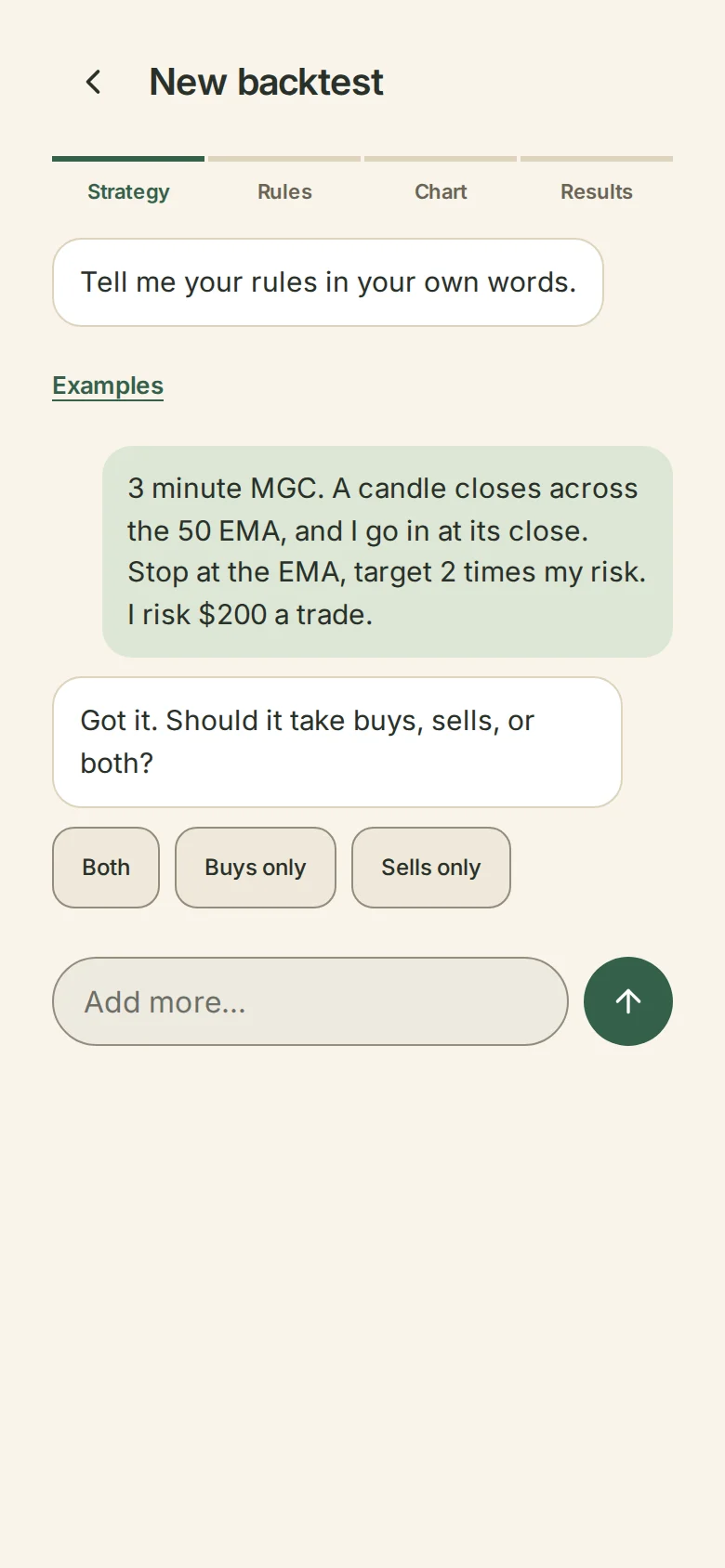
In Wildflower’s Backtest you choose your fees in Fees and slippage: your broker’s published fee, a fee you type in dollars per contract for the round trip, or none. Slippage is the Bot’s own: market orders fill 1 tick worse, stops fill 1 tick past, and targets fill only if price trades through. Under More, you can add extra ticks of your own, on entries made at market, never on a limit fill. Results show profit after fees with profit before fees beside it, and every result lists what it assumed. Real fills are always whatever your broker gives.
Free on a practice chart
Common questions
What is slippage in trading?
The difference between the price you expected and the price your order filled at.
What causes slippage?
Price moving before your order arrives, not enough orders waiting at the price you saw, fast markets, and gaps after a pause.
Can limit orders slip?
Not against you. A limit fills at your price or better. It may not fill at all.
Do stop losses slip?
They can. A stop becomes a market order when it triggers, so it fills where the market is, which can be past your stop.
What is positive slippage?
A fill at a better price than you expected, when price moves your way while the order travels.
How is slippage measured in futures?
In ticks, then in dollars: ticks × tick value × contracts.
Is slippage the same as the spread?
No. The spread is the gap between the bid and the ask at one moment. Slippage is how far your fill landed from the price you expected.
Does trading more contracts mean more slippage?
It can. A bigger market order can use up more than one price level in the order book.
How much slippage should a backtest include?
There’s no single right amount. Some traders use their own live fills as a guide. The choice is yours.
Learn it step by step in Wildflower Trading School, starting with the lesson “Slippage”.