
Micro futures contracts: what they are and how they compare
By Bec, futures trader and founder of Wildflower · Updated
Micro futures are smaller versions of full-size futures contracts. The chart, the price and the tick size are the same, but each point is worth less. Most micros are a tenth of the full size: one point on the Micro E-mini S&P 500 (MES) is worth $5, against $50 on the E-mini (ES).
What micro futures are
A An agreement, traded on an exchange, to buy or sell a set amount of something at a price agreed now, on a set date later.More in the glossary is an agreement to buy or sell something at a set price on a later date. Each one has a fixed size. The E-mini S&P 500 (ES), for example, is $50 times the index. At 6,000, one contract stands for $300,000 of the S&P 500.
A A smaller version of a futures contract. It moves in the same steps as the full-size one, but each step is worth less, often a tenth as much.More in the glossary is the same market in a smaller size. It follows the same index or commodity, so its chart looks the same. The one difference is the dollars. On the Micro E-mini S&P 500 (MES), each point is worth $5, not $50.
CME Group launched the first four Micro E-mini stock index futures on 6 May 2019, at a tenth of the size of its E-minis. It also lists micros on gold, crude oil, Bitcoin and other markets.
How to work out what a move is worth on a micro, step by step
1. Find the dollars per point
This is the The dollars one point of price is worth on one futures contract. On the E-mini S&P 500 it’s $50, and on the Micro E-mini $5.More in the glossary. On MES it’s $5.
2. Measure the move in points
From 6,000 to 6,012 is 12 points.
3. Multiply
12 points × $5 = $60 for one contract.
4. Times the contracts
With 3 contracts, 3 × $60 = $180.
The same sum works in What one tick is worth in money for one futures contract. On the E-mini S&P 500 it’s $12.50.More in the glossary. MES moves in steps of 0.25, and each step is worth $1.25. 12 points is 48 ticks, and 48 × $1.25 = $60. The dollars are the same either way, and they count the same whether the move goes for you or against you.
MES, MNQ, MYM, M2K, MGC, MCL and Micro Bitcoin
These are CME Group’s published figures. Each contract trades on one of its four exchanges: CME, CBOT, NYMEX or COMEX.
- Micro E-mini S&P 500 (MES), CME. $5 × the S&P 500 index. Tick 0.25, worth $1.25. The full-size ES is ten times bigger.
- Micro E-mini Nasdaq-100 (MNQ), CME. $2 × the Nasdaq-100 index. Tick 0.25, worth $0.50. The full-size NQ is ten times bigger.
- Micro E-mini Dow (MYM), CBOT. $0.50 × the Dow Jones Industrial Average. Tick 1.00, worth $0.50. The full-size YM is ten times bigger.
- Micro E-mini Russell 2000 (M2K), CME. $5 × the Russell 2000 index. Tick 0.10, worth $0.50. The full-size RTY is ten times bigger.
- Micro Gold (MGC), COMEX. 10 troy ounces of gold. Tick $0.10 an ounce, worth $1. The full-size GC is ten times bigger.
- Micro WTI Crude Oil (MCL), NYMEX. 100 barrels of oil. Tick $0.01 a barrel, worth $1. The full-size CL is ten times bigger.
- Micro Bitcoin (MBT), CME. 0.1 bitcoin. Tick $5 in the bitcoin price, worth $0.50. The full-size BTC is fifty times bigger.
Not every micro is a tenth. The full-size Bitcoin contract is 5 bitcoin, and Micro Bitcoin is 0.1 bitcoin, so it’s a fiftieth. Check each contract’s own specifications before you do any sums.
Exchanges can change these figures, so check the contract’s page on cmegroup.com for the current ones. The prices in the pictures are made up.
Micro vs full-size contracts
Ten MES contracts carry the same dollars per tick as one ES. So what’s different?
- Smaller steps. With micros you can size in steps of a tenth. That matters most when the amount you’re prepared to lose on a trade is small. Read about position sizing.
- Fees. What your broker and the exchange charge for each contract you trade, often quoted per contract for the round trip: in and out.More in the glossary and exchange fees are charged per contract. Ten micros are charged ten times, so compare your broker’s fees for both in dollars per contract.
- Margin. The Money kept in a futures account as a deposit to cover losses on open contracts. It isn’t a fee or a down payment, and losses can be bigger than it.More in the glossary a broker asks for is far less on a micro than on the full size, because the contract stands for less. Read about margin and leverage.
- Separate markets. A micro has its own buyers, sellers and order book, and how busy it is can differ from its full-size partner. The two charts move together because both follow the same index or commodity.
Expiry, rollover and settlement
Micros expire like other futures, on their own calendar:
- Stock index micros (MES, MNQ, MYM, M2K) have four contracts a year, in March, June, September and December, the same months as the E-minis. They’re settled in cash, not by delivering shares.
- Micro WTI crude oil (MCL) has a contract for every month. It’s settled in cash against the full-size crude oil price, and stops trading one business day before the matching full-size contract.
- Micro Bitcoin (MBT) has monthly contracts that expire on the last Friday of the month, settled in cash against CME’s Bitcoin reference rate.
Near expiry, traders move to the next contract. Read about contract rollover.
Easy mix-ups
Mini and micro. “E-mini” is CME’s name for its smaller stock index contracts, such as ES. Micros are smaller again. ES is the mini, MES is the micro.
Forex micro lots. In forex, a micro lot is 1,000 units of a currency. It has nothing to do with micro futures, apart from the name.
A tenth of the size isn’t a tenth of the risk on a trade. The dollars per point are smaller, but ten micros carry the same dollars as one full-size contract. What you risk depends on how many you trade and how far away your stop is.
The same symbol letters. ES and MES, NQ and MNQ, GC and MGC. One letter is the difference between $50 and $5 a point, so check which one a number refers to. Read about ticks and tick value.
Micro futures in a backtest
See a strategy’s trades in the contract you choose
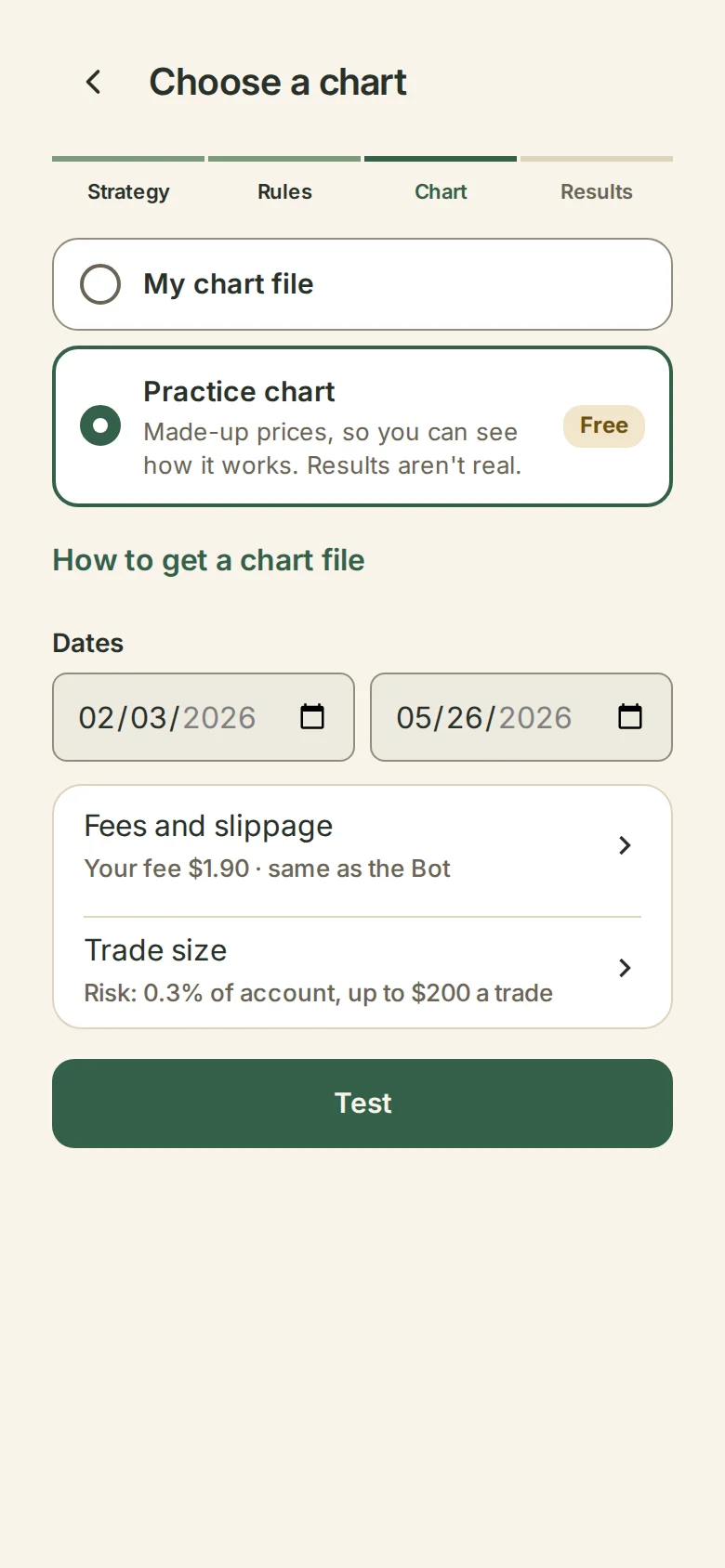
When you backtest a strategy in Wildflower, you choose the market, and each trade is worked out in whole contracts with that contract’s own tick size and tick value. You set how much a trade may risk, and each trade is sized in whole contracts so its planned loss at the stop stays within it. Fees are in dollars per contract, and every result says what it assumed about slippage. No coding needed.
Free on a practice chart
Common questions
What are micro futures?
Smaller versions of full-size futures contracts. The same chart and ticks, with each point worth less.
How much is one point on MES?
$5 per contract. On ES it’s $50.
How much is one tick on MNQ?
$0.50 per contract. MNQ moves in steps of 0.25, worth $2 a point.
Are micro futures a tenth of the size?
Most are. Micro Bitcoin is a fiftieth of the full-size Bitcoin contract.
When did micro futures start?
CME Group launched the Micro E-mini stock index futures on 6 May 2019.
Do micro futures trade the same hours?
The stock index micros trade the same hours as the E-minis on CME Globex, nearly around the clock from Sunday evening to Friday afternoon.
How many micros equal one mini?
For the stock index contracts, ten. Ten MES carry the same dollars per point as one ES.
Are fees higher on micros?
Fees are charged per contract, so ten micros cost ten sets of fees. Compare your broker’s fees in dollars per contract.
Is MGC the same as GC?
Same gold price, a tenth of the size: 10 troy ounces against 100.
Can I backtest on micro contracts?
Yes. In Wildflower’s Backtest you choose the market, and each trade uses that contract’s own tick value.
Learn it step by step in Wildflower Trading School, starting with the lesson “Micro currency futures”.