
Futures margin and leverage: what they are and how they work
By Bec, futures trader and founder of Wildflower · Updated
Futures margin is money you keep in your account as a good-faith deposit while you hold a contract. It isn’t a fee or a down payment, and the exchange and your broker set how much it is. Because the margin is much smaller than the contract’s full value, a small move in price is a big change compared with the money you put up. That’s leverage, and it makes losses bigger as well as gains.
What futures margin is
When you buy or sell a futures contract, you don’t pay its full value. Instead, you keep Money kept in a futures account as a deposit to cover losses on open contracts. It isn’t a fee or a down payment, and losses can be bigger than it.More in the glossary in your account: a good-faith deposit that shows you can cover the losses the position might make. The industry also calls it a performance bond.
Margin isn’t a fee, and nothing is spent. It isn’t a down payment either, because you aren’t buying the contract’s full value on credit. While the position is open, that money is set aside. When you close the position, it’s free again, plus or minus whatever you made or lost.
All the margin amounts and balances on this page are made up to show the idea. The real amounts depend on the contract, the exchange and your broker, and they change. Your broker’s own margin page shows today’s figures.
How leverage works, step by step
1. Work out what the contract stands for
Price times the dollars per point. One Micro E-mini S&P 500 (MES) at 6,000 stands for 6,000 × $5 = $30,000. That’s its A futures contract’s full value: its price times the dollars per point. One MES at 6,000 stands for 6,000 × $5 = $30,000.More in the glossary.
2. Look at the margin
Say your broker asks for $2,000 of margin to hold one MES. That’s what’s set aside, not $30,000.
3. Divide one by the other
$30,000 ÷ $2,000 = 15. The position is 15 times the size of the margin. People call that Holding a position worth more than the money put up for it. In futures, it’s the contract’s full value compared with the margin, and it makes losses bigger as well as gains.More in the glossary of 15 to 1.
4. Watch a small move
Price rises 60 points, just 1% of 6,000. 60 × $5 = $300, which is 15% of the $2,000 margin.
That’s all leverage is: the position’s full value compared with the money put up for it. A 1% move in price became a 15% change compared with the margin, because the position is 15 times bigger. You don’t borrow anything to get it. Margin simply isn’t the full price.
Leverage makes losses bigger too
Leverage doesn’t choose a side. The sum is the same whichever way price goes: points moved × dollars per point × contracts. A 1% rise was a $300 gain on one MES. A 1% fall is a $300 loss. Compared with the margin, both are 15%.
So a move that looks small on the chart can be a big share of the money in your account. That’s why many traders size their trades from what they could lose at their stop loss, in dollars, and not from how much margin they have spare. Read about position sizing.
Leverage on your whole account
The margin sets the most you’re allowed to hold. The leverage you actually use is up to you, and it’s easier to see against the whole account.
Say an account holds $10,000. One MES stands for $30,000, three times the account. Five MES stand for $150,000, fifteen times the account. The same 60-point fall costs $300 with one contract and $1,500 with five. The chart is identical. Only the number of contracts changed.
Initial, maintenance and day-trading margin
- Initial margin. What you need in the account to open a position you’ll hold past the end of the trading day. The exchange’s clearing house sets the minimum for each contract, and your broker can ask for more.
- Maintenance margin. The The level a futures account has to stay above while a position is open. Falling below it can lead to a margin call.More in the glossary is a lower level the account has to stay above while the position is open. It’s the same as the initial margin or a little below it.
- Day-trading margin. Many brokers ask for much less for a trade you open and close in the same day: a A lower margin some brokers ask for on trades opened and closed in the same day. The broker sets it, and it ends at the broker’s cut-off time.More in the glossary. This amount is the broker’s own, not the exchange’s, and it only lasts until a cut-off time the broker sets.
In the picture, an account with between $700 and $1,400 in it holds one MES. During the day, the broker’s made-up day margin of $200 is easy to cover. Past the cut-off, the full $2,000 applies, and the account doesn’t have it. What happens then is set by your broker: many close the position themselves.
What a margin call is
Futures are settled every day: gains and losses are paid into or out of the account at each day’s settlement price. Read about daily settlement.
If losses take the account below the maintenance margin, the broker asks you to bring it back up. That’s a A broker’s request for more money when an account falls below its maintenance margin. The top-up is back to the initial margin, and brokers can close positions instead.More in the glossary. The usual rule is to top it up to the initial margin, not just to the maintenance level. In the picture, the balance settles at $1,700, below the $1,800 line, so it needs $300 to get back to $2,000.
Brokers don’t always wait for a deposit. Many can close some or all of a position straight away if the account falls short, and their own terms say when.
What margin doesn’t do
It isn’t a limit on your loss. In the picture, a stop sits at 5,900, but the market opens at 5,560 after a break. The stop fills at the open, 5,560, and the loss is $2,200, more than the $2,000 margin. A loss can use up the margin and more, and you owe the difference.
It isn’t fixed. The exchange changes margins when markets get more or less jumpy, and brokers change theirs too, sometimes at short notice.
It isn’t the same for every contract. Each contract has its own amount, based on how much its price tends to move. A micro contract needs far less than the full-size one.
A low margin doesn’t mean low risk. A low day margin lets you hold more contracts. Each MES still moves $5 for every point.
Often confused with
Stock margin. Buying shares on margin means borrowing part of the price from your broker and paying interest. Futures margin is a deposit, with no loan and no interest.
Notional value. The contract’s full value: price times dollars per point. It’s what moves with the market, and it’s much bigger than the margin.
Account balance. All the money in the account. Margin is the part of it set aside for open positions.
Forex and CFD leverage. Those are often quoted as a fixed ratio, like 30 to 1. With futures, leverage comes from the margin and the number of contracts you choose.
Funded accounts. A prop firm account has its own rules on how many contracts you can hold and how much the account can lose. Each firm’s rules say whether margin applies, and how. Read about evaluations and funded accounts.
Testing a strategy in real dollars
See every test trade in dollars, not just points
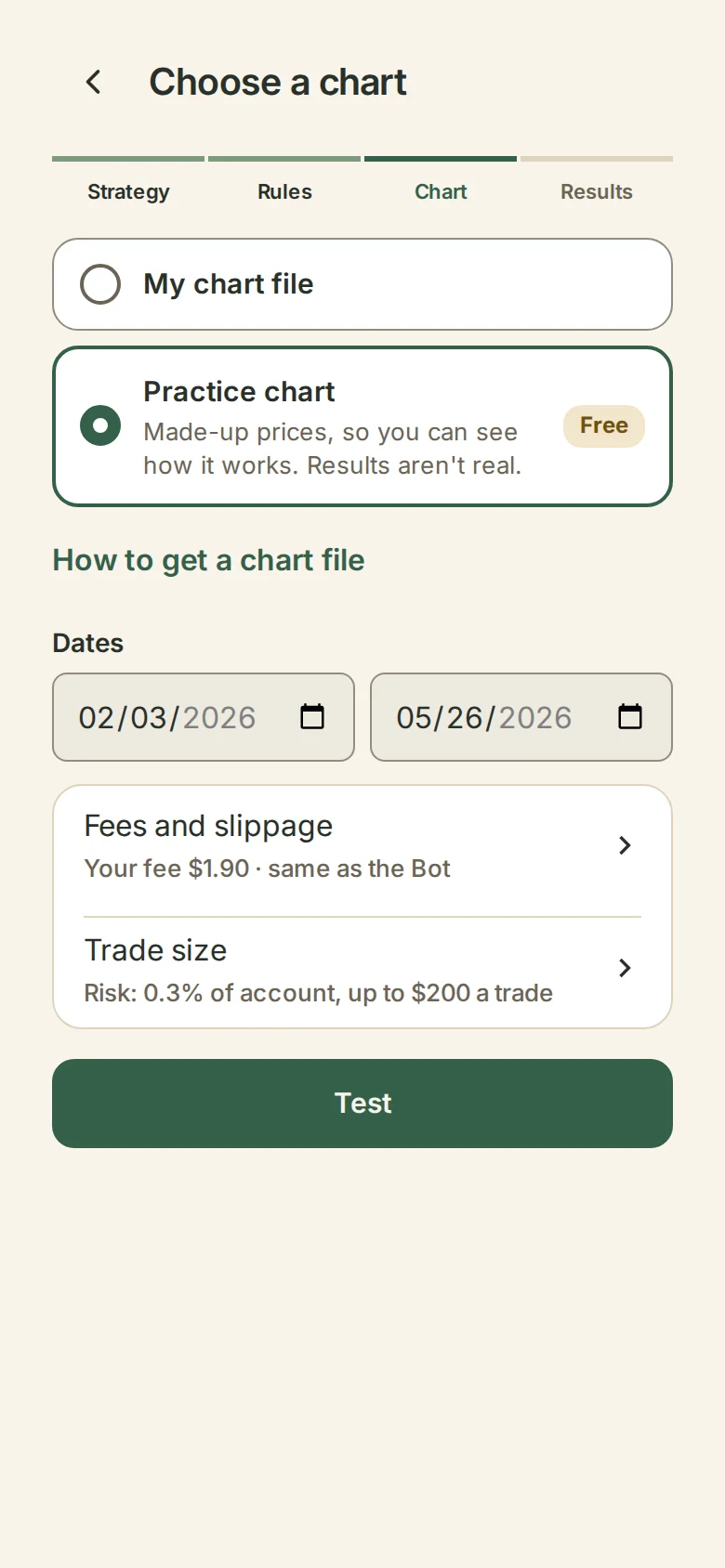
When you backtest your own strategy in Wildflower, you choose the market, and every trade is sized in whole contracts of it, so each result uses that contract’s own dollars per point. You set how much you risk per trade, and you type your fee per contract. Each trade shows its profit or loss before and after fees, so you can see what a move is worth in dollars, not just in points on a chart.
Set it up and see how it works, free. Only pay when you backtest on real market history.
Common questions
What is margin in futures?
A good-faith deposit you keep in your account while you hold a contract. It isn’t a fee or a down payment.
Who sets futures margin?
The exchange’s clearing house sets the minimum for each contract. Your broker can ask for more, and sets its own day-trading margins.
What is leverage in futures?
The contract’s full value compared with the margin you put up. It makes gains and losses both bigger compared with your money.
How do I work out leverage?
Divide the notional value (price × dollars per point × contracts) by the margin, or by your account balance to see the leverage on the whole account.
What is the difference between initial and maintenance margin?
Initial margin is what you need to open a position held overnight. Maintenance margin is the level the account has to stay above while it’s open.
What is day-trading margin?
A lower amount some brokers ask for on trades opened and closed in the same day. It’s set by the broker and ends at the broker’s cut-off time.
What happens in a margin call?
Your broker asks you to bring the account back up, usually to the initial margin. Many brokers can also close positions themselves.
Can I lose more than my margin?
Yes. Margin is a deposit, not a limit. A big move or a gap can take more than the margin, and you owe the difference.
Does futures margin change?
Yes. Exchanges and brokers change it as markets get more or less jumpy. Check your broker’s current figures.