
Judas swing: what ICT’s false move is and how it’s drawn
By Bec, futures trader and founder of Wildflower · Updated
A Judas swing is ICT’s name for a false move early in a trading session. Price runs one way from the session’s opening price, often past an earlier high or low, then turns and moves the other way. It can only be named after the turn, so it describes what happened, not what will.
What a Judas swing is, and why it’s called that
A ICT’s name for a false move early in a session: price runs one way from the open, then turns and moves the other way.More in the glossary is a move away from a session’s opening price that turns out to be false. Price runs one way for a while, then reverses and moves the other way, past where it started. The first move is the Judas swing.
The name comes from Judas, the disciple who betrayed Jesus in the Bible story. The idea is that the first move betrays anyone who followed it. The term is Inner Circle Trader, a trading educator whose names for chart patterns, like fair value gap, are now widely used.More in the glossary’s (Inner Circle Trader, a trading educator whose names for chart ideas are now widely used).
ICT teaches it as a move that runs past an earlier high or low, where he says stop orders are resting, before price turns. That makes it a kind of A quick move past an earlier high or low that then closes back inside it.More in the glossary tied to the start of a session. Read about liquidity sweeps.
How a Judas swing is marked, step by step
Here’s the way it’s most often taught, around the London open, using New York time:
1. Mark the opening price
ICT uses the price at 12:00 am New York time, the The price at 12:00 am New York time. ICT uses it as a reference level for the day.More in the glossary. Here it’s 102.25.
2. Watch the first move away
Price holds near it for two hours. Then, at 2:00 am, a candle closes below it.
3. Note where it runs to
It drops past the Asian range’s low at 101, to 99.50 at 3:00 am.
4. Look for the close back above the open
At 4:30 am a candle closes at 102.75, above 102.25. Now the drop can be called a Judas swing.
The The highest and lowest prices made during the Asian trading hours, over times a trader chooses.More in the glossary here is the high and low from 8:00 pm to midnight. Some traders use the Asian An ICT name for a window of clock time around a big session’s open, such as 2:00 to 5:00 am New York time. Sources give slightly different times.More in the glossary instead, or a different window. Read about kill zones.
Notice the order. At 3:00 am nobody can know the drop is false. It becomes a Judas swing only when price turns and closes back past the open. Until then, it’s just a move down.
Bullish and bearish Judas swings
Bullish. The false move is down, below the opening price and often below an earlier low. Then price closes back above the open and rises. In ICT’s teaching, it comes before the day’s real move up.
Bearish. The mirror image. The false move is up, above the opening price and often above an earlier high. Then price closes back below the open and falls.
The names describe the move that came after. A Judas swing isn’t bullish or bearish until the turn has happened.
What counts as a Judas swing, and what doesn’t
A turn back past the open. The first picture is a Judas swing: price closes back above where the session started.
A move that keeps going isn’t one. In the second, the drop carries on. It may be the real move of the day. A false move can only be called false once price turns.
A bounce isn’t enough. In the third, price turns up but never closes above the open. Whether that counts is your rule, and many traders want the close.
Which opening price. Midnight in New York is ICT’s reference for the London open. For the New York session, some traders use 8:30 am or 9:30 am instead. The level you use changes what counts.
How far, and how long. Some traders want the false move to run past an earlier high or low, or a set number of ticks from the open. Some want the turn within a set time. These are your choices. There’s no single rule.
How traders use the Judas swing
ICT teaches the Judas swing as a way to read the start of a session, not as a pattern on its own. Traders who follow his teaching describe using it in a few ways:
- With a bias for the day. Some decide beforehand which way they expect the day to go, then watch for an early move the other way.
- With a time window. Many only look for it inside a kill zone, such as 2:00 to 5:00 am New York time for London.
- With another setup. After the turn, some look for their own entry, such as a fair value gap or a break of structure. Read about fair value gaps.
None of this tells you what price will do. An early move can be a real move that keeps going, and some sessions have no clear first move at all.
ICT and the Judas swing: where the term comes from
The term comes from ICT, who teaches it for forex and futures, around the London and New York opens. The idea of an early false move is older than the name. ICT’s version ties it to a clock time and an opening price, which is what makes it something you can mark on a chart.
Often confused with
Liquidity sweep. A quick move past an earlier high or low that closes back inside it, at any time of day. A Judas swing is an early false move measured from a session’s opening price.
Power of three. ICT’s idea that a session opens, makes a false move, then moves the other way. The Judas swing is the false-move part of it. Read about power of three.
Opening range failed break. A close past the high or low of the first minutes of a session, then a close back inside. It uses a range, not a single opening price. Read about opening range breakouts.
Silver bullet. Another ICT idea: a one-hour window with a fair value gap inside it. Read about the silver bullet.
Marking the pieces of a Judas swing in TradingView
Mark the parts you can describe, to your own rules
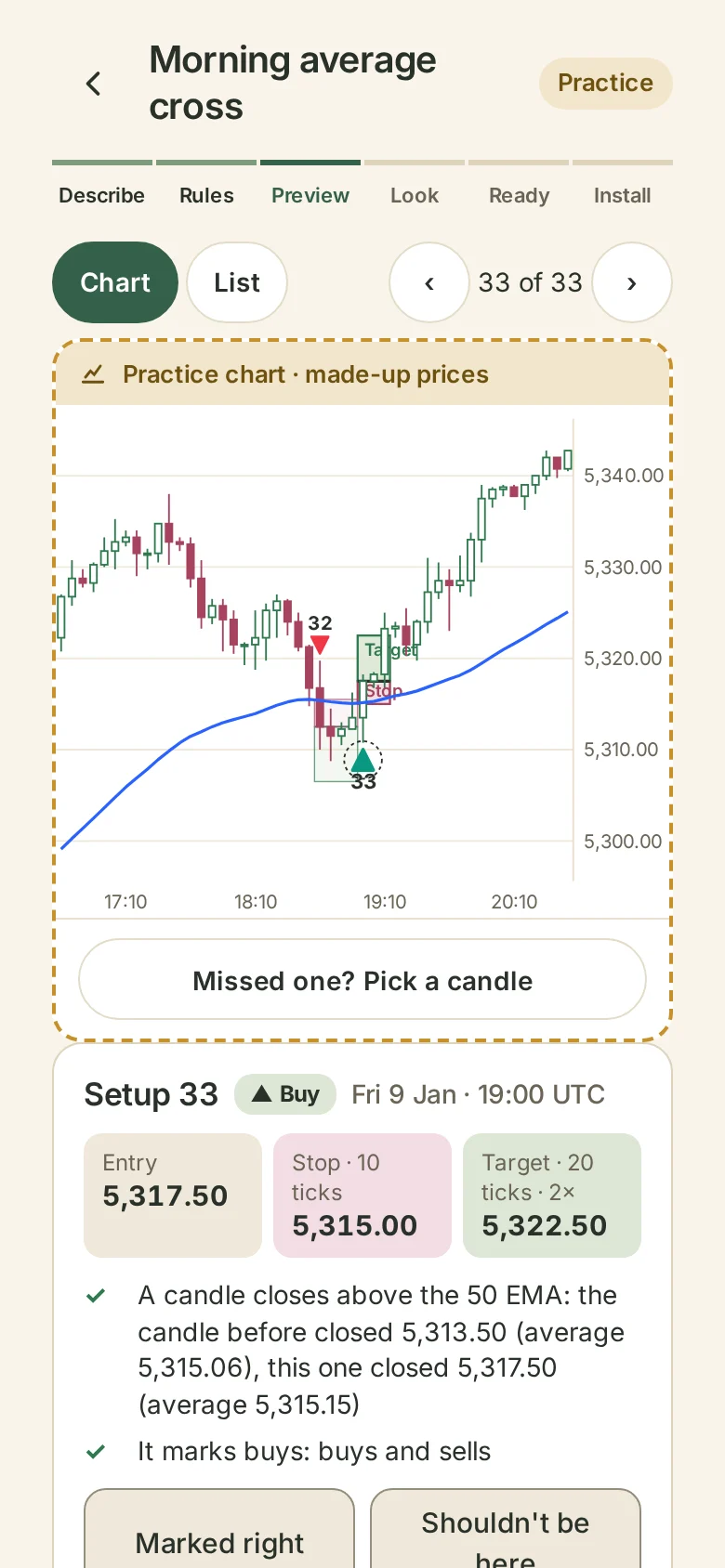
Wildflower’s Indicator marks things on a chart from rules you describe in plain words, with every number typed by you. It can draw the high and low of a time window you state, such as 8:00 pm to midnight New York time, and mark a close beyond them. It can mark a candle that trades past an earlier swing low or swing high and closes back inside, and keep its marks to the clock hours you choose (it uses Chicago time, one hour behind New York). A Judas swing as a whole, measured from the midnight opening price, isn’t one of its building blocks. If you describe one, it tells you plainly. Everything it can build, you can check on a chart for free, then add to TradingView with a step-by-step guide.
Free to build
Common questions
What is a Judas swing in ICT?
An early false move in a session: price runs one way from the opening price, then turns and moves the other way, past where it started.
Why is it called a Judas swing?
After Judas, who betrayed Jesus in the Bible story. The first move betrays traders who follow it.
What time does the Judas swing happen?
ICT teaches it most around the London open, measured from the midnight New York opening price, and also around the New York open. The times given vary.
What is the midnight open?
The price at 12:00 am New York time. ICT uses it as a reference level for the day.
Is a Judas swing the same as a liquidity sweep?
They overlap. A Judas swing often sweeps an earlier high or low, but it’s tied to a session’s start and its opening price.
Can you spot a Judas swing as it happens?
Not for certain. The move only becomes a Judas swing once price turns and closes back past the open.
What’s the difference between a Judas swing and power of three?
Power of three is ICT’s whole idea of a session: open, false move, then the real move. The Judas swing is the false move.
Does the Judas swing work in futures?
It can be marked on any chart with an opening price and a clock. It describes a move after it has happened, not what price will do.
Can I get a Judas swing indicator for TradingView?
Wildflower’s Indicator can mark a time window’s high and low, sweeps of earlier swings and the hours you choose. A Judas swing as a whole isn’t one of its building blocks. See the Indicator.
Learn it step by step in Wildflower Trading School, starting with the lesson “The Judas swing”.