
Opening range breakout (ORB): what it is and how it works
By Bec, futures trader and founder of Wildflower · Updated
The opening range is the high and low price in the first few minutes after a market opens. An opening range breakout (ORB) is when price then trades past that high or that low. How many minutes make the range is your choice.
What the opening range is, and why the open
Every A stretch of the trading day with a set start and end, such as the hours a big stock exchange is open.More in the glossary has an open. It’s often one of the busiest times of the day. Orders that built up overnight meet the people just sitting down to trade, and price can move fast while it settles.
The The highest and lowest prices in the first minutes of a trading session, over a length of time you choose.More in the glossary is simple: the highest price and the lowest price in the first stretch after the open. You pick the stretch. A 5-minute range and a 30-minute range are both opening ranges. They’re just different sizes.
Here’s an example. Say you chose a 15-minute range, and you’re looking at a 5-minute chart. That’s three candles. The highest of their highs is the top of the range, and the lowest of their lows is the bottom. That’s what the picture above shows.
A When price moves past a level, such as the top or bottom of a range, and keeps trading beyond it.More in the glossary is price moving past a level and trading beyond it. So an opening range breakout is price trading past the top or the bottom of that first range.
How to mark an opening range breakout, step by step
1. Pick the open and the length
Choose which session’s open you mean and how many minutes the range lasts. Then look at the candles in that time.
2. Mark the high and the low
Find the highest high and the lowest low of those candles. Draw a line at each and shade between them.
3. Wait for price to go past
Once the range time is over, watch for price to trade above the high or below the low.
4. That’s the breakout
The first trade past either edge is the opening range breakout. Here, it’s up.
Breakouts up and breakouts down
Breakout up. Price trades above the range high.
Breakout down. Price trades below the range low. Some traders call this a breakdown.
Price can break one side, come back, and later break the other side on the same day. Some traders only count the first break each day. Others count both.
The choices that change the range
Two traders can mark the same morning and get different ranges. These are the choices that decide it:
How long. A few minutes gives a small range. An hour gives a wide one. There’s no single rule.
Which open. US stock index futures trade nearly all day and night. Some traders use the New York stock market open at 9:30 in the morning, New York time. Others use the start of the futures session, or the London open.
Wicks or bodies. Many traders use the tips of the wicks. Some use only the candle bodies, which gives a narrower range.
How far past. Some traders want price to go a set number of The smallest step a price can move. On many stock index futures that’s 0.25 of a point.More in the glossary past the edge before they call it a break.
Touch or close. Some count the first trade past the edge. Others wait for a candle to close past it.
How late. A break hours after the open may not count for some traders. You choose the cut-off.
Some of these choices can be set in your own indicator: the length, the open, and whether to mark only the first break of the day or the first on each side. More on that below.
What counts, and what doesn’t
The range has to be finished. A new high inside the range time isn’t a breakout. It just makes the range bigger.
It has to go past. Reaching the high exactly isn’t a break. Price has to trade beyond it.
Wick or close is your rule. If you use closes, a wick past the edge that closes back inside doesn’t count.
Three things that can happen at the edge
Breakout. Price trades past the edge and moves away from the range.
Break and retest. Price closes past the edge, then comes back to it before moving on. Some traders wait for this return. Read about break and retest.
Failed break. Price trades past the edge, then closes back inside. Some traders watch for a move back towards the middle or the far side of the range. The shape is the same as a A quick move past an earlier high or low that then closes back inside it.More in the glossary of the range high. Read about liquidity sweeps.
The range can’t tell you which one you’ll get.
Where the opening range breakout comes from
Traders have watched the first moves of the day for as long as there have been opening bells. The name opening range breakout is linked with Toby Crabel, whose 1990 book was titled Day Trading with Short Term Price Patterns and Opening Range Breakout. It’s now used on futures, stocks, forex and crypto.
Often confused with
Initial balance. The high and low of the first hour of the day session. It’s a term from Market Profile. An initial balance is an opening range with a set length. Read about the initial balance.
Opening drive. Price moving hard in one direction straight from the open, with little back and forth. Read about the opening drive.
Opening gap. The jump between yesterday’s close and today’s open. That’s about where the day starts, not the range it makes. Read about price gaps.
Previous day high and low. Yesterday’s levels. Some traders watch them next to the opening range. Read about the previous day high and low.
Opening range breakout indicator for TradingView
Have the range and every break marked for you, to your own rules
Drawing the range by hand each morning, and spotting the break as it happens, is easy to get slightly wrong. Instead, tell Wildflower’s Indicator what you want in plain words, like “mark the high and low of the first minutes after the open I choose, then mark the first close past either side”. No coding needed. It takes the range from the wicks and counts a break on a candle’s close. It marks every range and every break on a chart so you can check it matches your rules. Then it gives you a script to add to TradingView, with a step-by-step guide.
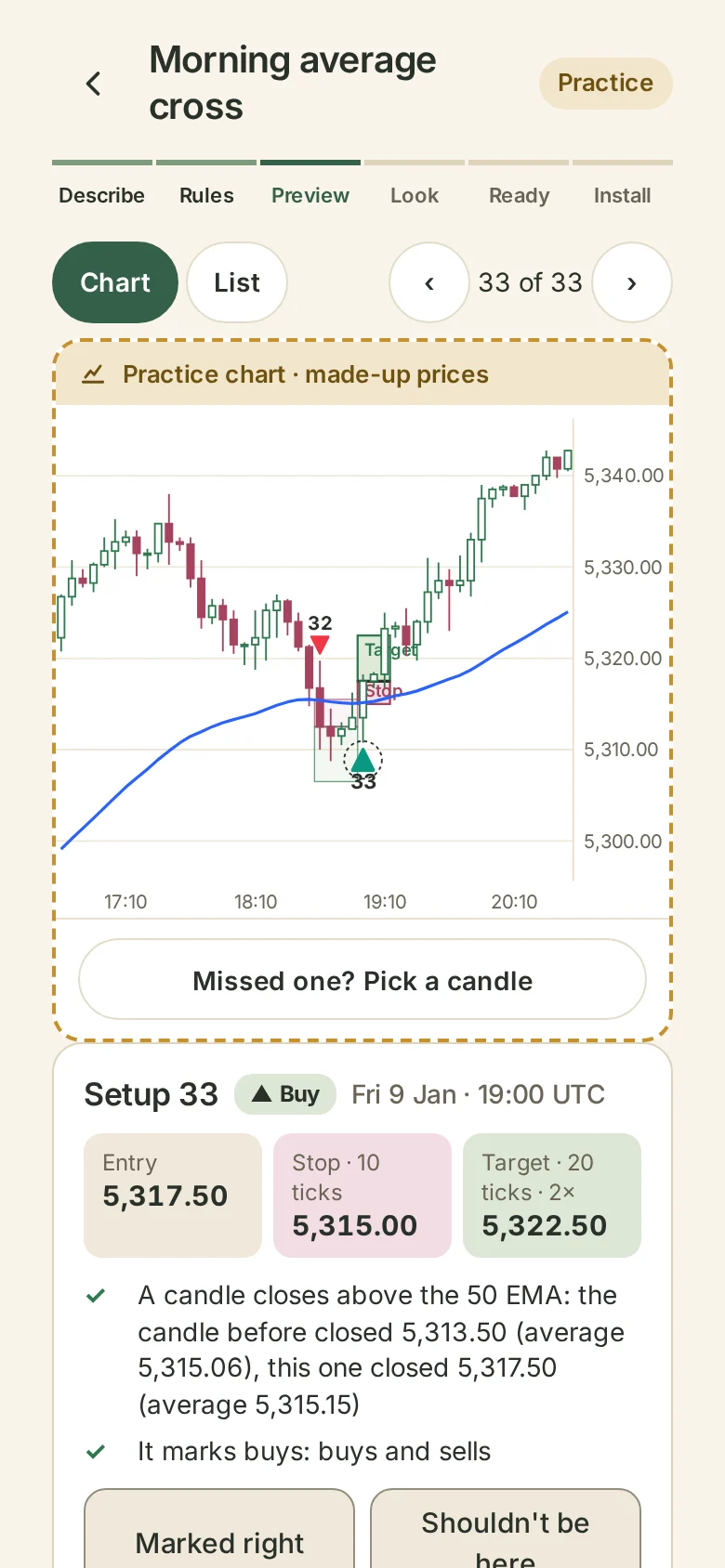
Try it free. You only pay when you add it to TradingView.
Common questions
What does ORB stand for in trading?
Opening range breakout.
What is the opening range?
The highest and lowest price in the first stretch of time after a session opens.
How long is the opening range?
There’s no single length. You choose it. A 5-minute range and a 30-minute range are both opening ranges.
What time does the opening range start for futures?
It depends which open you use. Some traders use the New York stock market open at 9:30 in the morning, New York time. Others use the futures session open or the London open.
Do you use wicks or bodies for the opening range?
Either. Wicks give the full range. Bodies give a narrower one.
Does a breakout need a candle close?
It’s your rule. Some count the first trade past the edge. Others wait for a close.
Can you mark an opening range on any market?
Yes, on any market with an open. Crypto trades all day, every day, so traders pick a time to treat as the open.
Is an opening range breakout the same as any breakout?
It’s one kind. The level it breaks is the high or low of the first minutes after the open.
What is a failed opening range breakout?
Price trades past the range edge, then closes back inside it.
What’s the difference between the opening range and the initial balance?
The initial balance is the first hour. The opening range can be any length you choose.
Can I get an opening range indicator for TradingView?
Yes. Describe your rules in plain words and Wildflower builds the indicator. Preview it free on a chart, then pay only when you add it to TradingView. See the Indicator.