
Breaker block: what it is and how to spot one
By Bec, futures trader and founder of Wildflower · Updated
A breaker block is an order block that price has closed through, now watched from the other side. In a bullish breaker, price takes out an earlier low, then rallies and closes above the last up candle before that drop. Traders mark that candle’s high and low and watch what price does if it comes back down.
What a breaker block is, and why it’s called that
Start with an The last candle that moved the other way before a strong move, often marked as a zone traders watch.More in the glossary: the last candle that moved the other way before a strong move. Before a drop, it’s the last up candle. Traders who use order blocks watch that candle’s range from below, in case price rises back into it.
Sometimes that doesn’t happen. Price comes back up and closes straight through the block. The block has been broken, so traders call it a An order block that price has closed through, then watched from the other side.More in the glossary, or a breaker. They now watch the same range from the other side: from above, in case price dips back into it.
Many traders add one more part to the story. Before the rally, the drop first took out an earlier low, a A quick move past an earlier high or low that then closes back inside it.More in the glossary. So a bullish breaker has a shape: a high, a lower low that takes out the one before it, then a rally through the high.
How to identify a breaker block, step by step
1. Find the order block
Before a sharp drop, find the last up candle. That’s the order block.
2. Check the drop took a low
The drop goes below an earlier A dip on the chart: a candle whose low is below the lows of the candles on both sides of it.More in the glossary. Many traders want this.
3. Wait for a close above
Price rallies, and a candle closes above the top of the order block.
4. Shade the breaker
The same high and low, stretched to the right, is the breaker.
In the example, the order block runs from 106 to 112. The drop reaches 97, below the earlier low of 100. Then a candle closes at 114, above 112. From there, the range from 106 to 112 is the breaker.
Bullish and bearish breaker blocks
Bullish breaker. The last up candle before a drop that took out an earlier low. Price then closes above it. Traders who use it watch the range from above.
Bearish breaker. The last down candle before a rally that took out an earlier high. Price then closes below it. Traders who use it watch the range from below.
What counts, and what doesn’t
A close, not a wick. The block is only broken when a candle closes past its far side. A wick poking through and closing back inside doesn’t count.
The block has to fail. If price comes back into an order block and turns away, the block held. There’s no breaker.
An earlier low taken, or not. Many ICT traders only call it a breaker if the drop took out an earlier low first. Without that, some call it a An order block that price closed through without first taking out an earlier high or low, then watched from the other side.More in the glossary instead. Others don’t make the difference. Say which one you mean.
Wick to wick, or body only. Many traders mark the candle’s whole range. Others mark only its body. Each gives a different zone.
How long it lasts. Some traders stop watching a breaker after a number of candles they choose, or after price first comes back to it.
Wick to wick or body only, and how long a breaker is watched, can be set in your own indicator. Whether an earlier low was taken first isn’t one of its checks. More on that below.
What can happen when price comes back
Held. Price comes back into the range and turns away without closing through it. That’s the case traders who mark breakers are watching for.
Closed back through. A candle closes below the breaker. Many traders then stop using it.
Never reached. Price moves on and doesn’t come back. A breaker can’t tell you which of these will happen.
Breaker block or mitigation block
Both are order blocks that price closed through. The difference is what happened first. In a breaker, the drop took out an earlier low. In a mitigation block, it didn’t: price made a higher low, then rallied through the block. Read about mitigation blocks.
When a breaker and a fair value gap overlap
The rally that breaks the block often moves fast and leaves a A price range that a fast move skips over, found with three candles in a row whose first and third wicks don’t overlap.More in the glossary. Sometimes that gap overlaps the breaker. Some ICT traders mark only the overlap and give the setup its own nickname, the unicorn. Here the breaker runs from 106 to 112, the gap from 108 to 113, and they overlap from 108 to 112.
ICT breaker blocks: where the term comes from
The name breaker block was made popular by Inner Circle Trader, a trading educator whose names for chart patterns, like fair value gap, are now widely used.More in the glossary (Inner Circle Trader), and it’s part of what traders call smart money concepts. The older idea behind it is simple: a level that held price from one side, once broken, gets watched from the other. It looks the same on any candle chart: futures, forex, crypto or stocks.
Often confused with
Order block. The last opposite candle before a strong move. A breaker is an order block that failed. Read about order blocks.
Mitigation block. Also a broken order block, but without the earlier low being taken first. More above.
Inverse fair value gap. A fair value gap that a candle closed through, watched from the other side. The same flip, applied to a gap instead of a candle.
Support turned resistance. A classic idea: a broken level gets watched from the other side. A breaker applies it to one candle’s range. Read about support and resistance.
Breaker block indicator for TradingView
Have every breaker marked for you, to your own rules
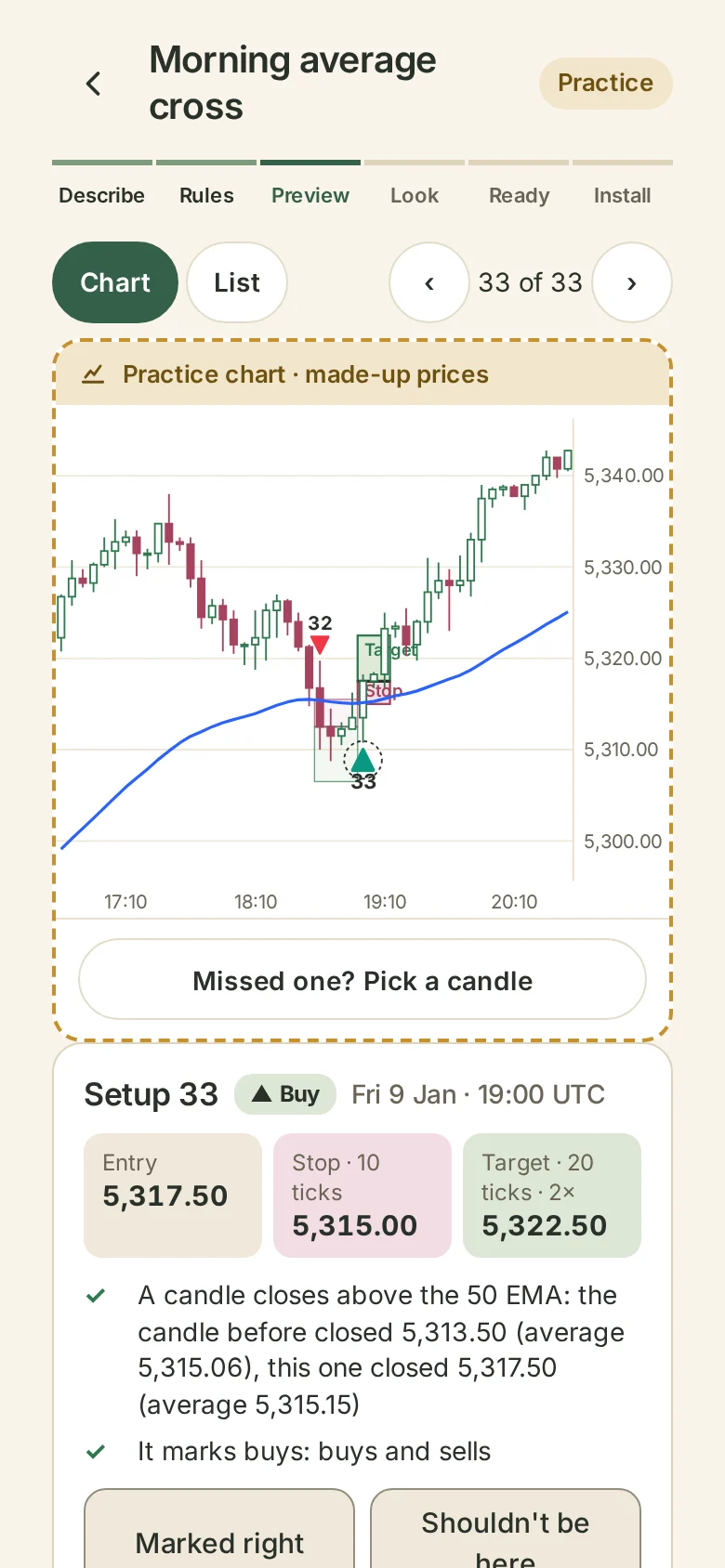
Tracking which order blocks have been broken, and which way to watch each one, is hard to do by eye. Instead, tell Wildflower’s Indicator what you want in plain words, like “mark every breaker block on the 15-minute chart, wick to wick”. It marks every order block that price closes through, then every return to it from the other side, so you can check it matches your rules. It can mark fair value gaps too, but not only the overlap between a gap and a breaker. If you describe that, it tells you plainly. Then it gives you a script to add to TradingView, with a step-by-step guide.
Try it free. You only pay when you add it to TradingView.
Common questions
What is a breaker block?
An order block that price has closed through, now watched from the other side.
What is a bullish breaker block?
The last up candle before a drop that took out an earlier low, which price then closed above.
What is a bearish breaker block?
The last down candle before a rally that took out an earlier high, which price then closed below.
What’s the difference between an order block and a breaker block?
An order block hasn’t been broken. A breaker is one that price closed through, so it’s watched from the other side.
What’s the difference between a breaker and a mitigation block?
In a breaker, the move before took out an earlier high or low. In a mitigation block, it didn’t.
Does a wick through an order block make it a breaker?
No. A candle has to close past the far side of the block.
What is an ICT unicorn?
A nickname for a breaker that overlaps a fair value gap. Traders who use it mark the overlap.
Which timeframe is best for breaker blocks?
There’s no best one. Breakers form on every timeframe. The one you watch is your choice.
Can I get a breaker block indicator for TradingView?
Yes. Describe your rules in plain words and Wildflower builds the indicator. Preview it free on a chart, then pay only when you add it to TradingView. See the Indicator.