
Break of structure (BOS): what it is and how to spot one
By Bec, futures trader and founder of Wildflower · Updated
A break of structure (BOS) is when price breaks the latest swing high in an uptrend, or the latest swing low in a downtrend. Many traders who use it want a candle to close past the level, not just a wick. It marks the trend taking one more step in the same direction.
What market structure means
The pattern of swing highs and swing lows on a chart. Traders use it to say whether price is rising, falling or moving sideways.More in the glossary is the pattern of peaks and dips on a chart. A peak is a A peak on the chart: a candle whose high is above the highs of the candles on both sides of it.More in the glossary. A dip is a A dip on the chart: a candle whose low is below the lows of the candles on both sides of it.More in the glossary.
Uptrend. Each swing high is higher than the last (a higher high), and so is each swing low (a higher low).
Downtrend. Lower highs and lower lows.
Range. Neither. Price goes sideways between a high and a low.
A break of structure is the moment the pattern takes one more step. In an uptrend, price breaks above the latest higher high. The “structure” is the chain of swings, and the “break” is price going past the last link.
How to find a swing high or low
A swing high is a candle whose high is above the highs of the candles next to it. How many candles on each side is your choice. The picture uses two on each side. With one, you’ll find lots of small swings. With five, only the bigger turns count.
A swing low is the same, flipped: a low below the lows on both sides. One catch: a swing isn’t confirmed until the candles after it have closed. With two on each side, you only know it’s a swing two candles later.
How to identify a break of structure, step by step
1. Mark the swings
Put a dot on each swing high and swing low.
2. Name the trend
Compare each swing with the one before. Higher highs and higher lows mean an uptrend.
3. Mark the latest swing high
Draw a line at the most recent higher high. That’s the level to break.
4. Wait for a close above
The first candle to close above the line is the break of structure.
After the break, the new high becomes the one to watch. The low before it becomes the latest higher low. Then you repeat.
Bullish and bearish break of structure
Bullish BOS. In an uptrend, a candle closes above the latest swing high.
Bearish BOS. In a downtrend, a candle closes below the latest swing low.
What counts, and what doesn’t
Close or wick. Many traders who use BOS want a candle body to close past the level. A wick through that closes back is often called a A quick move past an earlier high or low that then closes back inside it.More in the glossary instead. Some traders count a wick. The rule you pick changes what gets marked.
It has to be the latest swing. Breaking an older, lower high inside a pullback isn’t a break of the trend’s structure.
It has to go with the trend. A break the other way, like a close above a lower high in a downtrend, has its own name: a change of character.
How far past is up to you. Some traders want the close to be a set number of ticks past the level, so tiny breaks don’t count.
Big swings and small swings. Some traders track two sets of swings: the big ones, and the smaller ones inside each pullback. They often call the small ones internal structure. A small swing can break while the big trend stays the same.
Timeframe matters. A break on a 5-minute chart may be a small wiggle on a 1-hour chart. Many traders read structure on a bigger How much time each candle covers, such as 1 minute or 1 hour.More in the glossary first, then on a smaller one.
What can happen after a break of structure
The trend keeps going. Price pulls back, forms a new higher low, then breaks the next high. Each break adds a link to the chain.
The break fails. Price falls back and closes below the latest higher low. That first break against the trend is a change of character. Read about change of character.
Some traders wait for a pullback after a break before they do anything. Others ignore breaks that don’t leave a strong move. A break of structure describes what happened. It can’t tell you what comes next.
Where the idea comes from
Describing a trend as higher highs and higher lows goes back to Dow Theory, from Charles Dow’s writing more than a hundred years ago. The short names BOS and CHoCH come from smart money concepts, which grew out of Inner Circle Trader, a trading educator whose names for chart patterns, like fair value gap, are now widely used.More in the glossary’s teaching. The idea is applied the same way on any candle chart.
Break of structure vs change of character, and more
Change of character (CHoCH). A BOS breaks in the same direction as the trend. A CHoCH is the first break against it. In an uptrend, a close above the latest high is a BOS. A close below the latest higher low is a CHoCH. Read about change of character.
Market structure shift (MSS). Another name for a change of character, not a break of structure. Some ICT traders keep MSS for a break made with a strong, fast move.
Breakout. Any move past a level, such as a range high or a line. A BOS is a breakout of one level: the latest swing in the trend.
Liquidity sweep. A wick past a swing that closes back inside. It goes past the level but doesn’t close there. Read about liquidity sweeps.
Break of structure indicator for TradingView
Have every break marked for you, to your own rules
Tracking every swing and checking every close by eye is slow, and it’s easy to mark the wrong swing. Instead, tell Wildflower’s Indicator what you want in plain words, like “mark every close above the latest swing high, with swings found using the number of candles I choose on each side”. No coding needed. It marks every break on a chart so you can check it matches your rules. Then it gives you a script to add to TradingView, with a step-by-step guide.
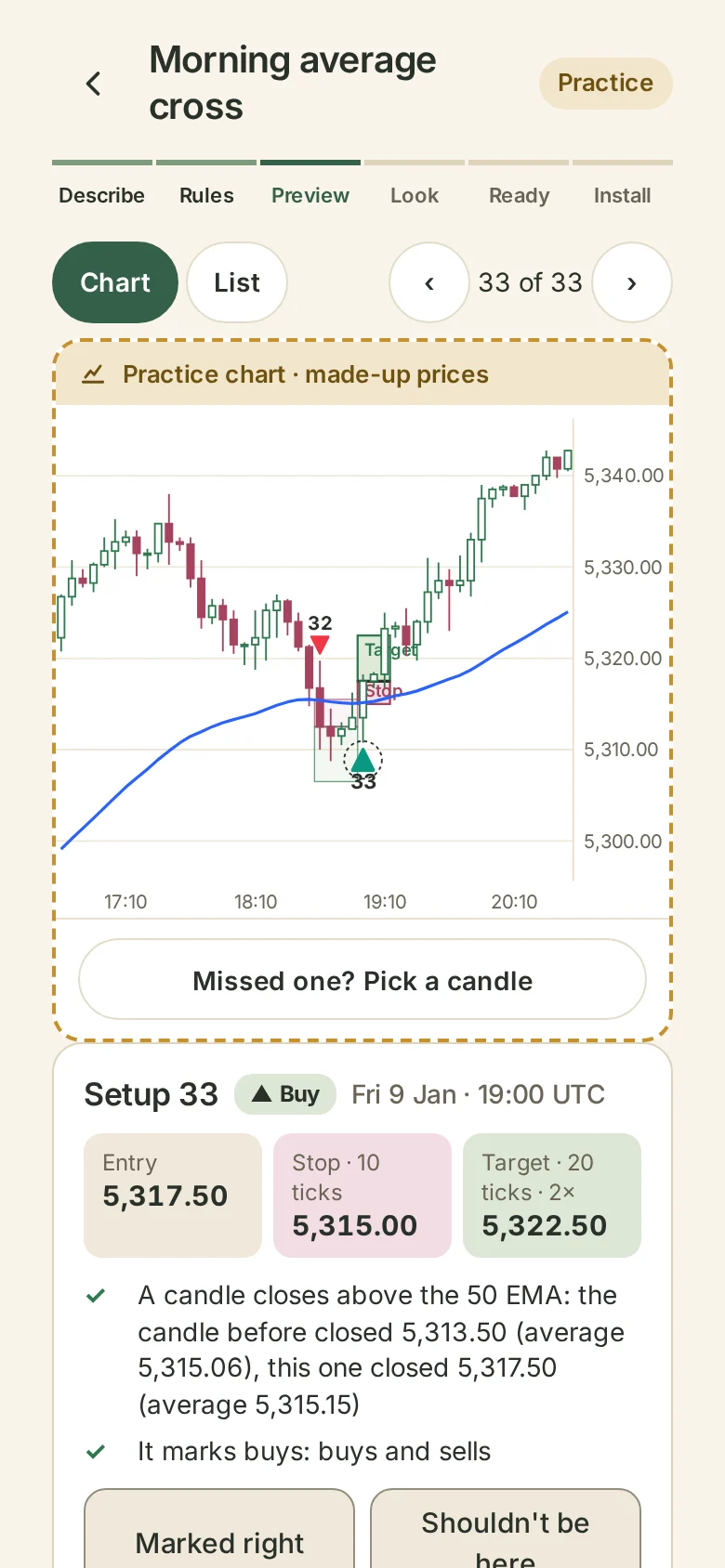
Try it free. You only pay when you add it to TradingView.
Common questions
What does BOS stand for in trading?
Break of structure.
What is a bullish break of structure?
In an uptrend, a candle closing above the latest swing high.
What is a bearish break of structure?
In a downtrend, a candle closing below the latest swing low.
What’s the difference between BOS and CHoCH?
A BOS breaks with the trend. A CHoCH is the first break against it.
Does a break of structure need a candle close?
Many traders who use it say yes. Some count a wick. It’s your rule to choose.
What is a higher high?
A swing high above the swing high before it. Higher highs and higher lows together make an uptrend.
What is internal structure?
The smaller swings inside a bigger move, such as the ups and downs within one pullback. Some traders mark them apart from the main swings.
How many candles make a swing high?
There’s no single rule. You choose how many lower highs must sit on each side.
Is a break of structure the same as a breakout?
It’s one kind: a breakout of the latest swing high or low in the trend.
Which timeframe is best for market structure?
There’s no best one. Structure forms on every timeframe, and each one can show a different trend.
Can I get a break of structure indicator for TradingView?
Yes. Describe your rules in plain words and Wildflower builds the indicator. Preview it free on a chart, then pay only when you add it to TradingView. See the Indicator.