
Risk to reward ratio: what it is and how to work it out
By Bec, futures trader and founder of Wildflower · Updated
The risk to reward ratio compares what a trade stands to lose if it reaches its stop with what it stands to make if it reaches its target. You work it out from three prices: the entry, the stop and the target. It describes the plan for one trade. It says nothing about how likely either ending is.
What the risk to reward ratio means
Before a trade, you can plan two exits. The An order that closes a trade if price reaches a level you set against it. It aims to limit the loss, but in a fast market it can fill at a worse price.More in the glossary closes the trade if price moves against you. The An exit order that closes a trade when price reaches a level you choose in your favour.More in the glossary, or take profit, closes it if price moves your way.
The risk is the distance from your entry to your stop. The reward is the distance from your entry to your target. The What a trade stands to lose at its stop compared with what it stands to make at its target. It describes the plan, not the odds.More in the glossary puts the two side by side. You’ll see it written R:R, RRR or risk-reward.
It’s a measurement of one plan. It doesn’t tell you if the plan is a good one, or how likely the trade is to reach either price.
How to work out risk to reward, step by step
1. Mark the entry
The price you get in at. Here, a buy at 100.
2. Measure the risk
Entry to stop. The stop is at 96, so the risk is 4 points.
3. Measure the reward
Entry to target. The target is at 106, so the reward is 6 points.
4. Divide reward by risk
6 ÷ 4 = 1.5. The ratio is 1 : 1.5. For every point at risk, the plan aims for 1.5.
You can do the same sum in ticks or in dollars. The answer is the same, because both sides are multiplied by the same amount.
Risk to reward on a long and a short trade
Long trade (you bought): the target is above the entry and the stop is below.
Short trade (you sold first): the target is below the entry and the stop is above. The sum is the same: reward divided by risk.
How to read different ratios
Three plans from the same entry, three ratios. A ratio below 1 means the target is closer than the stop. A ratio of 1 means they’re the same distance. A ratio above 1 means the target is further away.
None of these is better on its own. Price has to pass a closer target before it can reach a further one, so a closer target is reached at least as often, but pays less each time. A further target pays more, but price has further to travel. The ratio alone can’t tell you how a set of trades turns out.
The two connect through a simple sum. To break even before costs, the share of trades that must reach the target is risk ÷ (risk + reward). For the 1 : 1.5 plan, that’s 4 ÷ 10: the target has to be reached in 4 of every 10 trades. For 1 : 1, it’s 1 in 2. For 1 : 3, it’s 1 in 4. For 1 : 0.5, it’s 2 in 3. The sum tells you what’s needed. It doesn’t tell you what will happen.
What 1R means
Traders often measure results in A result measured in units of the amount at risk. If a trade risks 4 points, 1R is 4 points and a 6-point gain is +1.5R.More in the glossary, where 1R is the amount at risk on that trade. In the example, 1R is 4 points.
A trade that reaches its target makes 6 points, which is +1.5R. A trade that reaches its stop loses 4 points, which is −1R. Using R lets you compare trades with different stop distances, sizes or contracts on the same scale.
Adding up the R of a set of trades shows how the set did in units of risk, whatever size each trade was.
Ways of writing it vary. Some people put risk first (1 : 1.5), others put reward first (1.5 : 1), and some write 1.5R. If it’s not clear which way round someone means, ask.
Planned ratio vs what actually happens
The ratio is worked out before the trade. What happens can be different:
The trade closes early. A time limit, the end of the session or a change of plan closes it before either price. Here, at +0.5R.
The stop slips. A stop usually becomes a market order, so it can fill past its price. Here, the loss is 4.5 points, not 4: −1.125R. Read about stop losses.
Costs. Commission and fees come off every trade. Say each point is worth $5 and fees are $4 per contract for the round trip. The risk is $20 gross and $24 net. The reward is $30 gross and $26 net. After costs, the ratio is 1 : 1.08, not 1 : 1.5.
Often confused with
Reward to risk. The same two numbers the other way round. 1 : 1.5 risk to reward is 1.5 : 1 reward to risk.
The chance of winning. The ratio compares distances. A 1 : 3 plan doesn’t mean the target is three times as likely, or three times less likely.
Position size. The ratio is the same whether you trade one contract or ten. Size changes how many dollars each R is worth. Read about position sizing.
Risk and reward in a backtest
See the risk and reward of every trade
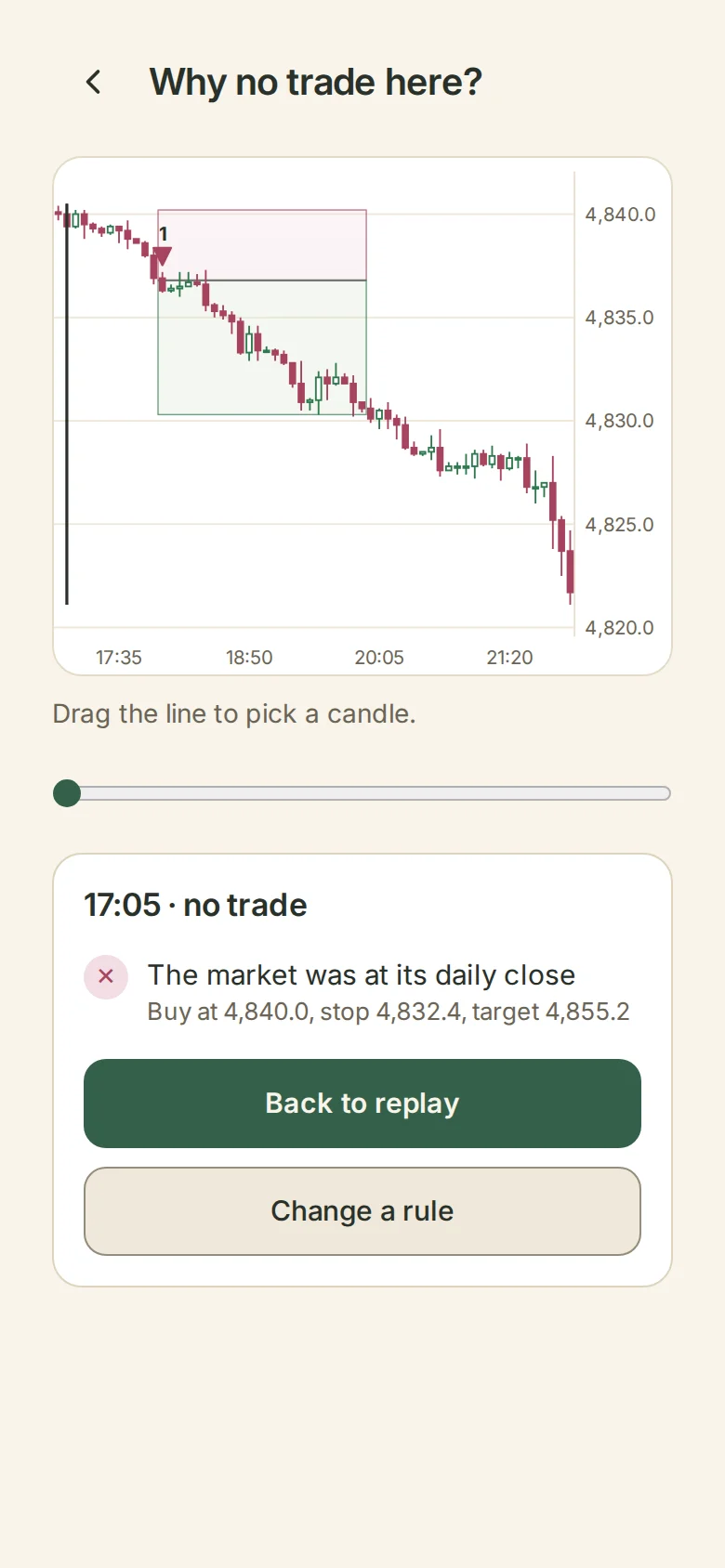
When you backtest a strategy in Wildflower, every trade is drawn on the chart with its entry, stop and target. So you can see the risk and reward each one planned, and where it actually closed. Add your own commission per contract and slippage in ticks, so every trade includes the costs you set. No coding needed.
Set it up and see how it works, free. Only pay when you backtest on real market history.
Common questions
What is a risk to reward ratio?
A comparison of what a trade stands to lose at its stop with what it stands to make at its target.
How do you work out risk to reward?
Measure entry to stop (the risk) and entry to target (the reward). Divide the reward by the risk. More above.
What does 1 : 3 mean?
The target is three times as far from the entry as the stop. It describes distances, not odds.
Is a higher risk to reward ratio better?
Not on its own. A further target pays more when reached, but price has further to go. The ratio can’t tell you how often either happens.
What ratio should I use?
There’s no right ratio. It depends on your strategy, and the choice is yours.
What is 1R?
The amount at risk on one trade, from entry to stop. Results are often counted in R, such as +1.5R or −1R.
Is risk to reward the same as reward to risk?
They use the same numbers the other way round. 1 : 1.5 risk to reward is 1.5 : 1 reward to risk.
Does the ratio include fees?
Only if you add them. Fees make the risk bigger and the reward smaller, in dollars per contract. More above.
Does risk to reward tell me the chance of a trade winning?
No. It compares two distances. It says nothing about which price is reached first.
Why was my actual result different from my planned ratio?
The trade may have closed early, the stop may have filled past its price, or fees came off. The plan and the result can differ.